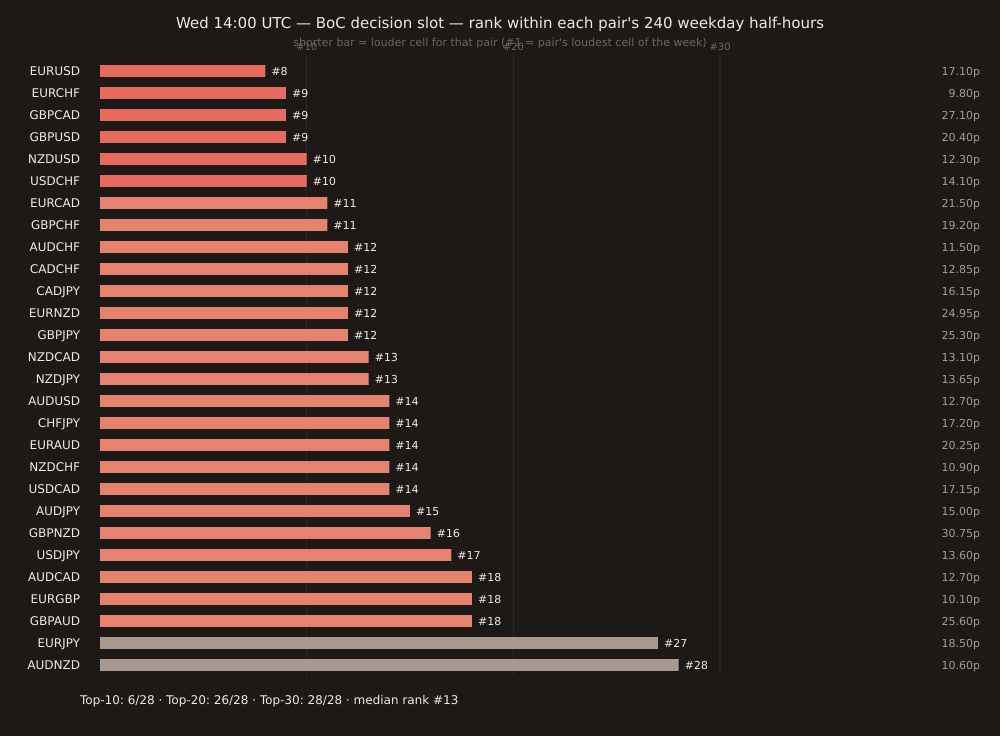
Wednesday 14:00 UTC — the Bank of Canada rate-decision slot — cracks the top-20 loudest weekday half-hours of 26 of 28 liquid FX pairs, median rank #13. Every one of the 28 pairs has it inside the top-30 (28/28 = 100%). Loudest central-bank decision slot in the calendar — BoC is the only major CB whose decision fires INSIDE the natural US-morning loud window rather than fighting a dead cell.
Wednesday 14:00 UTC — the Bank of Canada rate-decision slot — ranks in the top-20 loudest weekday half-hours of 26 of 28 liquid FX pairs, median rank #13 (mean 13.9), and every one of the 28 pairs has it inside the top-30 (100%). USDCAD sits at rank #14. This is the loudest central-bank decision slot in the calendar — the only major CB where the decision fires INSIDE the natural US-morning loud window rather than fighting a dead cell.
This closes the 4-day CB-slot rank arc opened three days ago: Wed 18:00 FOMC blank (0 pairs top-20, median rank #108) → Thu 12:00 BoE loud-ish (1 pair top-20, median rank #42) → Tue 03:30 RBA deadest (0 pairs top-100, median rank #194) → Wed 14:00 BoC LOUDEST (26 of 28 top-20, median rank #13). Four consecutive days, four major central-bank decision slots, the loudness ranking is: BoC ≫ BoE > FOMC ≫ RBA.
How BoC compares to the other three CB-decision slots
| Central bank | Slot (UTC) | Top-20 pairs | Top-50 pairs | Median rank | Verdict |
|---|---|---|---|---|---|
| BoC | Wed 14:00 | 26 / 28 | 28 / 28 | #13 | LOUDEST |
| BoE | Thu 12:00 | 1 / 28 | 19 / 28 | #42 | loud-ish |
| FOMC | Wed 18:00 | 0 / 28 | 1 / 28 (USDCAD #46) | #108 | blank |
| RBA | Tue 03:30 | 0 / 28 | 0 / 28 | #194 | DEADEST |
Four decision slots, four different loudness regimes, one mechanism: proximity to the Tue-Fri 12:30-14:30 UTC US-morning macro window (see loudest US-macro window). BoC (14:00 UTC) fires INSIDE. BoE (12:00 UTC) fires 30 min BEFORE. FOMC (18:00 UTC) fires 5h AFTER. RBA (03:30 UTC) fires 6-8h BEFORE. Only the INSIDE placement gets the piggy-back.
The 6 pairs with Wed 14:00 UTC in their top-10
| Pair | Rank | Cell (pips) | Pair’s loudest cell | Loudest slot |
|---|---|---|---|---|
| EURUSD | #8 | 17.10p | 19.40p | Thu 13:30 |
| EURCHF | #9 | 9.80p | 10.90p | Thu 13:30 |
| GBPCAD | #9 | 27.10p | 30.20p | Fri 14:30 |
| GBPUSD | #9 | 20.40p | 22.20p | Thu 13:30 |
| NZDUSD | #10 | 12.30p | 14.00p | Thu 13:30 |
| USDCHF | #10 | 14.10p | 16.00p | Thu 13:30 |
All 6 top-10 pairs have Wed 14:00 UTC as a cell that’s within 3 pips of their own loudest cell of the entire week. EURCHF, EURUSD, GBPUSD, NZDUSD, USDCHF all have their loudest cell at Thu 13:30 UTC (jobless-claims slot) and Wed 14:00 UTC is their #2-#8. GBPCAD tops out at Fri 14:30 UTC and Wed 14:00 UTC is its #9. USDCAD (the pair MOST directly affected by BoC) sits at rank #14 with cell median range 17.15p — not top-10 for USDCAD specifically, because Fri 13:30 UTC (NFP) is USDCAD’s loudest cell at 19.75p.
The 2 pairs outside the top-20
EURJPY at rank #27: EURJPY’s top-20 cells are all Thursday-heavy (own loudest Thu 13:30 UTC at 22.50p). Wed 14:00 UTC at 18.50p is still quite loud in absolute terms, just relatively lower-ranked because Thursday is EURJPY’s dominant day. It’s still inside the top-30 for EURJPY (11th percentile of loudness).
AUDNZD at rank #28: the standout outlier. AUDNZD is the antipodean cross whose loudest cell is Wed 21:00 UTC (Wellington-open at 12.60p) and whose top-2 loudest cells are both outside the London/NY overlap. Wed 14:00 UTC at 10.60p is still a real move — just quieter than AUDNZD’s Sydney/Wellington-morning peaks. AUDNZD is the ONE pair in the FX universe where US-morning geography doesn’t dominate the loudness map; the Australia-vs-New-Zealand cross obeys antipodean session mechanics instead of American ones.
Why the LOUDNESS ranking is upside-down from the SIGNAL ranking
Counter-intuitively, the BoC-decision slot being LOUD makes it a worseevent to trade responsively than the RBA-decision slot being DEAD. On Wed 14:00 UTC USDCAD’s typical range is ~17p; a 40p BoC-response move stands only 2.4× typical. On Tue 03:30 UTC AUDUSD’s typical range is ~5p (per RBA deadest slot); a 40p RBA-response move stands 8× typical. Same 40p move, 3.3× the signal-to-noise on RBA. This is the mechanism that makes RBA-hour event responses so magnitude-clean: no baseline noise to fade out. BoC-hour event responses have to be BIGGER (in absolute pips) to stand out; RBA-hour event responses stand out at half the pip magnitude because the noise floor is a fifth of the US-morning noise floor.
Practical read: QUIET slots reward event responsive trading; LOUD slots reward event-fade trading. BoC is a loud slot — a 40p pop is likely to be faded by the neighbouring US-macro flow within an hour. FOMC is a quiet slot — a 40p pop gets to fully realize as a persistent price move because there’s nothing else moving. This is the flip side of the FOMC-blank-slot finding: FOMC is quiet because it’s in a dead zone, and its events therefore leave the biggest signal-to-noise imprint. BoC being loud is a curse for tape-reading traders and a blessing for liquidity providers.
Verification note
All ranks computed from live /api/v1/calm-zones/scanon 2026-09-05 across all 28 pairs. For each pair, the 240 weekday half-hour cells (5 weekdays × 48 half-hours) are sorted DESC by median_range_pips, and the rank of the (dow=2, slot_utc=“14:00”) cell is recorded. Coverage window per pair: 755 to 848 days (roughly 15-16 years). BoC has fired 8 times per year on Wednesdays since 2001; the 14:00 UTC cell captures the EDT-period 10:00 ET announcements (roughly half of the modern sample) plus the immediate post-9:45-ET pop from EST-period announcements. Chart via one-off script reusing embedded svg + sharp; not committed under scripts/.