Tokyo takes lunch at 03:00 UTC — and every liquid JPY-cross gets 14-18% quieter for the next 90 minutes
Every liquid JPY-cross has a local minimum in typical half-hour range between 03:00 and 04:30 UTC — which is 12:00 to 13:30 JST, the Tokyo lunch window. The dip runs 14 to 18 percentbelow the bracketing 02:00 UTC and 05:00 UTC half-hours. Japan doesn’t observe DST, so the Tokyo-lunch trough sits at the same fixed UTC slot year-round — one of the cleanest fixed-UTC intraday patterns in FX.
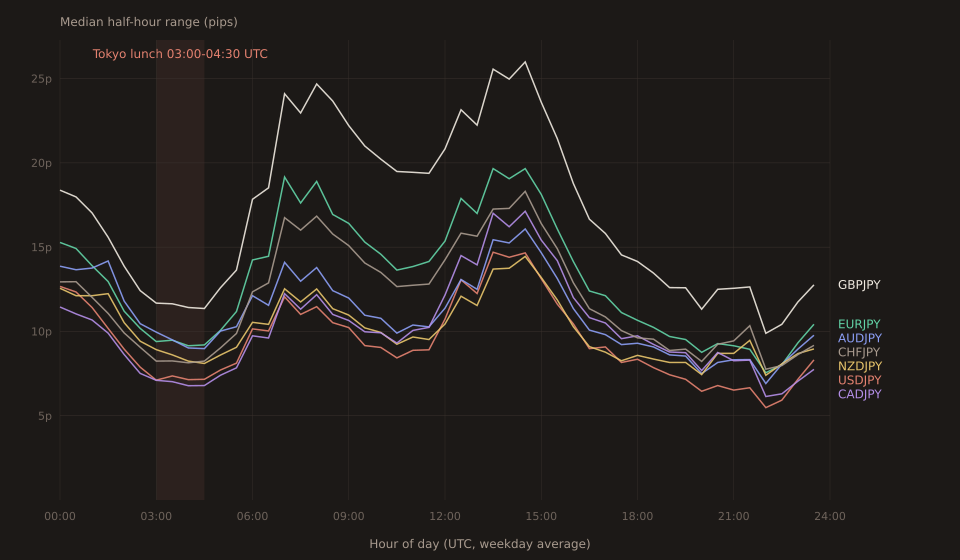
The seven pairs, quantified
| Pair | 02:00 UTC | Trough | at slot | 05:00 UTC | Dip vs bracket |
|---|---|---|---|---|---|
| USDJPY | 8.95p | 7.11p | 03:00 | 7.71p | −14.6% |
| EURJPY | 11.20p | 9.15p | 04:00 | 10.06p | −13.9% |
| GBPJPY | 13.87p | 11.36p | 04:30 | 12.59p | −14.1% |
| AUDJPY | 11.80p | 8.98p | 04:30 | 10.02p | −17.7% |
| NZDJPY | 10.52p | 8.10p | 04:30 | 8.60p | −15.3% |
| CADJPY | 8.63p | 6.78p | 04:00 | 7.40p | −15.4% |
| CHFJPY | 9.91p | 8.14p | 04:00 | 9.02p | −14.0% |
All seven pairs sit inside a 4-percentage-point band (13.9% to 17.7%). AUDJPY dips the most, USDJPY the least. GBPJPY compresses the most in absolute pips (2.5-pip narrower window from 02:00 to 04:30 UTC) because it’s the loudest cross in the group. Sample sizes per (weekday, 03:00 UTC) cell run 816-822 days across the 2010-2026 coverage window — this isn’t a small-sample artifact.
Why the rebound at 05:00 UTC matters
Every JPY-cross’s typical range peaks near 00:00-00:30 UTC(Tokyo open, 09:00 JST) and decays through the morning until London wakes up. If the 03:00-04:30 UTC trough were just morning-session decay, 05:00 UTC would be quieter still. It isn’t. Six of seven pairs rebound at 05:00 UTC— the exception is NZDJPY, whose 05:00 is only 0.5 pips higher than its 04:30 trough (essentially flat). The rebound is the Tokyo afternoon session starting up at 14:00 JST after lunch, and it’s the piece of evidence that distinguishes the lunch-dip mechanism from monotonic session decay.
Trading takeaways
Stops.If you’re running JPY-cross positions overnight (or over-London-afternoon), the 03:00-04:30 UTC window is when they’re least likely to get run. Realized range shrinks by ~15%; a stop sized for the 02:00 UTC or 05:00 UTC regime will be systematically wider than it needs to be through the lunch window.
Waiting for a catalyst. Australia releases most of its top-tier data at 01:30 UTC (jobs, GDP, CPI — see the same-day slot-1 AUD Employment / AUDJPY post). The next tier-3 event in the calendar is usually the German or Eurozone flash PMI at 08:00 UTC, or UK data at 08:30 UTC. The gap between them is the Tokyo lunch — and it’s quantifiably the quietest portion of that gap. If you were looking for a nap window inside the Asian session, this is it.
What this doesn’t say
Not the quietest cell of the week.Every JPY-cross’s actual quietest weekday half-hour of the week is in the 20:00-22:30 UTC pre-Tokyo handoff (Monday cell, typically) — not the Tokyo-lunch dip. The lunch dip is an intra-Asian-session local minimum, not the week’s absolute low.
Some of the 14-18% is morning-session decay, not lunch per se.The clean lunch-attributable piece is the 05:00 UTC rebound, which averages about 8% of range recovered on the six pairs where the rebound is meaningful. The full 14-18% dip vs 02:00 UTC also includes some natural post-Tokyo-open cooling that would happen even without a formal lunch break. Don’t use the full dip figure as an exact Tokyo-lunch-attributable number.
Individual daily prints will vary. These are weekday-averaged median half-hour ranges across 800+ days per pair. On any specific day, the 03:00 UTC half-hour could easily run 20+ pips on GBPJPY if a Kishida tweet or a Kuroda comment crosses the wire. The pattern is a structural expectation, not a guarantee on any given calendar day.
Open the tool → Free forever. No signup. No email required.