EURGBP is the quietest liquid major, and its loudest cell isn't close to anyone else's
Across every weekday half-hour cell on the Calm Zones grid, EURGBP prints a typical median 30-minute range of 5.8 pips. Its single loudest cell of the week, Thursday 13:30 UTC, prints 11.4 pips. Both of those numbers are smaller than the equivalent numbers on every other G10 major — even USDCHF, the next-quietest pair, has a typical cell of 7.7 pips.
This is the mirror-image of a “loudest slot” post. If you’re looking for a pair where a 10 pip stop actually contains typical noise for the majority of the trading week, this is the one.
The quiet major, in numbers
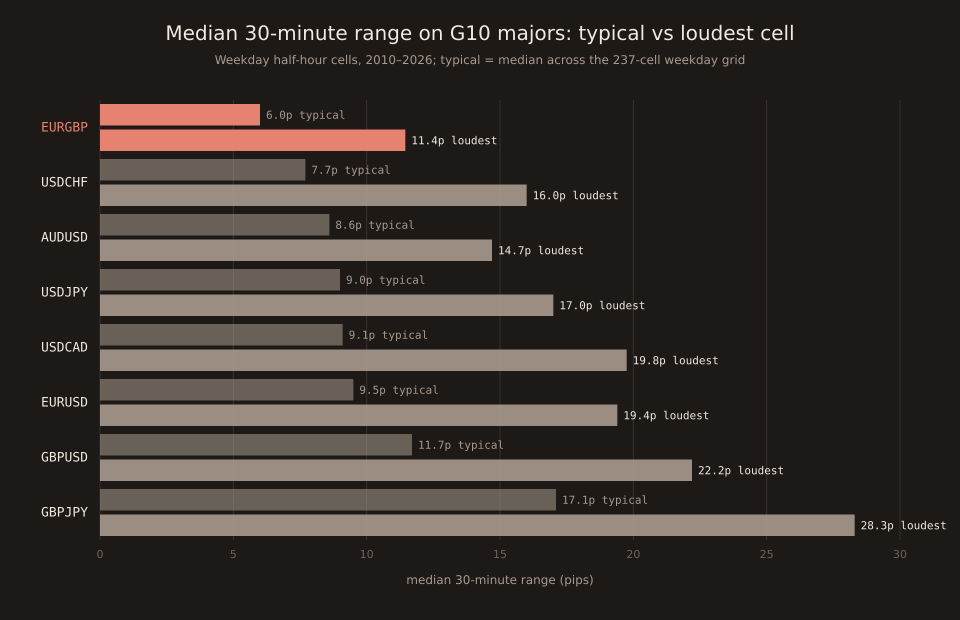
The gap is wide enough to matter. GBPJPY’s typical half-hour prints 17.1 pips of median range — nearly 3xEURGBP’s. Even GBPUSD’s quietest weekday cell (5.4 pips) is only marginally below EURGBP’s typical (5.8 pips). If you scalp with a fixed stop distance measured in pips, you’re trading a different game on EURGBP than on any of the others.
Even the loudest slot is quiet
| EURGBP slot | Session | n days | Median | p75 |
|---|---|---|---|---|
| Thu 13:30 UTC | Overlap | 852 | 11.45 | 15.50 |
| Fri 14:30 UTC | Overlap | 833 | 11.10 | 15.20 |
| Thu 14:30 UTC | Overlap | 852 | 11.10 | 15.28 |
| Thu 12:30 UTC* | Overlap* | 852 | 11.00 | 16.02 |
| Tue 14:30 UTC | Overlap | 849 | 10.80 | 14.53 |
Every one of EURGBP’s five loudest weekday cells is in the London/NY overlap band on Tuesday, Thursday, or Friday. That’s the same shape as GBPJPY — the overlap window is the loudest window on both — but the magnitudes are wholly different. GBPJPY’s Fri 13:30 UTC cell prints a 28.3 pipmedian. EURGBP’s equivalent overlap cells top out at 11.5 pips. The pair’s loudest hour is quieter than most pairs’ quiet hours.
*The Thu 12:30 UTC cellis flagged DST-ambiguous — that clock slot lands in the London/NY overlap during summer but London-only in winter, so the “Overlap” label is a summer-weighted average. Same caveat as on the GBPJPY loudest-slot post.
What this doesn’t say
It doesn’t say EURGBP never moves. These are weekday medians across roughly 800 observations per cell. Individual half-hours can and do print far more range — typically around scheduled UK data (CPI, jobs, retail sales), BoE meetings, and any risk-off day when EUR and GBP diverge. Calm Zones is a base-rate statistic, not a guarantee.
It doesn’t say quieter is better.A quiet pair means a favorable spread-to-range ratio only if your edge is the sort that needs low noise to survive. If your strategy needs tradable directional volatility, EURGBP is objectively a worse canvas — you’ll find both the median cell and the loudest cell smaller than on any other liquid major.
It doesn’t say the shape is fixed. The underlying data covers 2010-01-01 through 2026-07-21. Volatility regimes have shifted materially inside that window (2015 SNB, 2016 Brexit, 2020 COVID, 2022 UK gilt crisis). Calm Zones aggregates across the whole sample, so the numbers here are long-run averages, not a claim about any specific month.
How to use this
Two ideas fall out of the shape.
First, if you rebuild your stops in pip-per-cell terms, EURGBP needs a different scaling than any other liquid major. A stop sized to hold through a p75 Overlap cell needs about 15–16 pips on EURGBP; the same stop concept needs 25–30 pips on GBPUSD, 35–40 pips on GBPJPY. Position sizing that uses a fixed pip-distance stop across pairs is quietly running very different risk per unit.
Second, if you need to sit in a genuinely low-noise cell — for instance, working a limit order into a range you don’t want chopped up by broker noise — the four best-conditioned candidates on this pair are Monday through Thursday 04:00 UTC, all of which show a 3.1–3.2 pip median 30-minute range with the cell classified calm on 60–78%of weekdays. That’s the tightest window on any liquid FX pair for European hours.
Open the tool → Free forever. No signup. No email required.