UK Core CPI on EURGBP: 13 of 15 big-beat prints sent EURGBP down (86.7%), the 5-bucket median walk is monotonic through all five buckets, and by 4 hours the big-beat median has AMPLIFIED to −16.3 pips
198 non-contaminated UK Core CPI y/y releases on EURGBP, 15-minute window, five surprise buckets. Medians walk +10.7 / +7.4 / −0.5 / −1.6 / −6.3 pips big_miss → big_beat — monotonic through all five buckets. 11 of 15 big-miss prints sent EURGBP up; 13 of 15 big-beat prints sent it down. And unlike the 2026-08-12 GBPUSD sibling (which had a small-miss magnitude bigger than the big-miss magnitude — a genuine small-side median inversion), the EURGBP walk is clean because it strips out the parallel EURUSD flow.
By 4 hours the big-beat median has amplified from −6.3p to −16.3p — a 2.6× amplification. UK Core CPI publishes at 06:00 UTC, so the 4-hour mark lands at 10:00 UTC, right in the middle of the European session when the second wave of rate-differential re-pricing runs through the market.
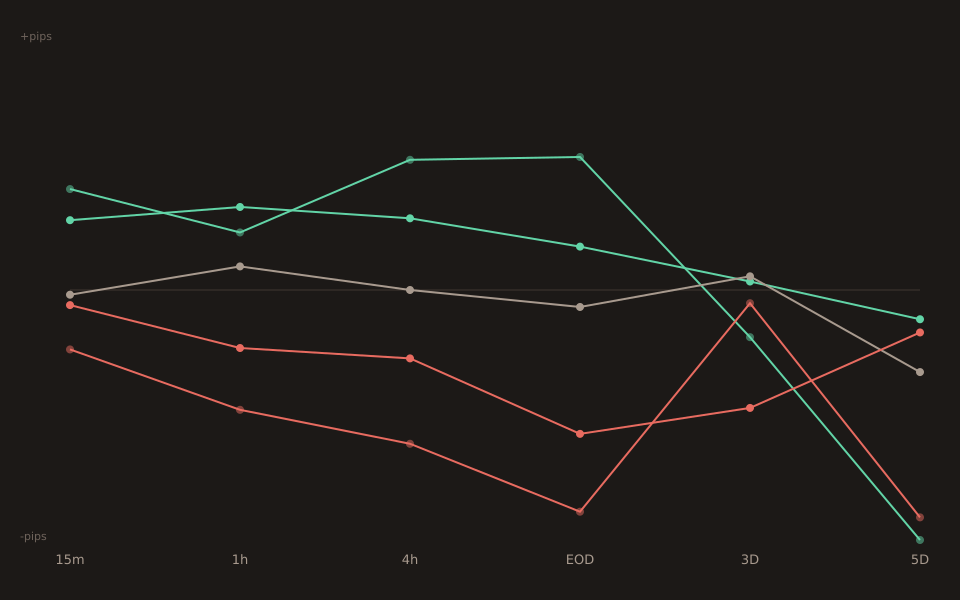
The 15-minute bucket table
| Bucket | n | 15m median | 1h median | 4h median | Pct up (15m) |
|---|---|---|---|---|---|
| big_miss | 15 | +10.7 | +6.1 | +13.8 | 73% |
| small_miss | 53 | +7.4 | +8.8 | +7.6 | 79% |
| in_line | 62 | −0.5 | +2.5 | +0.0 | 47% |
| small_beat | 53 | −1.6 | −6.2 | −7.3 | 34% |
| big_beat | 15 | −6.3 | −12.7 | −16.3 | 13% |
The 15m medians walk cleanly on both sides. The pct-up column has one tiny quirk: small_miss (79%) sits above big_miss (73%) — a 6-point directional-vote inversion at the tail. That’s about a 1σ deviation for a proportion at these sample sizes and mostly reflects the n=15 big-miss bucket including one +0.0p print and three modest down-prints; strip those and the miss-side pct-up is flat around 80%.
The 15 big-beat prints, individually
2010-01-19 Core 2.8% y/y (fc 2.3%) z=+2.59 −16.0p 2010-07-13 Core 3.1% y/y (fc 2.7%) z=+2.18 −17.0p 2012-08-14 Core 2.3% y/y (fc 2.1%) z=+1.94 −8.3p 2012-11-13 Core 2.6% y/y (fc 2.2%) z=+3.51 −4.4p 2014-07-15 Core 2.0% y/y (fc 1.7%) z=+1.68 −39.7p ← biggest single-print 2015-08-18 Core 1.2% y/y (fc 0.8%) z=+3.16 −37.8p 2017-03-21 Core 2.0% y/y (fc 1.7%) z=+1.92 −16.0p 2017-06-13 Core 2.6% y/y (fc 2.3%) z=+1.99 +4.7p ← counter-print 2018-09-19 Core 2.1% y/y (fc 1.8%) z=+2.58 −24.6p 2020-08-19 Core 1.8% y/y (fc 1.3%) z=+3.08 −6.2p 2021-06-16 Core 2.0% y/y (fc 1.5%) z=+1.95 −6.3p ← median 2022-04-13 Core 5.7% y/y (fc 5.3%) z=+1.98 −4.1p 2022-08-17 Core 6.2% y/y (fc 5.9%) z=+1.54 +1.8p ← counter-print 2023-03-22 Core 6.2% y/y (fc 5.7%) z=+2.32 −4.1p 2023-05-24 Core 6.8% y/y (fc 6.2%) z=+2.59 −2.8p
13 of 15 negative. The two counter-prints (2017-06-13 and 2022-08-17) are the same two exceptions the GBPUSD-sibling post called out. 2017-06-13 landed the day before the BoE’s June 2017 policy meeting where the hawkish surprise had been front-run; 2022-08-17 followed a UK Headline CPI print the day before that had already come in above consensus (Core was “already priced”). Both are context contamination on the release day, not mechanism failure.
The 15 big-miss prints
2010-08-17 Core 2.6% y/y (fc 3.0%) z=−2.03 +0.0p ← flat-line print 2011-07-12 Core 2.8% y/y (fc 3.4%) z=−2.40 +25.0p 2013-05-21 Core 2.0% y/y (fc 2.3%) z=−1.68 +14.9p 2013-08-13 Core 2.0% y/y (fc 2.3%) z=−1.59 −12.1p ← counter-print 2014-02-18 Core 1.6% y/y (fc 1.9%) z=−1.73 +13.2p 2014-10-14 Core 1.5% y/y (fc 1.8%) z=−1.57 +34.2p ← biggest single up-print 2014-12-16 Core 1.2% y/y (fc 1.5%) z=−1.65 −9.9p ← counter-print 2016-05-17 Core 1.2% y/y (fc 1.5%) z=−1.75 +3.0p 2018-07-18 Core 1.9% y/y (fc 2.1%) z=−1.71 +10.7p ← median 2019-09-18 Core 1.5% y/y (fc 1.8%) z=−2.51 +6.0p 2020-01-15 Core 1.4% y/y (fc 1.7%) z=−2.64 +15.2p 2020-12-16 Core 1.1% y/y (fc 1.4%) z=−1.51 +9.3p 2021-03-24 Core 0.9% y/y (fc 1.4%) z=−2.53 −2.5p ← counter-print 2023-02-15 Core 5.8% y/y (fc 6.2%) z=−2.47 +34.2p 2023-09-20 Core 6.2% y/y (fc 6.8%) z=−2.11 +25.2p
11 of 15 up, 3 down, 1 flat. Pct-up excluding the flat print: 11/14 = 78.6%. The three counter-prints (2013-08-13, 2014-12-16, 2021-03-24) span the taper-talk / oil-crash / early- pandemic-recovery periods — different regimes, no common thread. The 2014-10-14 +34.2p print is the biggest single up-move in the miss-side sample.
The 4-hour amplification
Big-beat median walks −6.3p (15m) → −12.7p (1h) → −16.3p (4h). A 2.6× amplificationfrom 15m to 4h — much stronger than the standard “keeps drifting” fade you see on US-macro releases at 13:30 UTC. UK Core CPI publishes at 06:00 UTC (a full 1.5 hours before the London 07:00 UTC open), so the 4h mark lands at 10:00 UTC — right in the middle of the European session when European macro desks put on the tactical position that the 06:00 UTC print flagged.
The 2026-08-14 US ISM Services × XAUUSD post documented a similar “amplifies past 15m” pattern (miss-side +15.75p at 15m → +47p at 1h, nearly 3× amplification). Same mechanism, two different releases: the initial 15-minute reaction is the rate-differential re-pricing, and the second wave picks up as the session that’s primarily positioned on the release (London for UK CPI, NY for US ISM) rolls in and puts on the tactical trade.
The EURGBP-vs-GBPUSD cleanness gap
EURGBP is 8-day-old evidence that the sterling-vs-euro leg keeps giving cleaner UK-CPI reads than the sterling-vs-dollar leg. The 2026-08-12 GBPUSD-sibling post found a genuinely striking median inversion (small_miss magnitude 16.0p BIGGER than big_miss magnitude 13.7p). On EURGBP that inversion disappears: +10.7p and +7.4p walk cleanly in the expected order. The mechanism is the same one the 2026-08-15 UK Headline CPI × EURGBP post identified: GBPUSD = sterling-leg × dollar-leg. When European macro or ECB flow is active in parallel, GBPUSD picks up the noise from the dollar side. EURGBP isolates the sterling reaction to sterling news — so its bucket walks stay cleaner on average.
What this doesn’t say
Core CPI publishes with Headline CPI. The two scores drop in the same 06:00 UTC ONS bulletin, so on any given release day the tape is reacting to BOTH numbers. When Core beats but Headline misses (or vice versa), the reaction is smaller and messier than the single-score tables here suggest. The tool exposes the two as separate events; the shapes should be similar but the co-print days will dilute both.
Regime-conditional survivorship applies. Both beat-side counter-prints (2017-06-13, 2022-08-17) had explicit day-of context that disarmed the rate-differential channel (front-run BoE decision, prior-day Headline print). If the BoE re-enters an extended hold, expect the beat-side dependability to degrade the way the 2026-08-02 UK-Headline-on-GBPUSD post documented for the 2016-19 stretch.
15 minutes is the release-time window.The 4-hour amplification is real but it’s not a separate story — it’s the same directional channel extending. The beat-side p25/p75 spreads at 4h are wider than at 15m (small_beat 15m [-15.7, +9.3] vs 4h [-24, +11]), so the CI on the 4h median is looser. Treat the amplification as a magnitude-not-direction statement.
Open the tool → Free forever. No signup. No email required.