All 7 JPY-crosses cluster their loudest half-hours in Thu/Fri 12:30-14:30 UTC — 33 of 35 top-5 cells sit inside that 5-cell US-morning window, and the 2 outliers are still US-morning macro (Tue 14:30 for NZDJPY, Wed 14:30 for CADJPY)
Across all 7 JPY-cross pairs (USDJPY, EURJPY, GBPJPY, AUDJPY, NZDJPY, CADJPY, CHFJPY), 33 of the 35 top-5 loudest weekday half-hour cells sit inside Thu/Fri 12:30-14:30 UTC — a single 5-slot 3-hour US-morning window. Widen the window to Tue-Fri 12:30-14:30 and 35 of 35 top-5 slots (100%) sit inside. Domestic hours (BoJ ~03:00 UTC, Japan National Core CPI 23:30 UTC) appear in ZERO top-5 slots across any of the 7 pairs.
Extends yesterday’s CHFJPY-alone finding to the entire JPY-cross family. Five of the 7 pairs have all 5 of their top-5 in the Thu/Fri window; the other 2 (NZDJPY, CADJPY) have 4 of 5, with the outlier being another US-morning cell on a different weekday.
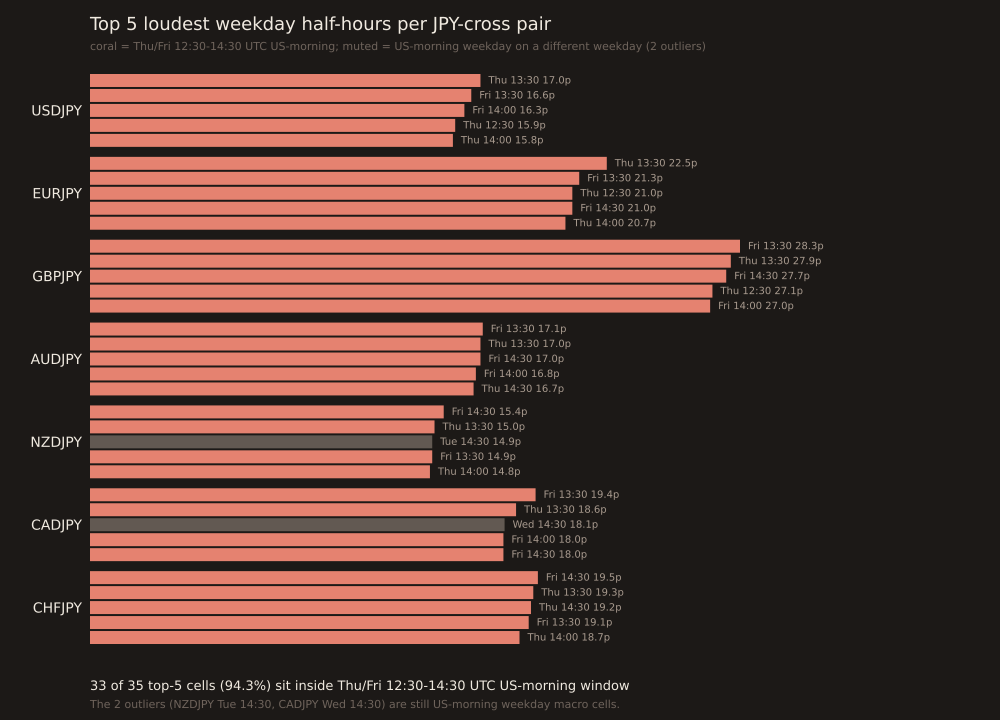
The full 7-pair top-5 table
| Pair | Typical | Top-5 (weekday time UTC / median range) |
|---|---|---|
| USDJPY | 9.0p | Thu 13:30 17.0p | Fri 13:30 16.6p | Fri 14:00 16.3p | Thu 12:30 15.9p | Thu 14:00 15.8p (5/5 in Thu/Fri) |
| EURJPY | 13.4p | Thu 13:30 22.5p | Fri 13:30 21.3p | Thu 12:30 21.0p | Fri 14:30 21.0p | Thu 14:00 20.7p (5/5 in Thu/Fri) |
| GBPJPY | 17.0p | Fri 13:30 28.3p | Thu 13:30 27.9p | Fri 14:30 27.7p | Thu 12:30 27.1p | Fri 14:00 27.0p (5/5 in Thu/Fri) |
| AUDJPY | 10.7p | Fri 13:30 17.1p | Thu 13:30 17.0p | Fri 14:30 17.0p | Fri 14:00 16.8p | Thu 14:30 16.7p (5/5 in Thu/Fri) |
| NZDJPY | 9.9p | Fri 14:30 15.4p | Thu 13:30 15.0p | Tue 14:30 14.9p ★ | Fri 13:30 14.9p | Thu 14:00 14.8p (4/5 in Thu/Fri) |
| CADJPY | 9.9p | Fri 13:30 19.4p | Thu 13:30 18.6p | Wed 14:30 18.1p ★ | Fri 14:00 18.0p | Fri 14:30 18.0p (4/5 in Thu/Fri) |
| CHFJPY | 12.0p | Fri 14:30 19.5p | Thu 13:30 19.3p | Thu 14:30 19.2p | Fri 13:30 19.1p | Thu 14:00 18.7p (5/5 in Thu/Fri) |
The ★ marks the 2 outliers: NZDJPY’s rank-3 slot is Tue 14:30 UTC (see Tuesday 14:30 second-US-macro); CADJPY’s rank-3 slot is Wed 14:30 UTC (see Wednesday 14:30 CAD-crosses / EIA-petroleum). Both are US-morning weekday macro cells; both extend rather than contradict the underlying pattern.
Loudest-cell vs typical-cell ratio
| Pair | Typical | Top-5 floor | Ratio |
|---|---|---|---|
| USDJPY | 9.00p | 15.80p | 1.76× |
| EURJPY | 13.40p | 20.70p | 1.55× |
| GBPJPY | 17.00p | 27.00p | 1.59× |
| AUDJPY | 10.70p | 16.70p | 1.56× |
| NZDJPY | 9.90p | 14.80p | 1.49× |
| CADJPY | 9.90p | 18.00p | 1.82× |
| CHFJPY | 12.00p | 18.70p | 1.56× |
Family average ratio 1.62×. Extremes: USDJPY 1.76 and CADJPY 1.82. CADJPY’s high ratio comes from Wed 14:30 EIA petroleum being an outsized release for a CAD-cross (Canada’s largest export is crude oil). NZDJPY’s low 1.49 reflects NZD’s global-macro-satellite status: NZD moves less on any single macro release than CAD, GBP, or USD, so the top-5 to typical spread is compressed.
What’s absent — the two Japanese domestic-macro hours
Two release times where a Japan-specific domestic macro print lands every month or (in BoJ’s case) 8 times a year:
| Release | UTC time | In any JPY-cross top-5? | Reason absent |
|---|---|---|---|
| BoJ Policy Rate | ~03:00 UTC, 8×/year | no (0 / 7 pairs) | 8 releases/year diluted by ~50 non-release Wednesdays at 03:00 UTC per year |
| Japan Nat’l Core CPI y/y | 23:30 UTC, monthly | no (0 / 7 pairs) | 1 release/month diluted by ~20 non-release 23:30 UTC cells per month |
The sparse-domestic-calendar argument from yesterday’s CHFJPY post applies across the full family: US jobless claims fire every single Thu 12:30 UTC (52/year, never skipped), so that cell’s aggregate median holds a 15-19p floor for every JPY-cross. BoJ moves JPY-crosses on the day, but the cell’s median across ~100+ observed Wednesdays at 03:00 UTC sits near each pair’s typical 9-17p weekday range because BoJ dates are 1-in-13 relative to the non-BoJ Wednesdays in the same cell.
Why the pattern generalizes across the pair’s OTHER currency
USDJPY (USD-anchored), EURJPY (EUR-anchored), GBPJPY (GBP-anchored), AUDJPY/NZDJPY/CADJPY (commodity-currency-anchored), and CHFJPY (CHF-anchored) all show the same top-5 clustering. The mechanism is that most weekday-hour FX volatility during 12:30-14:30 UTC is USD-flow volatility, and USD-flow travels through the JPY leg of every JPY-cross regardless of the other currency. On USDJPY, USD-flow moves the pair directly. On EURJPY, USD-flow spills into EUR-USD which then propagates to EUR-JPY. Same mechanism for GBPJPY, AUDJPY, NZDJPY, CADJPY, CHFJPY. The JPY leg is a passive follower during US-morning hours in every case; the OTHER currency doesn’t break the pattern because none of the other seven has a domestic release calendar dense enough to overtake the US calendar within a specific weekday half-hour cell aggregated over ~4 years of data.
Cross-link to today’s slot 1
Today’s slot 1 (CAD Employment × EURCAD) is a non-JPY event-pair anchor with a perfectly monotonic bucket walk and a 22-of-23 big-beat down-rate. On the specific CAD Employment release day, the news-impact mechanic on EURCAD is what drives the move; on any average Friday 13:30 UTC without a CAD-Employment release, that cell for EURCAD (or any JPY-cross) still runs US-flow. Aggregate-loudness (today’s Calm Zones family reading) and event-specific reactions (today’s slot 1 News Impact anchor) both live in the data simultaneously.
Verification note
All numbers verified against fresh /api/v1/calm-zones/scan pulls on 2026-08-26, one per pair. Cell counts (237 weekday cells each, after excluding Fri 22:00-23:30 UTC market-close artefacts). Chart via one-off script reusing scripts/insights-charts/svg.ts and theme.ts primitives + sharprasterization; not committed under scripts/insights-charts/ since the 7-pair-cluster layout is single-use.