Every major central-bank rate decision buckets 82-98% 'in_line' — 845 of 897 decisions across the Fed, BoE, ECB, BoJ, BoC, RBA, RBNZ, SNB
845 of 897 major central-bank rate decisions across the Fed, BoE, ECB, BoJ, BoC, RBA, RBNZ, and SNB have landed in the in_line bucket on the tool — 94.2% of every rate decision the tool has data for. The BoE is the most predictable at 98.1% in-line. The SNB is the least at 82.1%. That’s not because rate decisions don’t matter — it’s because OIS (overnight index swap) markets have already priced the decision by the morning of the meeting.
This isn’t a bug in the tool — it’s a genuine feature of the underlying data. The tool’s surprise-z metric is computed as (actual − consensus forecast) / SD of past surprises. Rate decisions get forecast very accurately by consensus (because the underlying OIS market prices them so accurately), so surprise-z rarely exceeds the ±0.5 threshold that would push a decision out of the in_line bucket.
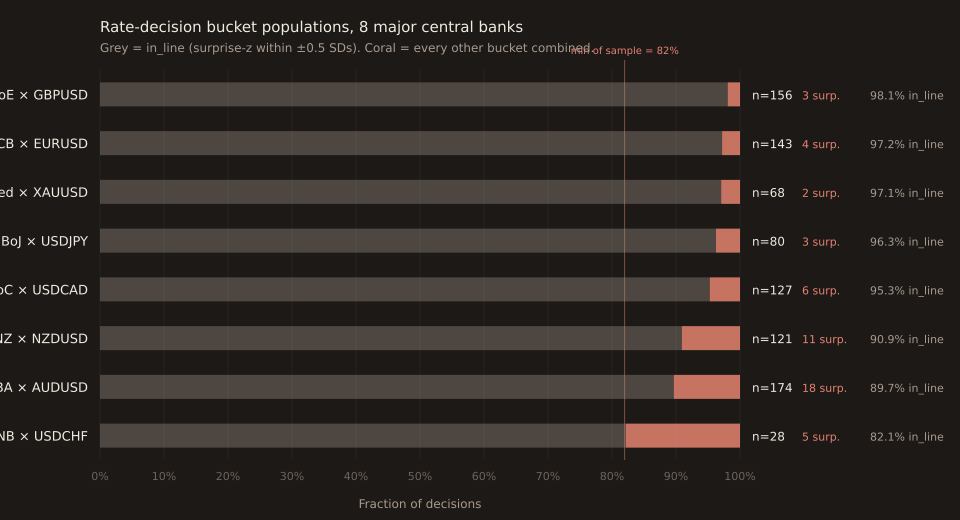
The full 8-CB table
| CB | Pair | Total n | in_line % | Surprises | Notable surprise-bucket median |
|---|---|---|---|---|---|
| BoE | GBPUSD | 156 | 98.1% | 3 | small_beat n=2 → +81.9p |
| ECB | EURUSD | 143 | 97.2% | 4 | small_miss n=2 → −80.4p |
| Fed | XAUUSD | 68 | 97.1% | 2 | small_miss n=1 → +227p on gold |
| BoJ | USDJPY | 80 | 96.2% | 3 | small_beat n=2 → +91.7p |
| BoC | USDCAD | 127 | 95.3% | 6 | small_beat n=3 → −119.2p |
| RBNZ | NZDUSD | 121 | 90.9% | 11 | small_miss n=8 → −47.1p |
| RBA | AUDUSD | 174 | 89.7% | 18 | small_miss n=9 → −64.0p |
| SNB | USDCHF | 28 | 82.1% | 5 | big_beat n=1 → −119.1p |
Aggregate: 845 of 897 = 94.2% in-line across all 8 CBs. Only 52 surprises total across roughly 130-170 combined CB decisions per year.
What’s making the buckets in-line?
Central-bank rate decisions get the most-heavily-traded forecasts in macro markets. The instruments that price these forecasts —OIS (overnight index swap) contracts, Fed funds futures for the FOMC specifically — trade continuously and reflect every new piece of information. By the morning of an FOMC meeting, the Fed funds futures contract that expires just after the meeting is typically within 2-5 basis pointsof what the FOMC will announce. That’s the OIS-implied policy rate, and it’s also almost always what economists’ consensus survey ends up matching (because economists watch the OIS market too).
Three consequences follow:
- The tool’s surprise-z is small. If actual minus consensus is 2 bps and the standard deviation of past surprises is 5 bps, surprise-z is +0.4 — inside the in_line bucket boundary. Every meeting where the CB delivers the OIS expectation lands in-line.
- The tail buckets are hollow.Rare surprise decisions don’t evenly populate small_miss, big_miss, small_beat, big_beat — they’re typically just 1-3 prints in each side’s small_miss/small_beat, with almost nothing in big_miss/big_beat.
- When surprises DO happen, the moves are giant. The rare small-miss/small-beat prints move the FX pair much more than a comparable-z surprise on a data print. The ECB small-miss median is −80 pips on EURUSD, vs a typical CPI small-miss around −5 to +8 pips. Same z-score, radically different market response — because a rate-decision surprise repriced the entire rate PATH, not just one datapoint.
Which CBs are most and least predictable
The ranking is largely a communication-style ranking:
- BoE (98.1% in-line). High-transparency MPC vote structure; individual member views telegraphed via Bank Rate futures and pre-meeting speeches.
- ECB (97.2%). Extensive ECB Governing Council member communication in the two weeks before meetings; ECB rate decisions rarely surprise vs the OIS forward.
- Fed (97.1%). Dot-plot forward guidance, FOMC minutes, Fed speaker circuit. Small n=68 in the sample but striking that only 2 surprises occurred.
- BoJ (96.2%). Long stretches of unchanged policy make the OIS forecast trivially accurate; almost every meeting is a “no change”.
- BoC (95.3%). Similar to Fed in structure but fewer speakers and shorter forward-guidance horizon.
- RBNZ (90.9%). Meets only 7x per year vs 8x for the Fed and 8x for the ECB; higher accumulated policy uncertainty between meetings.
- RBA (89.7%). Meets 11x per year (vs 8x for Fed / ECB) but with much less pre-meeting communication; RBA decisions have historically been the biggest surprise-rate in the G10.
- SNB (82.1%). Meets only 4x per year. SNB has a history of unscheduled policy actions (January 2015 CHF cap removal being the extreme case) that trained the market to discount its OIS forecast more.
What this doesn’t say
“In-line” is not the same as “doesn’t move markets”.Rate decisions move markets constantly — the tool’s in_line bucket for an FOMC meeting on USDJPY still shows a typical 15m move around ±3-5p (larger than an average 15m window). The in_line bucket contains the reaction to the accompanying statement, press conference, and dot-plot updates that carry information beyond just the level of the rate. Statement wording changes can move markets substantially without changing the announced rate.
Rate-decision surprises aren’t a repeatable systematic signal.The best-case surprise sample sizes are RBA n=18 and RBNZ n=11 over 15+ years. The 95% distribution-free CI on the true move-direction rate for n=9 is roughly ±30% wide. You can’t confidently trade a “5% surprise → 60-pip move” rule with that sample. The tool’s surprise buckets on rate decisions are most useful as historical CONTEXT (“when the SNB surprises with a big_beat, what did USDCHF do last time?”) rather than as a systematic edge.
The bucket thresholds are z-based, not bps-based. A z-score is (actual − consensus) / SD-of-past-surprises. If the SD of past surprises is very small — because a CB has been predictable — then a small bps surprise can register as a large z and push into a surprise bucket. If a CB starts communicating differently (like a policy-transition period), the SD widens and newer surprises need to be bps-larger to reach the same z. Read surprise-z as “how unusual by this CB’s historical standards”, not as “how many bps off consensus”.
Open the tool → Free forever. No signup. No email required.