Every liquid FX pair's loudest weekday half-hour is at least 2× its quietest — and EURUSD's is nearly 5×
For each of the 28 liquid FX pairs, divide the median range of its loudest weekday half-hour by the median range of its quietest (excluding the Friday 22:00-22:30 UTC market-close artifact). Every one of the 28 lands above 2×. 13 land above 3×. 6 land above 4×. EURUSD tops the list at 4.97×: its Thursday 13:30 UTC cell prints a median range of 19.4 pips; its Monday 22:30 UTC cell prints 3.9 pips.
This is a different lens on the calm-zones data than any previous post. The Monday-quietest cross-pair post (2026-08-04) counted how many pairs share the same quietest slot. This post asks a different question: within each pair, how big is the gap between its loudest and quietest half-hour? Answer: the gap is never small.
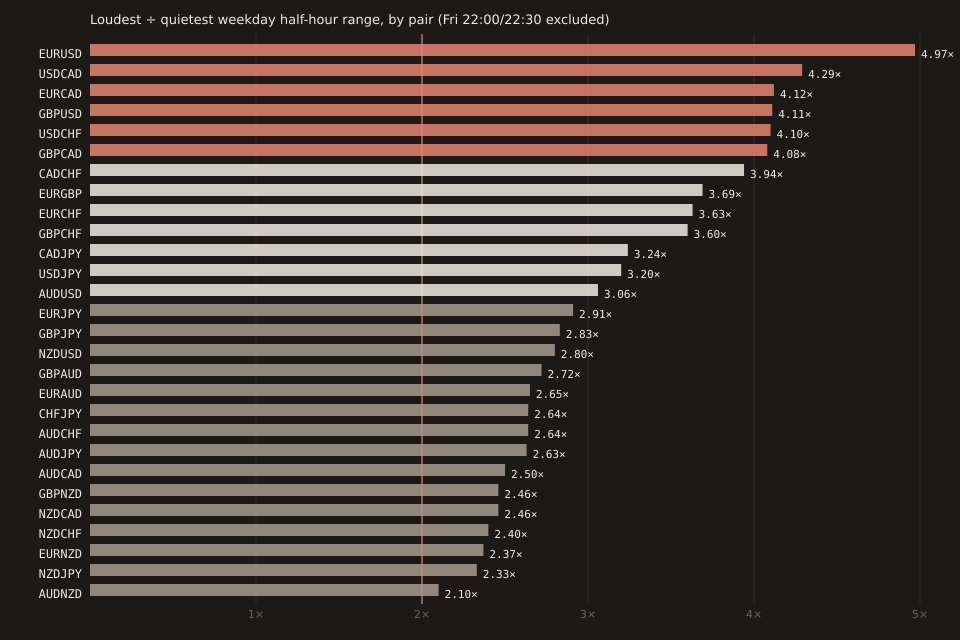
/api/v1/calm-zones/scan?pair=<pair> for each of the 28 pairs, weekday-only, Fri 22:00/22:30 excluded.The full ranking
| Pair | Ratio | Loudest cell | Loud median | Quietest cell | Quiet median |
|---|---|---|---|---|---|
| EURUSD | 4.97× | Thu 13:30 | 19.4p | Mon 22:30 | 3.9p |
| USDCAD | 4.29× | Fri 13:30 | 19.8p | Mon 22:30 | 4.6p |
| EURCAD | 4.12× | Fri 13:30 | 24.5p | Wed 04:00 | 6.0p |
| GBPUSD | 4.11× | Thu 13:30 | 22.2p | Mon 22:30 | 5.4p |
| USDCHF | 4.10× | Thu 13:30 | 16.0p | Mon 04:00 | 3.9p |
| GBPCAD | 4.08× | Fri 14:30 | 30.2p | Mon 04:00 | 7.4p |
| CADCHF | 3.94× | Fri 13:30 | 14.2p | Mon 04:00 | 3.6p |
| EURGBP | 3.69× | Thu 13:30 | 11.4p | Mon 04:00 | 3.1p |
| EURCHF | 3.63× | Thu 13:30 | 10.9p | Mon 04:00 | 3.0p |
| GBPCHF | 3.60× | Thu 14:30 | 20.9p | Mon 04:00 | 5.8p |
| CADJPY | 3.24× | Fri 13:30 | 19.4p | Mon 22:30 | 6.0p |
| USDJPY | 3.20× | Thu 13:30 | 17.0p | Mon 21:30 | 5.3p |
| AUDUSD | 3.06× | Fri 14:00 | 14.7p | Mon 20:30 | 4.8p |
| EURJPY | 2.91× | Thu 13:30 | 22.5p | Mon 22:30 | 7.7p |
| GBPJPY | 2.83× | Fri 13:30 | 28.3p | Mon 20:00 | 10.0p |
| NZDUSD | 2.80× | Thu 13:30 | 14.0p | Mon 20:00 | 5.0p |
| GBPAUD | 2.72× | Fri 14:30 | 30.2p | Mon 20:00 | 11.1p |
| EURAUD | 2.65× | Fri 14:30 | 23.8p | Mon 20:00 | 9.0p |
| CHFJPY | 2.64× | Fri 14:30 | 19.5p | Mon 20:00 | 7.4p |
| AUDJPY | 2.63× | Fri 13:30 | 17.1p | Mon 20:00 | 6.5p |
| AUDCHF | 2.64× | Thu 14:30 | 13.2p | Mon 20:00 | 5.0p |
| AUDCAD | 2.50× | Fri 14:30 | 15.0p | Mon 04:30 | 6.0p |
| GBPNZD | 2.46× | Fri 14:30 | 34.5p | Mon 04:30 | 14.0p |
| NZDCAD | 2.46× | Fri 13:30 | 14.5p | Mon 04:30 | 5.9p |
| NZDCHF | 2.40× | Thu 13:30 | 12.0p | Mon 04:30 | 5.0p |
| EURNZD | 2.37× | Fri 14:30 | 27.6p | Mon 04:30 | 11.7p |
| NZDJPY | 2.33× | Fri 14:30 | 15.4p | Mon 20:00 | 6.6p |
| AUDNZD | 2.10× | Wed 21:00 | 12.6p | Mon 17:30 | 6.0p |
27of 28 pairs’ quietest cell lands on Monday (the exception is EURCAD, whose quietest half-hour is Wednesday 04:00 UTC — deep in the Asian session for a pair whose primary flow is European and North American). The Monday concentration picks up the same pattern the Monday-quietest post already established. What’s new here is the LOUD side of the ratio: 17of 28 pairs’ loudest cell lands on Thursday 13:30 UTC (ECB press-conference / London-NY overlap opening) or Friday 13:30 UTC (NFP release), and another 10land on Thursday 14:30 or Friday 14:30 UTC (the post-open hour, or in NFP’s case the post-NFP hour). One pair, AUDNZD, does something different (Wed 21:00 UTC per the AUDNZD Wellington post).
Why this matters for sizing
A typical risk-per-trade model sizes positions using a session-average or day-average range as its estimate of typical stop distance. If your typical stop distance is set at the session-average, you’re using an average of a distribution that spans a 2-5× range within any given week.
Two systematic errors follow:
Loud-window trades get over-stopped.Your “typical” stop distance is well below the actual p75 of the current 30-minute cell, so most positions never come anywhere near their stops. You’re carrying too much size per dollar-of-risk-per-trade, and when volatility inevitably mean-reverts down toward the session average later in the day you’re still holding the loud-window position size.
Quiet-window trades get under-stopped.Your stop is at the session-average distance, but the current 30-minute cell’s p75 range is well below that number. You can put on the position, but you’re paying spread to enter a cell where the pair typically moves less than half your stop distance — a low-signal environment. When some genuinely-random 3σ move DOES happen in the quiet window (it does, occasionally — see Stats #6 on fat tails), you’re holding a size that assumed a wider distribution than the median suggests.
Both are fixable with cell-specific stops. The tool’s per-cell p75 range is what you actually want; the pair-average or session-average is what you probably have.
The 5×-outlier: what makes EURUSD unusual?
EURUSD’s 4.97× ratio is the biggest in the panel by a fair margin — USDCAD is second at 4.29×. Two features conspire.
First, EURUSD’s loudest cell (Thu 13:30 UTC, 19.4p) isn’t especially loud in absolute terms — GBPNZD’s loudest cell is 34.5p, GBPCAD’s is 30.2p. EURUSD’s ratio is high because its QUIET cell is unusually quiet: Mon 22:30 UTC at 3.9p is the third-quietest weekday half-hour in the entire dataset (only USDCHF Mon 04:00 UTC and EURCHF Mon 04:00 UTC print smaller medians).
Second, EURUSD is the world’s most-traded FX pair (approximately 28% of daily spot FX volume, per BIS 2022). One might expect a highly-traded pair to have a flatter intra-week distribution — more market participants continuously active — but the opposite is true: the very concentration of European and US bank-desk flow on EURUSD MEANS the pair is practically dead when neither Europe nor the US is active. Monday 22:30 UTC is the moment right after the US closes on Sunday-reopening Monday and Tokyo hasn’t opened yet — a pair with no dedicated Asian bank-desk flow spends 30 minutes in a genuinely thin book. Pairs like GBPNZD (which never had continuous Asian participation because it’s a cross, not a USD-major) are only 2.5× because their quiet cells are already pricing in low participation baseline.
What this doesn’t say
The 2× lower bound assumes we exclude Fri 22:00-22:30 UTC. Include those two cells and every pair’s ratio jumps to 20-100× because most brokers cut sessions at Friday 22:00 UTC and the two straddling half-hours have essentially zero trading. That’s a broker-calendar artifact, not a genuine market-behaviour finding. The exclusion is documented and matches the Monday-quietest post’s same handling.
Sample sizes vary across pairs. The n_days_total for individual cells ranges from about 661 to 852across the panel. The ratios are stable at those sample sizes — none of the results would flip a bucket if you halved the sample — but the specific pair-loudest and pair-quietest slots can shuffle within a pair’s top-3 or bottom-3 if the sample changes materially. The 2× floor and the general shape (all pairs concentrated, no pair flat) is robust.
Median range is not the same as expected range. This post uses the median, which is what the Calm Zones tool exposes as its headline cell number. The mean range would give slightly different (and typically bigger) ratios because it picks up more tail-weight. The median is more resistant to outlier days (holiday closures, one-off flash crashes) that would otherwise inflate the loud-cell measurement. Use the median for cell-typing; use the mean if you specifically want to price the expected value of an outlier trade.
Open the Calm Zones tool → Free forever. No signup. No email required.