The Monday 22:30 UTC late-NY handoff isn't just a JPY-cross thing: it's the single quietest weekday half-hour for EURUSD, GBPUSD, and USDCAD too — three of the four G7 USD majors, plus CADJPY and EURJPY
Monday 22:30 UTC is the single quietest weekday half-hour of the week for 5 of the 28 liquid FX pairs — a set that includes both JPY-crosses and the three G7 USD majors EURUSD, GBPUSD, USDCAD. Widen the criterion to bottom-3 and 8 pairs qualify, split evenly between JPY-crosses and G7 USD majors. The 2026-08-16 late-NY-handoff post found this window for JPY-crosses only. It extends further.
Yesterday’s Monday-Asia handoff clusters post showed 26 of 28 pairs concentrate their quietest weekday half-hour into one of two Monday-Asia handoff clusters: the 04:00-04:30 UTC Tokyo lunch and the 20:00-22:30 UTClate-NY handoff. This post narrows to the single strongest cell inside the second cluster and shows the pair-set is more surprising than the “JPY-cross” label the 2026-08-16 post used would suggest.
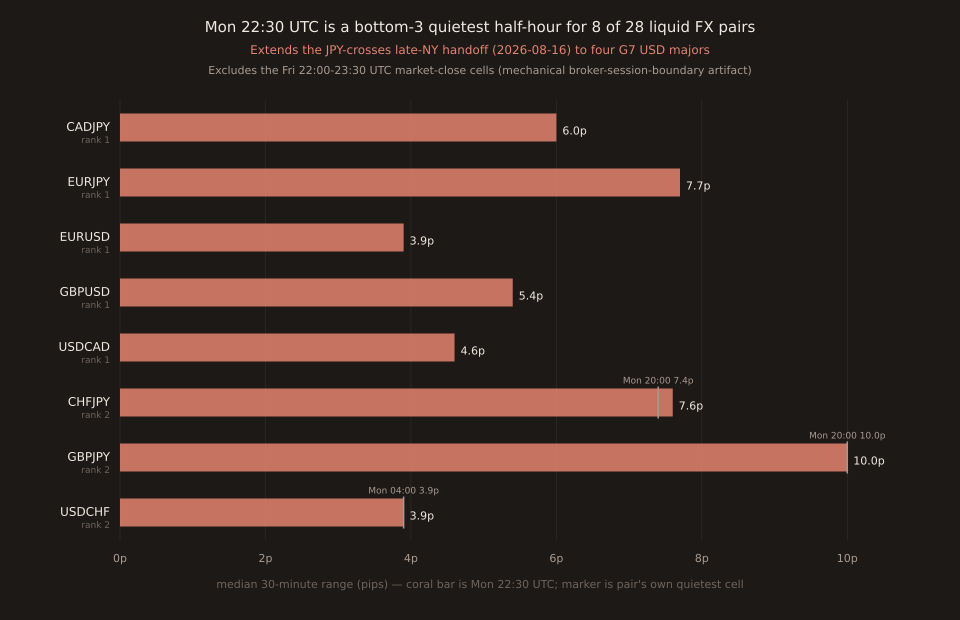
The 8 pairs, in rank order
| Pair | Mon 22:30 rank | Mon 22:30 median | Pair’s own quietest cell |
|---|---|---|---|
| CADJPY | 1 | 6.0p | Mon 22:30 (this cell) |
| EURJPY | 1 | 7.7p | Mon 22:30 (this cell) |
| EURUSD | 1 | 3.9p | Mon 22:30 (this cell) |
| GBPUSD | 1 | 5.4p | Mon 22:30 (this cell) |
| USDCAD | 1 | 4.6p | Mon 22:30 (this cell) |
| CHFJPY | 2 | 7.6p | Mon 20:00 (7.4p) |
| GBPJPY | 2 | 10.0p | Mon 20:00 (10.0p, tied) |
| USDCHF | 2 | 3.9p | Mon 04:00 (3.9p, tied) |
USDJPY is the near-miss. Its Mon 22:30 UTC cell prints at 5.8p, ranking 5 of 236 — outside the bottom-3 threshold used here, but its own single-quietest cell is the neighboring Mon 21:30 UTC at 5.3p which the 2026-08-16 late-NY-quiet post called out as the quietest single cell in the whole 7-JPY-cross matrix. USDJPY is inside this quiet zone; it just picks the preceding half-hour instead of the 22:30 cell exactly.
The mechanism — nobody’s home for either leg
Take EURUSD at Mon 22:30 UTC. What’s active?
London: closed for six-plus hours (16:00 UTC in DST months, 17:00 UTC otherwise). The euro-side of the pair has no active home market — no ECB rate-window flow, no European real-money desks, no European speculative books. New York: winding toward its own close at 21:00-22:00 UTC (broker-dependent). The dollar-side is drifting toward end-of-day, no fresh macro releases scheduled after 20:15 UTC on a typical Monday. Tokyo: hasn’t opened yet — the 00:00 UTC open is 90 minutes away. Sydney: technically open (from 22:00 UTC in DST months) but handles the tape thinly on its own, no dominant EUR or USD flow.
Now the same picture for USDCAD, GBPUSD, USDCHF: all four G7 USD-majors lose one leg (London-side) at 16:00-17:00 UTC and the other leg (NY-side) tapers into its own close by 22:00 UTC. The Mon 22:30 UTC cell catches the exact intersection of “both legs are asleep or wrapping up” before Tokyo re-anchors the USD-side at 00:00 UTC and Frankfurt re-anchors the euro-side at 07:00 UTC.
For the JPY-crosses in the same table (CADJPY, EURJPY, CHFJPY, GBPJPY, and USDJPY at the neighboring cell) the same multi-session handoff applies — plus Tokyo hasn’t come back to give the JPY-side its home market. Both legs are asleep or handing off.
Why Monday specifically
The multi-session handoff argument applies every weekday — the 20:00-22:30 UTC window is structurally the same time-zone gap Monday through Friday. But Monday piles two independent quiet-drivers on top of each other. First, the multi-session handoff. Second, the Monday-quietest effect established in the 2026-08-04 post — 27 of 28pairs have their quietest weekday half-hour on Monday, driven by Sunday-late-open flow that hasn’t fully accumulated yet by the time NY closes.
Stack those together and Monday 22:30 UTC wins. Tuesday 22:30 UTC is the second-quietest in most cases — you can see it in the ranks table (CADJPY, EURJPY, USDJPY all rank Tue 22:30 as bottom-2 or bottom-3 too), but Monday’s two-driver stack is what makes it the single winner.
What this doesn’t say
It doesn’t say Mon 22:30 UTC is quiet on every calendar Monday. These are median-of-medians across 665-848 observed Mondays per pair over the 2010-2026 sample. A specific Monday inside a Fed week, or the Monday after a US bank holiday, or the Monday of a month-end can and does print bigger ranges. The claim is distributional: over a long-run window this half-hour is the pair’s quietest.
It doesn’t include the Fri 22:00-23:30 UTC market-close cells. Those print ~0 median range for every pair (most brokers cut FX sessions at 22:00 UTC Friday), and the 2026-08-06 ledger dismissed them as a mechanical broker-session-boundary artifact rather than a satisfying finding. The Mon 22:30 UTC ranking here is after excluding those 4 cells.
The 4 G7 USD-major finding is specifically these 4 pairs. USDJPY misses by 30 minutes (rank 5 with Mon 21:30 being its strict-quietest). NZDUSD Mon 22:30 UTC ranks 4 (its true quietest is Mon 20:00 at 5.0p tied with Fri 21:00). AUDUSD ranks 11. The 4 G7 USD-major cluster (EURUSD, GBPUSD, USDCAD, USDCHF) at bottom-3 with USDJPY next door is the finding — not the broader “all USD majors” claim that would fail on AUDUSD, NZDUSD.
Open the tool → Free forever. No signup. No email required.