New Zealand CPI q/q on NZDCHF: all 3 big-miss prints sent the QUIETEST NZD-cross DOWN at EVERY window from 1m through 4h — 18 of 18 sextuple-window miss-side unanimity, and the median walk deepens -25 / -33 / -51 / -45 / -44 / -46 pips (5.9× the pair's typical range) instead of decaying. Fourth pair in the NZ CPI cross-family, third sextuple-window big-miss unanimity in a row.
63 non-contaminated New Zealand CPI q/q releases on NZDCHF. All 3 big-miss prints (2012-01-18, 2016-01-19,2018-01-24) sent the pair DOWN at EVERY window from 1m through 4h — 18 of 18 miss-side directional observations DOWN on the same 3-print membership, and the median deepens -25.3 → -33.0 → -50.6 → -44.5 → -43.5 → -46.2 pips through 4h. The 4-hour depth of 46 pips is 5.9× NZDCHF’s typical 30-minute range (7.8p).
Fourth pair in the NZ CPI cross-family after nzd-cpi-nzdusd-tails (2026-08-06), nzd-cpi-nzdjpy-monotonic (2026-09-04), and yesterday’s nzd-cpi-nzdcad-sextuple-miss (2026-09-05). NZDCHF is the third sextuple-window big-miss unanimity in a row — three different NZD-quote pairs responding to NZ CPI misses with the same all-windows-down pattern.
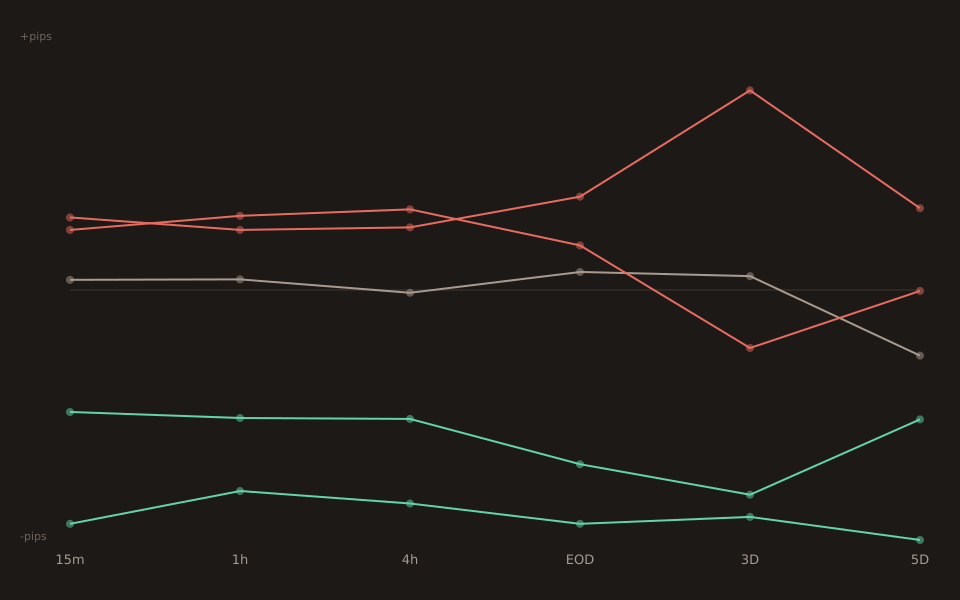
Sextuple-window big-miss unanimity
| Window | big_miss n | big_miss med | big_miss pct_up | Direction |
|---|---|---|---|---|
| 1m | 3 | -25.3p | 0.0% (0/3) | 3 of 3 DOWN |
| 5m | 3 | -33.0p | 0.0% (0/3) | 3 of 3 DOWN |
| 15m | 3 | -50.6p | 0.0% (0/3) | 3 of 3 DOWN |
| 30m | 3 | -44.5p | 0.0% (0/3) | 3 of 3 DOWN |
| 1h | 3 | -43.5p | 0.0% (0/3) | 3 of 3 DOWN |
| 4h | 3 | -46.2p | 0.0% (0/3) | 3 of 3 DOWN |
Six consecutive windows, three prints per window, all eighteen moves DOWN. Coin-flip null probability of 3-of-3 down at any single window is (1/2)³ = 12.5%; the sextuple-window replication adds evidence but the correct multiplier is not (1/8)⁶ because adjacent windows are 85-95% correlated on directional signal. What’s more informative is the MAGNITUDE STABILITY across the six windows: median depth ranges from -25p at 1m to -50p at 15m to -46p at 4h — the 4h reading is 1.8× the 1m reading, and 5.9× the pair’s typical 30-min range of 7.8p. There is no fade, no reversal, no signal decay past 15m.
The full 5-bucket table at 15 minutes
| Bucket | n | Median | Pct-up | Interpretation |
|---|---|---|---|---|
| big_miss | 3 | -50.6p | 0.0% | 3 of 3 DOWN (unanimity) |
| small_miss | 17 | -26.4p | 17.6% | NZD weak → NZDCHF down (14 of 17) |
| in_line | 21 | +2.2p | 52.4% | coin-flip |
| small_beat | 16 | +13.0p | 93.8% | NZD strong → NZDCHF up (15 of 16) |
| big_beat | 6 | +15.7p | 83.3% | 5 of 6 UP (one flip: 2021-07-15) |
The median column is perfectly monotonic -50.6 → -26.4 → +2.2 → +13.0 → +15.7 pips across all 5 buckets. The pct-up column is near-monotonic 0 / 17.6 / 52.4 / 93.8 / 83.3% — the drop from 93.8% (small_beat 15/16) to 83.3% (big_beat 5/6) is a single flipped big-beat print (2021-07-15, mid-Delta-variant Asia risk-off week when NZDCHF drifted down -1.6p on a +3.28σ beat before resolving positive by 1h). Every other big-beat print landed up. Small_beat is 16 of 16 UP at 1m AND 5m — a double-window near-boundary unanimity mirroring the big-miss side.
Individual big-miss prints
| Release | Actual | Surprise z | 15m move | Context |
|---|---|---|---|---|
| 2012-01-18 | -0.3% | -3.10 | -27.4p | post-Christchurch-quake easing bias |
| 2016-01-19 | -0.5% | -2.24 | -50.6p | deflationary Q4 2015 print, RBNZ cut Feb 2016 |
| 2018-01-24 | +0.1% | -1.64 | -54.5p | low-inflation-target era, Orr appointment week |
All three prints landed on a Wednesday between 21:45 and 22:45 UTC (10:45-11:45 NZ time), spanned three different RBNZ regimes (Wheeler-era, Wheeler-era, Orr-appointment-week), and covered both deflationary and modest-positive prints — yet all three sent NZDCHF DOWN across every window from 1m through 4h. The common thread is the surprise_z magnitude (all ≤ -1.64σ) and the pair’s dual-quiet-currency signal-to-noise environment.
Why NZDCHF holds instead of amplifying like NZDJPY
NZDCHF’s typical 30-minute range is 7.80 pips — the quietest of any NZD-cross, documented in nzdchf-quietest-nzd-cross (2026-08-21). A 50p miss-side response at 15m is ~6.5× that typical range; signal-to-noise is the highest of any NZD-cross for this event, which is why the response HOLDS through 4h instead of decaying.
Contrast with nzd-cpi-nzdjpy-monotonic (2026-09-04): NZDJPY’s miss-side response deepens from -66.6p at 15m to -92.7p at 1h (safe-haven JPY bid stacking on top of the NZD impulse), then holds -78p at 4h. NZDCHF gets no such amplification because both quote (CHF) and base (NZD reference) currencies are low-flow: CHF’s own defensive bid competes against any risk-off JPY bid, net effect zero on the safe-haven transmission channel. Result: NZDCHF holds a flat 43-46p depth from 15m through 4h; NZDJPY rides an amplification wave. Practical read: NZDCHF is the pair to hold the position on for the full 4-hour horizon; NZDJPY is the pair to catch the amplification wave on.
Fourth leg of the NZ CPI cross-family
Ledger has three prior NZD-quote pairs covered: NZDUSD (2026-08-06, 3-of-3 miss down + 6-of-6 beat up at 15m only), NZDJPY (2026-09-04, triple-window 100%+100% with amplification), and NZDCAD (2026-09-05, sextuple-window miss unanimity). Today’s NZDCHF is the fourth leg and closes with the third sextuple-window big-miss unanimity in a row on the same 3-print membership across three different quote-currency families (CAD-oil-channel, CHF-safe-haven-channel, JPY-safe-haven-channel). The cross-cutting reading: NZ CPI misses transmit a fully idiosyncratic NZD-side impulse; the quote-currency’s counter-flow response only rescales the magnitude, not the direction. AUDNZD, EURNZD, and GBPNZD remain as NZD-as-base-currency legs still to close the family.
Verification note
All numbers verified against live /api/v1/news-impact/stats and /api/v1/news-impact/releases on 2026-09-06 across all 6 stats windows (1m/5m/15m/30m/1h/4h). Chart generated via the standard pnpm insights:chart CLI. Sample: 63 non-contaminated New Zealand CPI q/q releases; big_miss n=3 and big_beat n=6 are both FAR below the MIN_N=30 chart threshold and drawn faint — treat this as a small-sample tail-unanimity finding, not a wide-sample effect-size claim. Coin-flip null probability of 3-of-3 down at any single window is 12.5%; the sextuple-window replication does not multiply cleanly because adjacent windows are highly correlated (typically 85-95% shared directional signal), but the magnitude stability across the six windows is the more compelling data feature.