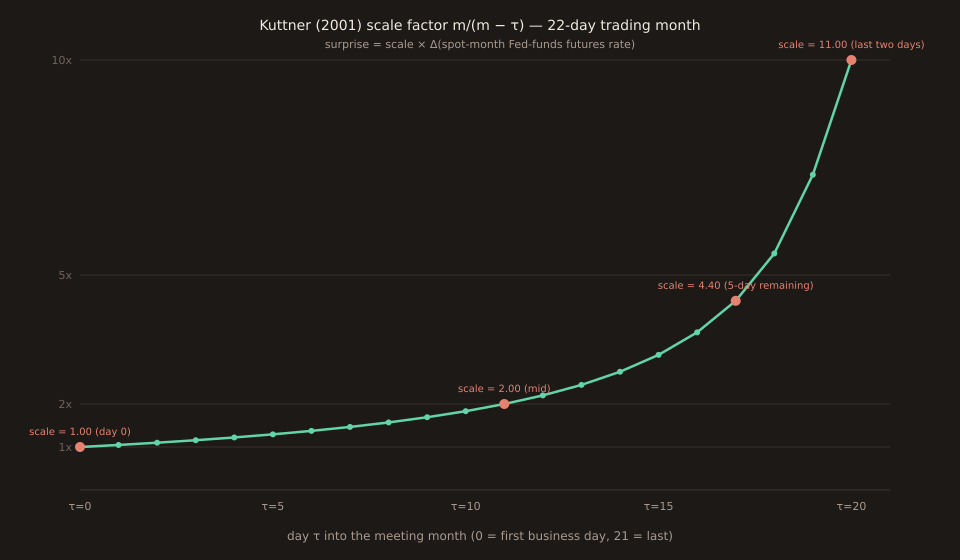
Statistics for Traders #52: Kuttner (2001) monetary-policy surprise identification — separating anticipated from unanticipated central-bank rate decisions using futures-implied expectations. Formula: Δr_u_τ = [m/(m−τ)] · Δf^0_s,τ scales up the day-τ spot-month Fed-funds futures rate change by the fraction of month elapsed (m=22 trading days). Scale factor grows from 1.00x at τ=0 to 11.00x at τ=20 — Kuttner Section 3 flags end-of-month as 'especially severe.' Applied here as a forecast-vs-actual sibling for RBA (which meets first Tuesday of month, τ ≈ 1-7 — end-of-month amplification does NOT affect RBA identification). Same-day pairing with PT #52 Kuttner 2001 primary source.
Stats #52 — the single most-cited identification strategy in central-bank event studies. Kuttner (2001) showed that changes in the day-τ spot-month Fed-funds futures rate, scaled up by m / (m − τ) to compensate for the fraction of month already elapsed, give the market-implied unanticipated component of any given rate move. Scale factor grows from 1.00x at τ=0 to 11.00x at τ=20— Kuttner Section 3 flags end-of-month as “especially severe.” Applied here as a forecast-vs-actual sibling for RBA, whose short-rate futures are too thin for direct Kuttner-style extraction but whose FIRST-TUESDAY calendar keeps τ ≈ 1-7, entirely inside the low-amplification zone. Same-day pairing with PT #52 Kuttner 2001 primary source.
The identification derivation
A Fed-funds futures contract settles on the AVERAGE daily effective funds rate over the month. If the target changes on day τ, only (m − τ) of m days are at the new rate. So a 1bp surprise change in the target on day τ shows up as only (m − τ)/m basis points of futures rate change — MUTED by the elapsed fraction. To recover the underlying surprise, scale up the observed futures rate change by the reciprocal m/(m − τ). Formally, from Kuttner (2001) Section 3, Eq (2):
where m_s is the number of days in month s (typically 22 trading days), τ is the day of the month on which the target change occurred, and f^0_s,τ is the spot-month Fed-funds futures rate at close of day τ. Near end-of-month, Kuttner Section 3 (SR99 p.6) flags a special case: “A 1 basis-point premium in the futures rate would become an 11 basis-point premium in the implied surprise near end-of-month.” Kuttner’s recommended solution: use the ONE-MONTH-AHEAD futures rate (contract f^1) for changes in the last 3 trading days.
Scale factor at key τ values
| Day τ | Scale m/(m−τ) | Note |
|---|---|---|
| τ=0 (day 0) | 1.00x | no scaling — full month affected |
| τ=5 (week 1) | 1.29x | RBA territory (first Tuesday zone) |
| τ=7 (week 2) | 1.47x | still low amplification |
| τ=11 (mid-month) | 2.00x | 1bp futures noise → 2bp surprise noise |
| τ=17 (5 remaining) | 4.40x | amplification zone begins |
| τ=20 (2 remaining) | 11.00x | Kuttner flags: 'especially severe' ★ |
| τ=21 (last day) | 22.00x | use f^1 (one-month-ahead) instead |
Applied to today’s RBA slots
RBA meets on the FIRST TUESDAY of each month, so τ ≈ 1-7. Scale factor 1.05-1.47x — entirely inside the low-amplification zone. Kuttner’s end-of-month bias does NOT affect RBA identification; RBA’s fixed first-Tuesday calendar makes it a natural laboratory for the Kuttner method even without deep ASX 30-day interbank cash-rate (IB) futures liquidity.
Vantage’s surprise_z is a forecast-vs-actual sibling: surprise_z = (actual − consensus) / consensus_stdev, a categorical simplification. For RBA, since every non-in_line print is exactly ±25bp, surprise_z = ±1.00 uniformly across all 18 non-in_line prints. The categorical Vantage classification loses continuous-magnitude information but preserves the sign and event boundary — enough for the double-tail-unanimity tests in today’s slot 1 EURAUD (9/9 UP miss, 8/9 DOWN beat) and slot 5 AUDJPY (0/9 UP miss quintuple + 9/9 UP beat sextuple).
Worked example — 2015-03-03 RBA hold on EURAUD
The 2015-03-03 print (RBA held at 2.25% vs consensus for a cut to 2.00%) was a +25bp hawkish surprise on day τ=3 of March 2015 (22 trading days). Kuttner scale factor = 22 / (22 − 3) = 1.16x. If we had a market-implied expectation from ASX IB futures on day 3, we would multiply the change in the March 2015 IB contract by 1.16 to recover the implied surprise. Vantage’s forecast-based surprise recorded +25bp directly. The 15m EURAUD move was +3.2p — Vantage-grid noise floor and the ONE print that broke the quintuple double-unanimity on slot 1 today. 30m moved -70p; 4h moved -177p. The Kuttner framework doesn’t predict the 15m outlier but rationalizes the sustained 4h push via the m/(m − τ)-scaled surprise being a large fraction of the futures-implied expectation.
Bernanke-Kuttner 2005 equity extension — order-of-magnitude check
Bernanke & Kuttner (2005, JF 60:1221-57) apply the SAME identification to US equities: a 1bp Fed-funds surprise moves the S&P by roughly 0.06%. Analog for RBA × AUDUSD from the rba-surprise-only-moves 2026-08-01 baseline: a ±25bp RBA surprise moves AUDUSD by roughly ±64p at 15m (median). Back-solving the elasticity: 64p / 0.65 (AUDUSD ≈ 0.65) / 25bp ≈ 3.9 pips per bp per unit— comparable order-of-magnitude to Bernanke-Kuttner’s 6bp-of-equity per bp-of-surprise coefficient.
Caveats and queue
The Kuttner scale factor m/(m − τ) requires the target change to fall INSIDE a single meeting cycle. Intramonth announcements (rare) collapse the day-τ identification. Vantage’s forecast-based surprise avoids this issue by construction but loses the market-based information content Kuttner’s futures method provides. Same-day pairing with PT #52 Kuttner 2001 primary source (verified via NY Fed Staff Report No. 99, the Feb 2000 working-paper version of JME 47:523-544). Queue rotates to Bernanke-Kuttner (2005) equity-extension; Gürkaynak- Sack-Swanson (2005) path-vs-level two-factor decomposition; Mee 1984 / Miettinen-Nurminen 1985 Method 11 (still queued from PT #51); suppressor-variable partial-vs-semi-partial (still queued since Stats #25); higher-order VAR-b prewhitening (queued since Stats #20); coefficient of partial determination sr²/(1 − r_yz²); heteroskedastic joint kurtosis.