Swiss CPI on USDCHF: clean 5-bucket directional response with 198 releases behind it
198 monthly Swiss CPI releases since 2010, split into five surprise buckets on USDCHF 15-minute moves. The medians line up: +6.6 / +2.6 / +0.3 / −1.5 / −4.5 pips. All five buckets in the right order. Both tails carry n≥11 — an unusually rich tail-bucket sample for a mid-tier CHF release.
This is the tail-density cleanest CPI print in the tool for any instrument-vs-domestic-central-bank pair. Australia’s Trimmed Mean has n=5 on big_miss; Canada’s Trimmed CPI has n=5; Switzerland has n=18. The story that follows is not propped up by three or four tail observations — it’s built on an entire distribution.
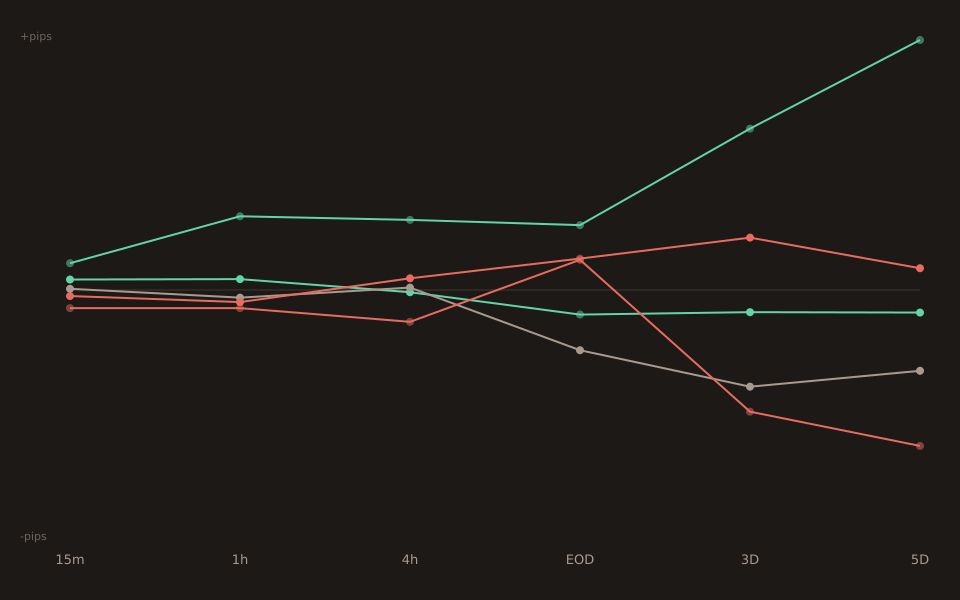
The bucket table
| Bucket | n | 15m median | 30m median | 1h median | Pct up (15m) |
|---|---|---|---|---|---|
| big_miss | 18 | +6.6 | +9.2 | +18.3 | 78% |
| small_miss | 59 | +2.6 | +2.4 | +2.7 | 63% |
| in_line | 67 | +0.3 | +0.3 | −1.9 | 52% |
| small_beat | 43 | −1.5 | −2.1 | −3.0 | 37% |
| big_beat | 11 | −4.5 | −2.8 | −4.5 | 36% |
Read the pct-up column top to bottom: 78%, 63%, 52%, 37%, 36%. That’s a smooth walk from “four in five miss-prints push USDCHF up” to “roughly one in three beat-prints push USDCHF up” — exactly the monotonic gradient a real directional signal produces.
Why misses push USDCHF up, mechanically
The SNB targets price stability — formally, CPI inflation below 2% year-on-year, and in practice a much narrower comfort band given Switzerland’s decade-long fight with disinflation. A Swiss CPI miss makes it more likely the SNB will either hold rates lower for longer or (in the extreme) return to franc-selling intervention to prevent further CHF strength. Both actions weaken the CHF; a weaker CHF means USDCHF goes up. Miss = up.
A CPI beat compresses the tail probability of new intervention and modestly raises the odds of eventual normalisation; that strengthens CHF and pushes USDCHF down. Beat = down. Both directions follow the same OIS-repricing logic that governs the AUDUSD response to Australia’s Trimmed Mean CPI or the USDCAD response to Canada’s Trimmed CPI — same mechanism, different currency.
The miss-side response grows through the hour
big_miss at 5m: +4.0p. At 15m: +6.6p. At 30m: +9.2p. At 1h: +18.3p. The response nearly triples between the release and the top of the following hour, and it isn’t a wide-error-bar phenomenon: the pct-up rate stays at 78% at 15m and 80%at 1h. Miss-side directional persistence with growing magnitude is the “real re-pricing” signature — traders keep buying USD/selling CHF as the SNB-easing scenario firms up in analyst notes and OIS quotes.
big_beatis different: −4.5p at 15m, −4.5p at 1h. Flat. The beat-side response is fully-priced within the first fifteen minutes; the market decides “the SNB doesn’t need to intervene as hard” and the story doesn’t extend further. Which fits with the asymmetric SNB reaction function: beats reduce the intervention tail, misses re-open it.
What this doesn’t say
The pooled sample averages across SNB regimes. The 198 releases span 2010 through 2026 — a period that includes the September 2011 EURCHF-floor introduction at 1.20, the January 2015 abrupt removal, negative rates (2015-2022), positive rates (2022-2024), and multiple rounds of verbal and actual franc-selling intervention. Individual prints during the floor-defence years saw USDCHF magnitudes dragged around by EURCHF’s peg. The aggregated table is an average across regimes; if today’s SNB stance is materially different from the mean of the sample, expect today’s response to differ in magnitude (though probably not in direction).
The magnitudes are small in absolute terms. Even the biggest median move — +18.3p on big_miss at 1h — is barely one typical 30-minute range for USDCHF (median cell ~7.6p, loudest Thu-13:30 cell 16.0p). Swiss CPI is a signal, not a shock, and it’s a signal that pays best when compounded with directional conviction that the print reinforces rather than as a standalone immediate-reversal trade.
The direction is the load-bearing claim, not the precise pip count. Per Stats for Traders #3, the 95% confidence interval on the median at n=11 (big_beat) is wide enough that the −4.5p point estimate could easily be anywhere from −9p to +1p. Trust the sign; treat the magnitude as directional order-of-magnitude only.
Open the tool → Free forever. No signup. No email required.