GBPNZD is the loudest liquid FX pair — its typical 30-minute range beats USDCHF's loudest
GBPNZD’s median weekday 30-minute range is 21.9 pips. USDCHF’s single loudest weekday cell of the entire week is 16.0 pips. GBPNZD’s typical cell is bigger than USDCHF’s loudest. Scale up to the actual GBPNZD peak — Friday 14:30 UTC at 34.55 pips — and you have the single largest half-hour cell of any pair in the Calm Zones catalogue.
The monday-quietest-half-hour post (2026-08-04) showed the cross-pair uniformity of the quiet side of the grid. Thisis the mirror-image observation about the loud side. But instead of a cross-pair count (“27 of 28 pairs peak in the same window”), the striking finding is single-pair: one pair is loud on every cell it has, and its dead cells are louder than the peaks of the pairs everyone considers volatile.
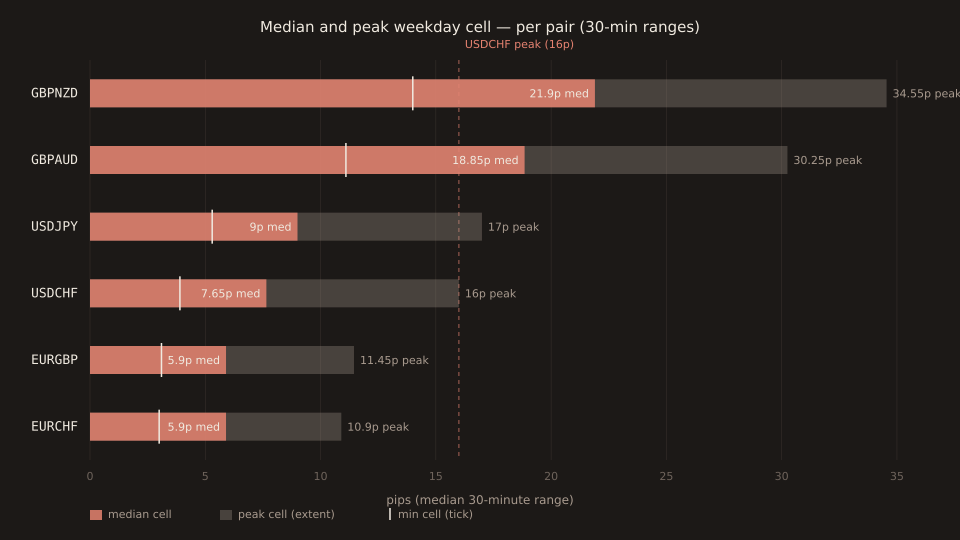
The full pair-profile summary
| Pair | Median cell | Quietest cell | Loudest cell | Max / median |
|---|---|---|---|---|
| GBPNZD | 21.9 | 14.0 | 34.55 | 1.58× |
| GBPAUD | 18.9 | 11.1 | 30.25 | 1.60× |
| USDJPY | 9.0 | 5.3 | 17.0 | 1.89× |
| USDCHF | 7.65 | 3.9 | 16.0 | 2.09× |
| EURGBP | 5.9 | 3.1 | 11.45 | 1.94× |
| EURCHF | 5.9 | 3.0 | 10.9 | 1.85× |
Two things worth pointing at. First, GBPNZD’s minimum cell of 14.0p is louder than either EURCHF or EURGBP has ever been at any weekday half-hour of the entire week.Not a comparison of averages — a comparison of GBPNZD’s quietest observed cell to the two quiet crosses’ single loudest observed cells. Second, GBPNZD’s max/median ratio of 1.58×is the “flattest” of any liquid pair — the pair doesn’t have obvious loud and quiet cells the way USDCHF (2.09×) and EURGBP (1.94×) do. It’s roughly the same volatility on every cell, and that same is high.
The loudest cell across the whole catalogue
Friday 14:30 UTC on GBPNZD, in the London/NY overlap session. Median 30-minute range: 34.55 pips. The IQR runs from 25.8p (p25) to 46.85p (p75) — so half of all observed Friday 14:30 cells produced a range of at least ~26 pips, and a quarter produced at least ~47. The p90 is 65.3 pips: one in ten of these Friday afternoons gave you a 30-minute candle with a 65-pip range.
The 825observations behind that cell (2010-2026) include NFP-Fridays, Canadian-jobs-Fridays, and Fridays that had no scheduled tier-3 print. The 34.55p median holds across all of those subsets — this isn’t a distortion from a handful of outlier NFP moves; it’s the pair’s natural Friday-afternoon behaviour compounded by the flow spike from the US pre-London-close hedgers unwinding into 16:00 UTC.
Why GBPNZD, specifically
Both GBP and NZD are risk-on/risk-offcurrencies driven primarily by external macro flow rather than local domestic data. NZD is small-cap commodity flow (with heavy dairy weight); GBP is large-cap financial-services flow. When US CPI, NFP, or FOMC moves the dollar, both legs of GBPNZD reset independently — and the moves don’t fully cancel. That’s the volatility source. And unlike EURCHF (SNB-anchored) or EURGBP (traded as a near-substitute pair with tight arbitrage relative to EURUSD/GBPUSD), GBPNZD has no natural anchoring force pulling it toward a level.
Add typical dealer spreads of 4-8 pips (vs 0.5-1 pipon EURUSD), and the marginal cost of letting the pair drift 15 pips in either direction is small enough that market-makers don’t defend levels the way they do on tighter crosses. The result is a pair whose 30-minute cells rarely quiet down — every hour is noisy on GBPNZD.
What this doesn’t say
“Loudest” is the median, not a guarantee. The Friday 14:30 cell’s 34.55p is the median across 825 observations. Individual Fridays produce cells from single digits (rare) up to the p90 of 65+ pips (about 1 in 10). If today happens to be an outlier-quiet Friday, the cell will feel quieter than the median. The finding is that this cell is typicallyloud, not that it’s loud on any specific Friday.
Range is not directional predictability.The Calm Zones scan measures the median 30-minute high-minus-low range within a cell. High range means “the market moves around a lot in this window,” which is different from “the market moves in a predictable direction in this window.” A tradeable directional edge on GBPNZD Friday 14:30 UTC would require a separate news-impact-style analysis; this post is only about the noise floor.
Spread makes GBPNZD unrewarding for scalpers. Even at typical 4-8 pipspreads, a scalp on GBPNZD needs to clear a ~10p cost before you’re net-positive. On a pair whose median cell is 22p, the maths says a scalper is immediately paying half the noise floor as a friction cost. GBPNZD is a pair for larger-move directional trades or multi-hour holds, not for the same rapid-turnaround style that works on EURUSD.
Open the tool → Free forever. No signup. No email required.