Paper Trail #38: Risk in Dynamic Arbitrage — the Price Effects of Convergence Trading (Kondor, 2009) — the paper that dynamically extended yesterday's PT #36 arc by showing convergence-trade arbitrageurs can lose money EVEN ON A FUNDAMENTALLY RISKLESS TRADE, because the equilibrium gap between two identical assets must widen over time to keep the arbitrageurs indifferent to when they deploy capital. Smith Breeden First Prize for the Best Paper in Asset Pricing 2009.
Paper Trail #38. Péter Kondor (Central European University, formalized at LSE and finalized at U. Chicago GSB) (2009), “Risk in Dynamic Arbitrage: The Price Effects of Convergence Trading.” Journal of Finance Vol. LXIV No. 2 (April 2009) pp. 631-655, DOI 10.1111/j.1540-6261.2009.01445.x. Winner: Smith Breeden First Prize for Best Paper in Asset Pricing 2009. Full primary source verified 2026-09-07 via WebFetch + pymupdf on the LSE mirror (25 pages, text-native, no OCR).
The paper that dynamically extended the two-period limits-of-arbitrage frame of PT #33 Shleifer-Vishny 1997 and PT #36 Gromb-Vayanos 2002 with a continuous-time equilibrium model of convergence trading and a RANDOM exponentially-distributed window closure. The headline result (Proposition 4): the realized return of arbitrageurs conditional on window length t̃ is monotonically DECREASING in t̃, so the return distribution is NEGATIVELY SKEWED — large losses in small-probability long-window states, small gains in short-window states — even though the trade is fundamentally riskless.
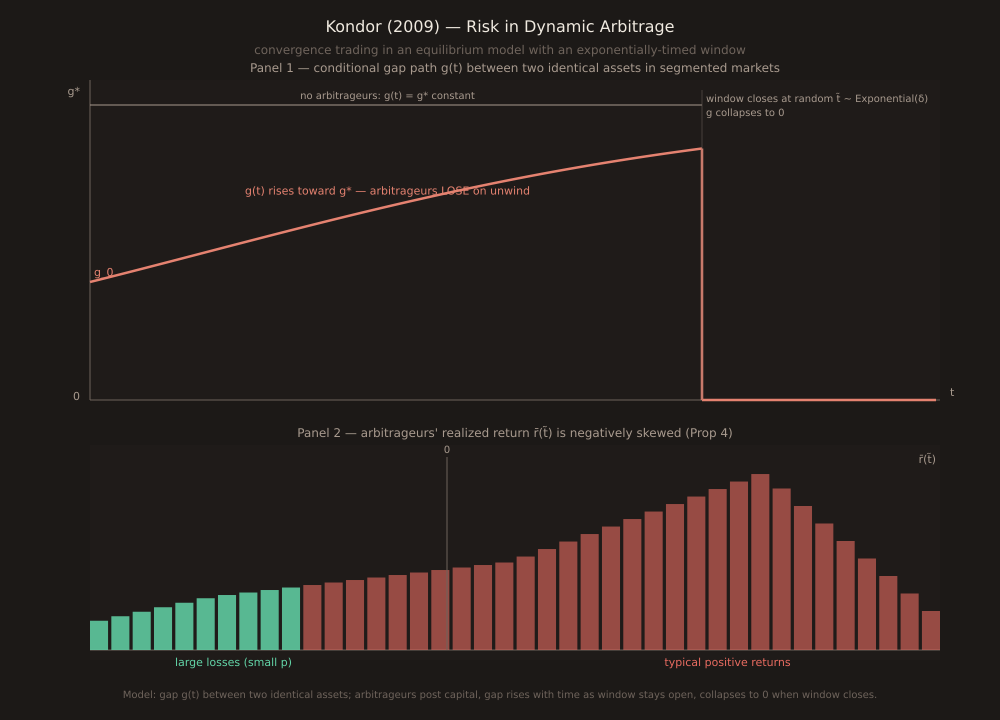
The setup: two identical assets, one random-length window
The universe (Section I, page 4 verbatim): “Two assets have identical cash flows and are traded in separate markets. A unit mass of risk-neutral arbitrageurs can trade in both markets. The representative arbitrageur shorts x(t) shares of the expensive asset and buys x(t) units of the cheap asset.” Local traders (non-arbitrageurs) provide a static demand curve for the gap g(t) = f(x̄(t)) in the random time interval [0, t̃]. At t̃ the difference in local demand curves disappears, the inverse demand curve collapses, and the gap goes to zero. The random closure time t̃ is exponentially distributed with a constant hazard rate δ.
The constraint: arbitrageurs’ capital v(t) evolves according to their existing position and the current gap change. They face a capital constraint that rules out positions that could make them go bankrupt in any state of the world, given liabilities are marked to market. This is Kondor’s dynamic-time analogue of GV 2002’s per-account collateral rule and SV 1997’s performance-based bailout constraint.
The equilibrium gap path — must widen or arbitrageurs won’t hold
The Euler condition (equation 4): δ g(t) · dg(t)/dt = J′(v(t)). This makes the arbitrageur indifferent between deploying capital now and saving it for later. The general solution (equation 7):
g(t) = g_∞ g_0 / (g_∞ e^(-δt) + g_0 (1 - e^(-δt)))
Proposition 1 shows this generates a continuum of symmetric equilibria for aggregate capital v̄_0 ∈ (0, v̄_max), each characterised by a starting g_0 and an asymptote g_∞. Proposition 2 introduces an arbitrarily small holding cost m > 0 which selects a UNIQUE equilibrium — the “robust equilibrium” in which g(t) strictly monotonically rises through [0, T] and reaches g* by time T. As m → 0 the robust equilibrium of the perturbed system converges to the corresponding equilibrium of Proposition 1 with g_∞ = g*.
Proposition 3 — more arb capital, smaller gap AND longer half-life
Section III’s central comparative-static result. In the robust equilibrium, for any fixed t and u > t:
- the gap g(t), the expected return on capital J′(v(t)), and the expected change in the gap are ALL decreasing in aggregate capital v̄_0 — more capital in the trade = smaller edge, expectedly.
- the half-life of the gap h_t(g_0) is INCREASING in v̄_0 — more capital = SLOWER decay of the remaining edge, less-expectedly. This is the paper’s cleanest testable prediction: crowded convergence trades decay their normalized Sharpe more slowly than sparsely-populated ones.
- as v̄_0 → v̄_max, g(t) approaches a martingale — the gap becomes the discounted-fair-value process itself.
Proposition 4 — the negatively-skewed return distribution
The paper’s empirical-implication headline. Proposition 4: “The realized return of arbitrageurs conditional on a window of length t̃, r̄(t̃), is monotonically decreasing in t̃. Consequently, (i) the distribution of r̄(t̃) is skewed toward the left, (ii) Cov(r̄(t̃), g(t̃)) > 0.”
The mechanism: the gap g(t) rises monotonically while the window is open. When the window closes at t̃, the arbitrageur captures the MTM gain from g(t̃) → 0. But the mark-to-market path during [0, t̃] is a WIDENING gap, which produces mark-to-market losses on the existing position. The longer the window stays open, the deeper the marked-to-market losses accumulated. If capital hits the collateralization constraint before t̃, the arbitrageur is FORCED TO UNWIND at a loss. When the window is short, the modal outcome is a small positive realized return (the direct convergence profit); when the window is long, the outcome is a large negative return.
The exponential distribution of window closure times means most windows close short but occasionally very long ones occur — which maps precisely onto the empirical hedge-fund-return literature (Fung & Hsieh; Getmansky, Lo & Makarov) documenting negative-skew, positive-liquidity-beta hedge fund returns. Kondor gives this profile an equilibrium mechanism that requires no exogenous shock.
LTCM 1998, and the paper’s motivation
Page 1 verbatim: “The near-collapse of the Long-Term Capital Management (LTCM) hedge fund in 1998 is frequently cited as an example of this phenomenon. To what extent can these losses be attributed to the actions of arbitrageurs as opposed to unforeseen shocks?” Kondor’s answer is that a substantial portion of the LTCM losses can be attributed to the equilibrium widening of gaps in convergence trades — no exogenous shock required. The Russian default of August 1998 was a trigger, but the deeper mechanism was that LTCM’s convergence-trade portfolio had aggregate capital v̄_0 large enough that the equilibrium demanded widening gaps and deep drawdowns. Prop 5 formalizes this: the tail of the g(t̃) distribution is increasing in v̄_0 — the more capital in the trade, the fatter the left tail of realized returns.
Cross-links to the wider Paper Trail arc
Kondor 2009 explicitly cites PT #33 Shleifer-Vishny 1997 and PT #36 Gromb-Vayanos 2002 alongside Xiong 2001 as prior amplifier-mechanism models (Section V verbatim): “losses with the intuition of other models of limits to arbitrage—for example, Shleifer and Vishny (1997), Xiong (2001), and Gromb and Vayanos (2002). The common element of all these models is that they present mechanisms that amplify exogenous shocks: Arbitrageurs lose capital because some initial loss makes them liquidate part of their positions, which widens the gap and reduces their capital further.” Kondor’s contribution is to show that the same profile of losses arises WITHOUT any exogenous shock. Kondor also cites the 2007 working-paper version of PT #34 Brunnermeier-Pedersen 2009 for “aggregate funding liquidity in the market” — the Kondor and BP papers were circulating simultaneously through 2007-2008 and published within a year of each other in JF 2009.
Retail-trader takeaway
Two things. First, if you run a convergence-like strategy (any pair trade, statistical-arbitrage screen, or macro-mean-reversion signal), expect and plan for the strategy’s return distribution to be NEGATIVELY SKEWED. The modal outcome is a small positive return; the tail outcome is a large drawdown. Sharpe ratio understates this — Sortino (see Stats #9) reflects it better. Second, Prop 3’s crowd-in-the-trade prediction (more capital → longer Sharpe half-life) suggests that watching AUM flows into your strategy family is a legitimate forward-looking risk signal — if the strategy’s edge doesn’t decay AS FAST AS it used to, that’s consistent with the equilibrium adjustment Kondor predicts and warns that you’re now in a fatter-left-tail regime.