NZDCHF is the quietest of the seven NZD-crosses — typical 30-minute range 7.80 pips, and its loudest weekday cell (12.00p) is smaller than every other NZD-cross's loudest
NZDCHF’s median weekday 30-minute range is 7.80 pips. NZDUSD’s is 8.10p, AUDNZD’s is 8.60p, NZDCAD’s is 8.90p, NZDJPY’s is 9.90p, EURNZD’s is 18.00p, GBPNZD’s is 22.00p. Every other NZD-cross is louder than NZDCHF. Its single loudest weekday cell of the year — Thursday 13:30 UTC — prints just 12.00 pips, still 0.60p below AUDNZD’s loudest and 55% of EURNZD’s typical cell.
This is the NZD-family analog of the CADCHF quiet-CAD-cross post from 2026-08-06. Same mechanism: pair a commodity currency with CHF and you get the family’s quietest cross.
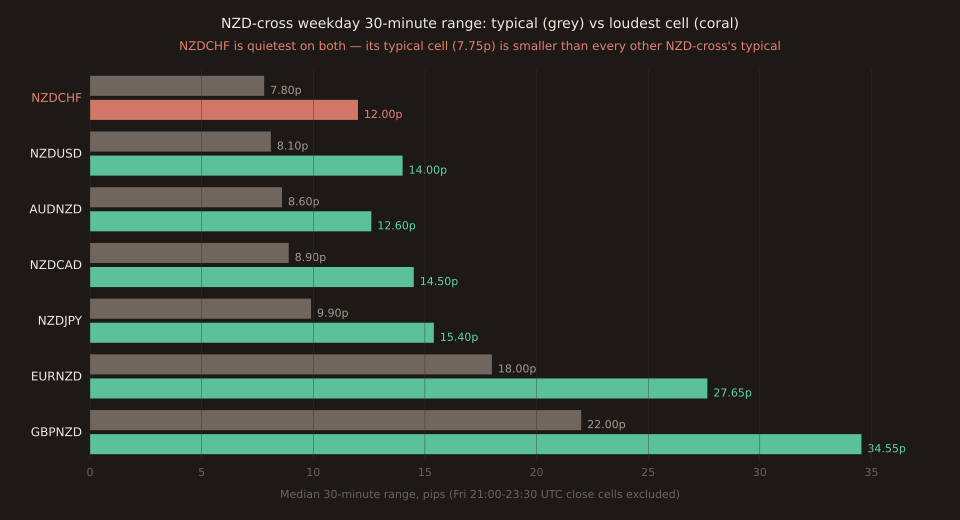
The full NZD-cross activity table
| Pair | Typical cell | Quietest cell | Loudest cell | Peak / typical |
|---|---|---|---|---|
| NZDCHF | 7.80 | 5.00 | 12.00 | 1.54× |
| NZDUSD | 8.10 | 5.00 | 14.00 | 1.73× |
| AUDNZD | 8.60 | 6.00 | 12.60 | 1.47× |
| NZDCAD | 8.90 | 5.90 | 14.50 | 1.63× |
| NZDJPY | 9.90 | 6.60 | 15.40 | 1.56× |
| EURNZD | 18.00 | 11.65 | 27.65 | 1.54× |
| GBPNZD | 22.00 | 14.00 | 34.55 | 1.57× |
Coverage per cell: 2010-01-01 through 2026-07-21, n_days_total 700-800 depending on the specific weekday half-hour. Fri 21:00-23:30 UTC close cells excluded from all quietest / typical / loudest picks — same treatment as the CADCHF post and the 2026-08-19 mon-2230-usd-majors-quiet post. Every row verified against a fresh /api/v1/calm-zones/scan?pair=<pair> pull on 2026-08-21.
Why CHF-cross-of-a-commodity-currency ends up quietest
Same mechanism the CADCHF post identified. CHF is a “quiet” currency: its biggest exogenous drivers are SNB policy decisions (quarterly, plus one-off shocks like 2015-01-15) and broad safe-haven flows. Neither of those has a weekly cadence. So CHF-crosses that also happen to strip out USD end up with almost no natural big-flow catalyst on the calendar.
NZD’s own big-flow drivers are: NZ macro data (see today’s NZ GDP × NZDUSD post) which lands at 22:45 UTC in a Sydney-morning cluster; RBNZ OCR decisions which land at 01:00 or 02:00 UTC; and secondary exposure to Chinese dairy prices (Fonterra Global Dairy Trade auction) which lands at ~13:00 UTC on the second and fourth Tuesday of each month. None of these overlap with the CHF release calendar (Swiss CPI 07:30 UTC first Wed of month, SNB decision quarterly). So the two currencies’ big-flow windows don’t line up.
Contrast with the loud NZD-crosses. GBPNZD (typical 22.00p, peak 34.55p) gets both GBP-side London-open flow AND NZD-side Sydney-morning flow AND US-macro spillover — three separate catalysts, all firing on different weekdays. EURNZD (typical 18.00p) is the same story with EUR instead of GBP. NZDCHF has essentially only NZD-side catalysts on the calendar; CHF sits quiet through most of them.
What this means practically
NZDCHF is what you trade when you want NZD exposure without the USD noise. Every big NZ macro finding on NZDUSD from this ledger — the 0-of-18 NZ GDP miss unanimity, the 0/3 big-miss + 6/6 big-beat NZ CPI tails — is fundamentally an RBNZ-terminal-rate story. NZDCHF gets that same story with less USD-side contamination. Stop distances shrink; position sizes for equivalent variance grow. And you can hold overnight from the London close into Sydney open without a USD-data-window landmine detonating in your face.
The 12.00p peak weekday cell is worth remembering for stop sizing. Any stop at or beyond 15 pips sits outside the p75 of every non-Thursday-13:30 cell — even more true for NZDCHF than for CADCHF (which had a 14.2p peak). The trade-off is that NZDCHF is also less liquid than NZDUSD, so quoted spreads run wider (typical 3-5 pips vs NZDUSD’s 1-2), which eats some of the tighter-stop advantage back.