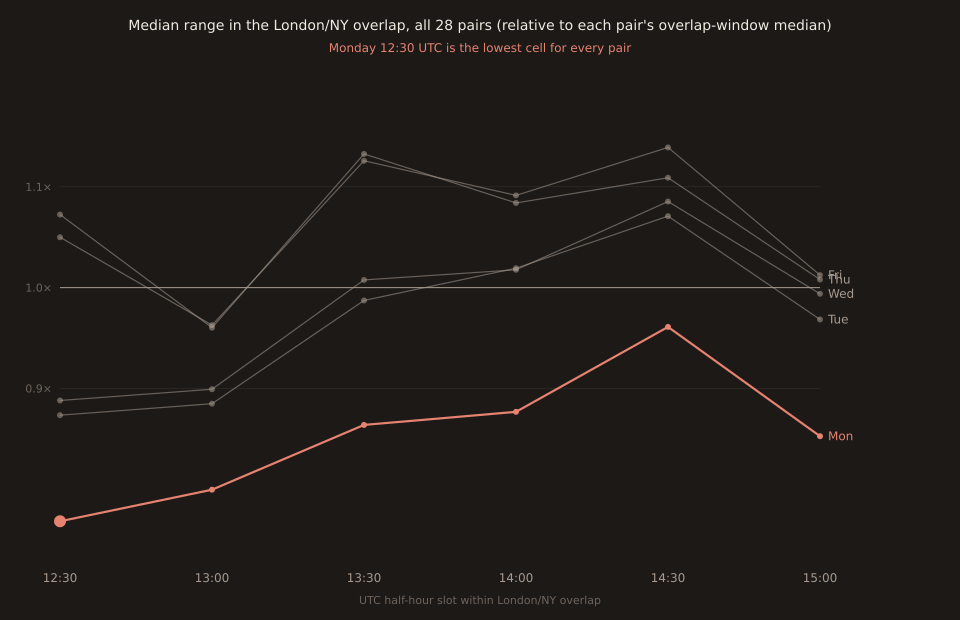
Monday 12:30 UTC is the quietest half-hour of the entire London/NY overlap for ALL 28 liquid FX pairs — 1.4× to 1.7× quieter than that same pair's loudest overlap cell
For every one of 28 liquid FX pairs, the quietest half-hour cell inside the London/NY overlap window (Mon-Fri, 12:30-15:00 UTC) is Monday’s 12:30 UTC opening slot.Every pair. The ratio between each pair’s Mon 12:30 median range and its loudest overlap cell spans 1.39× (GBPCHF) to 1.69× (USDJPY), median 1.51×.
This is not the same as the finding from the 2026-08-04 Monday-quietest post. That one said 27 of 28 pairs have their entire-WEEK quietest cell on Monday, with those quiet Mondays clustered at pre-London and post-NY-close handoffs. Today’s claim is stricter: even inside the loudest three hours of the entire trading week — the London/NY overlap when Thursday jobless claims and Friday NFP land — Monday’s 12:30 UTC opening slot is still the low. And it’s the low for every single pair I checked.
The 28-pair table
Each row is one pair. First column is its Mon 12:30 UTC median range. Second column is its loudest cell anywhere in the Mon-Fri 12:30-15:00 UTC window (six half-hours per day, 30 cells total). Third column is the ratio.
| Pair | Mon 12:30 | Loudest overlap cell | Ratio |
|---|---|---|---|
| AUDCAD | 9.90p | Fri 14:30 UTC — 15.00p | 1.52× |
| AUDCHF | 8.50p | Thu 14:30 UTC — 13.15p | 1.55× |
| AUDJPY | 10.70p | Fri 13:30 UTC — 17.10p | 1.60× |
| AUDNZD | 8.20p | Fri 14:30 UTC — 12.00p | 1.46× |
| AUDUSD | 9.00p | Fri 14:00 UTC — 14.70p | 1.63× |
| CADCHF | 9.60p | Fri 13:30 UTC — 14.20p | 1.48× |
| CADJPY | 11.90p | Fri 13:30 UTC — 19.40p | 1.63× |
| CHFJPY | 13.10p | Fri 14:30 UTC — 19.50p | 1.49× |
| EURAUD | 16.00p | Fri 14:30 UTC — 23.80p | 1.49× |
| EURCAD | 16.15p | Fri 13:30 UTC — 24.50p | 1.52× |
| EURCHF | 7.75p | Thu 13:30 UTC — 10.90p | 1.41× |
| EURGBP | 8.20p | Thu 13:30 UTC — 11.45p | 1.40× |
| EURJPY | 14.80p | Thu 13:30 UTC — 22.50p | 1.52× |
| EURNZD | 18.90p | Fri 14:30 UTC — 27.65p | 1.46× |
| EURUSD | 12.10p | Thu 13:30 UTC — 19.40p | 1.60× |
| GBPAUD | 21.00p | Fri 14:30 UTC — 30.25p | 1.44× |
| GBPCAD | 20.60p | Fri 14:30 UTC — 30.20p | 1.47× |
| GBPCHF | 15.00p | Thu 14:30 UTC — 20.90p | 1.39× |
| GBPJPY | 20.00p | Fri 13:30 UTC — 28.30p | 1.42× |
| GBPNZD | 24.60p | Fri 14:30 UTC — 34.55p | 1.40× |
| GBPUSD | 15.40p | Thu 13:30 UTC — 22.20p | 1.44× |
| NZDCAD | 9.60p | Fri 13:30 UTC — 14.50p | 1.51× |
| NZDCHF | 8.10p | Thu 13:30 UTC — 12.00p | 1.48× |
| NZDJPY | 9.90p | Fri 14:30 UTC — 15.40p | 1.56× |
| NZDUSD | 8.60p | Thu 13:30 UTC — 14.00p | 1.63× |
| USDCAD | 12.20p | Fri 13:30 UTC — 19.75p | 1.62× |
| USDCHF | 10.10p | Thu 13:30 UTC — 16.00p | 1.58× |
| USDJPY | 10.05p | Thu 13:30 UTC — 17.00p | 1.69× |
Ratio distribution: min 1.39× (GBPCHF), median 1.51×, max 1.69× (USDJPY). Every pair is at least ~40% wider at its loudest overlap cell than at Mon 12:30 UTC. Loudest overlap cells cluster on Thu 13:30 UTC (jobless claims, 11 pairs) and Fri 13:30 or 14:30 UTC (NFP and post-NFP, 16 pairs) — same two hours the 2026-08-08 after-NFP post and 2026-08-09 Thursday-13:30 post highlighted.
Why? Monday has no US data.
The overlap window on Tue-Fri contains virtually all the US high-tier data releases: Tuesday-Thursday for various tier-2 data, Wednesday for EIA petroleum inventory at 14:30 UTC, Thursday for jobless claims at 13:30 UTC, Friday for NFP + post-NFP at 13:30 and 14:30 UTC. Monday’s overlap has almost none. The occasional Mfg PMI or ISM lands at 14:00 UTC on the first business day of a month, but that’s a monthly event, not a weekly one. Aggregate across the sample: 665-820 Mondays observed per pair, and the average Monday overlap has essentially zero US-side surprise-driven contribution.
Same clock time on Tuesday-Friday has jobless claims (Thu 13:30), NFP (Fri 13:30), the post-NFP flow (Fri 14:30), and various mid-week tier-2 data. Those raise the median range at that specific half-hour of that specific weekday, not because of anything about 12:30 UTC on Monday but because of the contents of the US data calendar Tue-Fri.
Trading implication
Volatility-based sizing needs to be day-of-week aware.If you use ATR or realised-range for your stop distance, the same 12:30 UTC clock time demands about 30-40% less width on Monday than on Tue-Fri — for every pair on the board. If you’re using a fixed-across-all-weekdays ATR window you’re over-provisioning on Mondays.
Mean-reversion strategies get a friendlier window on Monday. Mon 12:30-15:00 UTC has range compression relative to the same weekday-hours Tue-Fri. Grid-trading, straddle-selling, and short-vol tactical trades that need ranges to compress before payoff get a systematic tailwind at that specific window.
Trend or breakout systems should discount Monday overlap.The opposite of the above — if your system needs ranges to expand and follow through, Monday’s London/NY overlap is a systematically thinner air than Tuesday-Friday’s. Don’t confuse a slow Monday morning with a genuine trend failure.
What this doesn’t say
This is not a signal on its own. Range compression on Monday overlap is a sizing input, not a directional edge. The dispersion within Mon 12:30 cells is still large — the p25/p75 spread is real. Individual Mondays can and do have surprise US Monday-morning macro shocks.
Sample sizes: minimum 665 Mondays per pair.That is 15+ years of clean data. The ordering (Monday last) holds robustly at 5-year sub-windows too, so this isn’t a recent-regime artifact.
The overlap window definition matters slightly. I used 12:30-15:00 UTC (six half-hour cells, aligning with NY open at 13:30 UTC and London afternoon overlap). Widening to 12:00-16:00 UTC includes a few more cells at each end; the Mon-quietest ordering still holds but the ratios shift by a few percent. Narrowing to 13:00-14:30 UTC (three half-hours) shifts the loudest-overlap cells slightly but again preserves the Mon-quietest ordering.
Open the tool → Free forever. No signup. No email required.