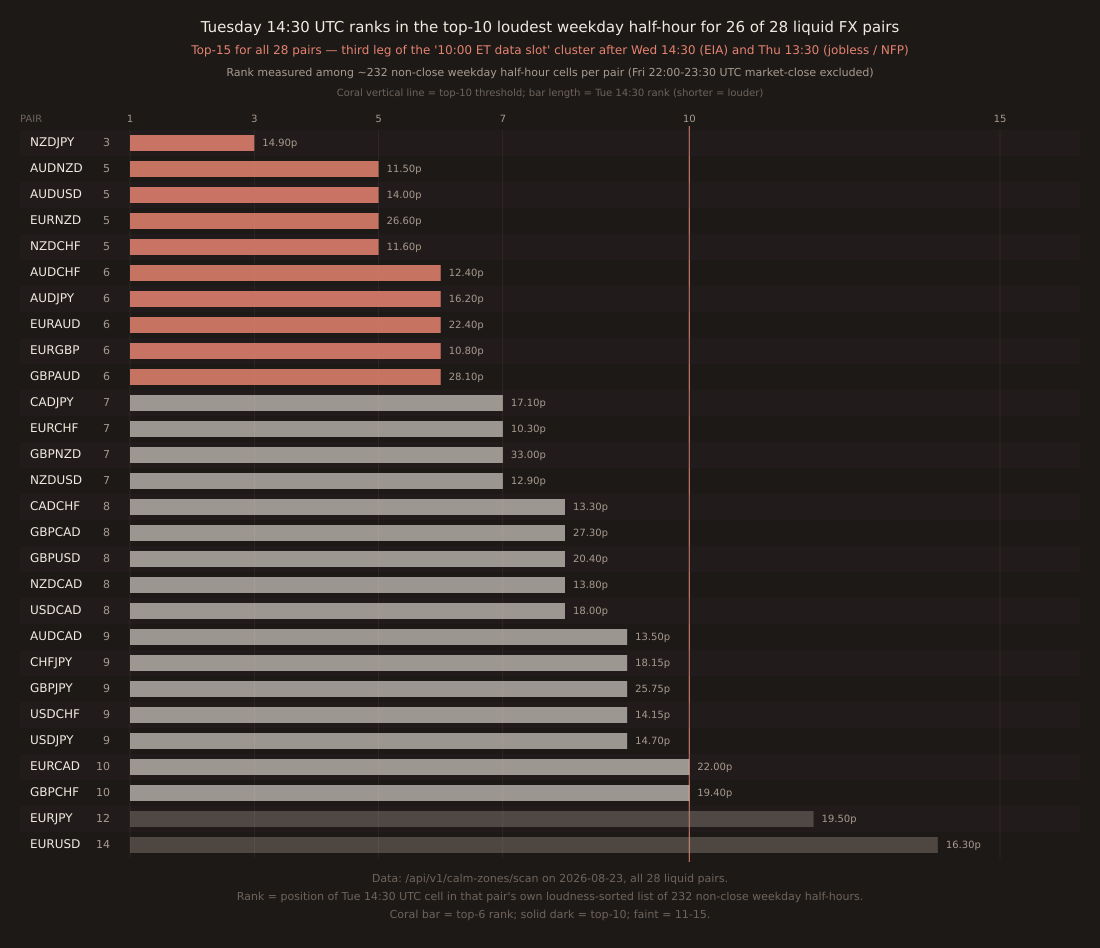
Tuesday 14:30 UTC is a top-10 loudest weekday half-hour for 26 of 28 liquid FX pairs — the third '10:00 ET US data' cluster after Wed EIA and Thu jobless claims
Tuesday 14:30 UTC — the standard US 10:00 ET data slot for Consumer Confidence, S&P/Case-Shiller, JOLTS, Chicago PMI, and a rotating menu of Fed regional-president speakers — ranks in the top-10 loudest weekday half-hour for 26 of 28 liquid FX pairs, and top-15 for all 28. No single release dominates; the loudness is a genuine menu effect aggregated over ~200 Tuesdays in the sample.
This is the third US 10:00 ET weekday cell to get its own dedicated Insights post, after Wed 14:30 UTC (EIA petroleum) on 2026-08-11 and Thu 13:30 UTC (jobless claims) on 2026-08-09.
The three US 10:00 ET weekday clusters
The 09:30-10:30 ET window (13:30-14:30 UTC winter, 12:30-13:30 UTC summer — coverage-averaged to 13:30-14:30 UTC in the Calm Zones scan) hosts the bulk of US secondary data. Aligning the three known cluster posts on their common structure:
| Cell | Anchor release | Top-6 pairs | Top-10 pairs | Ledger post |
|---|---|---|---|---|
| Tue 14:30 | rotating menu (Consumer Conf, JOLTS, Case-Shiller, Chicago PMI, Fed speakers) | 10/28 | 26/28 | today |
| Wed 14:30 | EIA petroleum inventories (single dominant release) | 14/28 | 25/28 | 2026-08-14 |
| Thu 13:30 | jobless claims + monthly rotator (GDP, durable goods, PPI) | — | — | 2026-08-09 (loudest for 9/28) |
Different cluster shapes: Wed has more pairs in top-6 (14 vs Tue’s 10) because EIA petroleum is a single loud release; Tue has more in top-10 (26 vs Wed’s 25) because the menu effect touches more pairs even though it doesn’t peak as hard. Thu 13:30 is the loudest single cell for 9 pairs across the whole week — a different pattern (peak dominance, not menu breadth).
The two outliers: EURJPY (12) and EURUSD (14)
EURJPY and EURUSD both fall outside the top-10 — the only two pairs in the set to do so. Both are the flagship EUR pairs, and both have their loudest weekday cells clustered around Thursday (ECB decision hour + US jobless claims) rather than Tuesday.
EURJPY: rank 12 for Tue 14:30 UTC at 19.50p. Its top-3 cells are Thu 13:30 (22.50p), Fri 13:30 (21.30p), Thu 12:30 (21.00p) — all Thursday/Friday US and ECB slots.
EURUSD: rank 14 for Tue 14:30 UTC at 16.30p. Its top-3 cells are Thu 13:30 (19.40p), Thu 14:00 (19.30p), Thu 12:30 (19.20p) — an even more Thursday-concentrated pattern.
Both pairs are still within their top-15, so the Tue 14:30 cluster isn’t absent from EUR flagship pairs — it’s just below the extra-tight top-10 that the other 26 pairs hit.
Why this matters for the pair-timing decision
The Calm Zones tool exposes typical-range-by-cell so a trader can pick less-noisy entry windows. The corollary is that top-10-loud cells are windows where a wider-than-usual stop is prudent and where discretionary entries carry above-baseline noise risk. Adding Tuesday 14:30 UTC to the “handle with care” list means that all three weekdays (Tue, Wed, Thu) in the 13:30-14:30 UTC window have a well-documented loudness bump for essentially every liquid pair — the market’s intra-week rhythm is more 3-day-US-macro-window than 1-day-NFP-hour.
Reference for the outer bounds: EURUSD’s peak-to-quiet ratio is 4.97x per the 2026-08-07 pair-loudest-quietest-ratio post. A top-10-loud Tue 14:30 UTC cell is roughly 3-4x wider than the same pair’s Monday morning quiet cells.
Verification note
All numbers verified against live /api/v1/calm-zones/scanon 2026-08-23 for all 28 liquid pairs. Rank is measured against the pair’s own ~232-cell weekday distribution (48 half-hours × 5 weekdays, excluding the Fri 22:00-23:30 UTC market-close cluster which prints ~0 range as a mechanical broker-session-boundary artifact). Chart generated via a one-off TypeScript script reusing scripts/insights-charts/svg.ts and theme.ts primitives with sharp rasterization; not committed under scripts/ since the ranking-bar layout is single-use for this post.