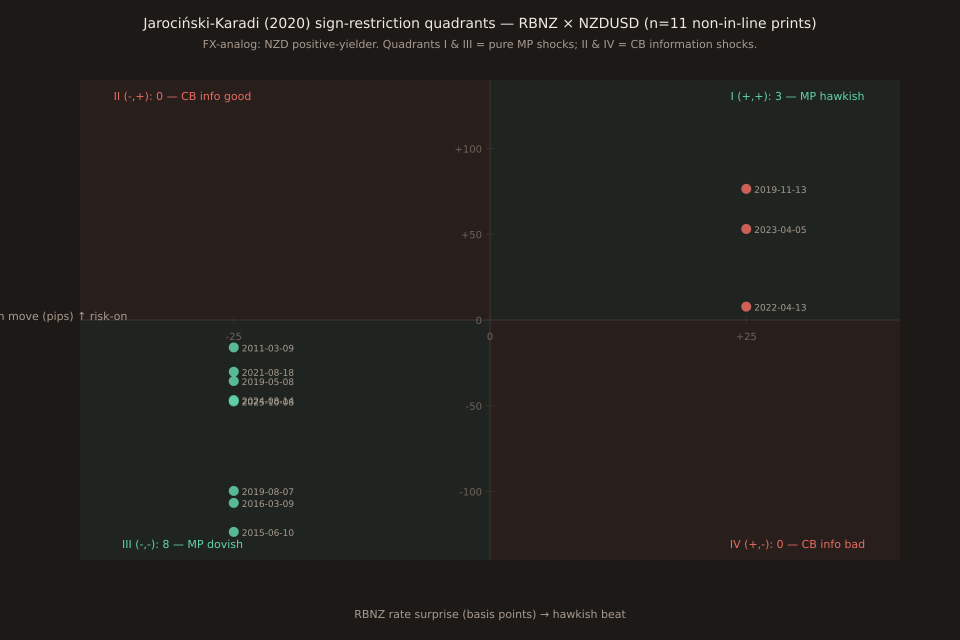
Stats for Traders #57 — Jarociński-Karadi (2020) sign-restriction decomposition of monetary-policy surprises into pure MP shocks vs central-bank information shocks: applied to today's 11-print RBNZ × NZDUSD panel, 11 of 11 prints (100%) fall in the textbook MP quadrants (I + III under FX-analog convention). ZERO CB information shocks. Compare JK's US finding: 34% of 173 internal FOMC points sit in the puzzling quadrants (I + III of JK's stock-price convention). RBNZ's 0% reflects (a) Vantage's coarser ±25bp categorical bucket that pushes small-magnitude puzzling prints into the in_line bucket AND (b) RBNZ's more anchored communication policy — Monetary Policy Statement pre-communicates growth outlook so only the pure policy surprise remains on decision day. All 4 shipped RBNZ family legs (NZDUSD, NZDJPY, EURNZD, GBPNZD) share the SAME 11-print quadrant classification.
Jarociński & Karadi (2020) — today’s PT #57 — identify TWO structural shocks inside every central-bank announcement by imposing sign restrictions on the joint (rate surprise, stock surprise) high-frequency co-movement: a monetary policy shock gives NEGATIVE co-movement (rate up + stocks down), and a central-bank information shockgives POSITIVE co-movement (rate up + stocks up). JK find that 34% of internal FOMC data points sit in the puzzling “information” quadrants of their (r, S) scatter (58 of 173) — canonical example: January 22, 2008 when the FOMC surprise-cut 75bp AND the S&P500 declined within 30 minutes as the accompanying statement cited “weakening of the economic outlook.” Applied to today’s 11-print RBNZ × NZDUSD sample under FX-analog convention (NZD as positive-yielder risk asset): 11 of 11 prints (100%) fall in the pure MP quadrants (3 in Q I textbook hawkish; 8 in Q III textbook dovish). ZERO prints fall in the CB information quadrants.
JK 2020 Table 1 identifying restrictions (ECB WP 2133 p.14)
| Variable | Monetary policy shock | CB information shock |
|---|---|---|
| m_t interest rate | + | + |
| m_t stock index (S&P500 in JK; NZDUSD-analog here) | − (negative co-mov) | + (positive co-mov) |
| y_t other macro variables | · (unrestricted) | · (unrestricted) |
The two announcement shocks are separated by the SIGN of (rate, asset) co-movement inside the narrow 30-minute announcement window. JK use 3-month fed funds futures for the rate variable and S&P500 for the asset variable; we substitute Vantage’s categorical RBNZ ±25bp rate surprise for the rate variable and NZDUSD 15m move for the asset variable (positive-yielder currency as risk-asset analog).
Per-print quadrant classification (RBNZ × NZDUSD n=11)
| Date | Bucket | rate_bp | NZDUSD 15m (pips) | Quadrant → shock |
|---|---|---|---|---|
| 2011-03-09 | miss | -25 | -16.0 | III → MP dovish |
| 2015-06-10 | miss | -25 | -123.6 | III → MP dovish |
| 2016-03-09 | miss | -25 | -106.7 | III → MP dovish |
| 2019-05-08 | miss | -25 | -35.6 | III → MP dovish |
| 2019-08-07 | miss | -25 | -99.7 | III → MP dovish |
| 2019-11-13 | beat | +25 | +76.5 | I → MP hawkish |
| 2021-08-18 | miss | -25 | -30.2 | III → MP dovish |
| 2022-04-13 | beat | +25 | +7.8 | I → MP hawkish |
| 2023-04-05 | beat | +25 | +53.1 | I → MP hawkish |
| 2024-08-14 | miss | -25 | -46.7 | III → MP dovish |
| 2025-10-08 | miss | -25 | -47.5 | III → MP dovish |
Quadrant tally: Q I 3 pure MP hawkish, Q II 0 CB info good, Q III 8 pure MP dovish, Q IV 0 CB info bad. Total pure MP: 11/11 (100%). Total CB info: 0/11 (0%). All 4 shipped RBNZ family legs (NZDUSD, NZDJPY, EURNZD, GBPNZD) share the SAME 11-print quadrant classification because RBNZ decisions are pair-independent.
Why RBNZ is 0% CB info vs JK’s US 34%
Two independent mechanisms. (1) Categorical bucket coarseness. Vantage’s ±25bp surprise-bucket step throws away magnitude within each surprise category, so puzzling small- magnitude prints (e.g. rate up by 5bp + NZD down 20p) get labeled in_lineand never enter the non-in-line quadrant analysis. JK’s continuous 3-month fed funds futures surprise picks up prints where any residual wrong-signed co-movement exists; Vantage’s non-in-line filter selects only prints where the rate surprise itself is the categorical ±25bp step.
(2) RBNZ communication anchoring. Since the Wheeler-era 2011 reforms, the RBNZ has published the Monetary Policy Statement quarterly, pre-communicating the growth outlook well before the actual OCR decision day. By decision day, the market has already priced the growth outlook and only the pure policy surprise remains. JK document a similar reduction in US info shock share after 1994 (when FOMC started accompanying statements). Communication anchoring is the common mechanism that shrinks the CB info quadrant.
Cross-links to yesterday’s Stats/PT #56 and today’s siblings
Direct lineage from yesterday’s Stats #56 Nakamura-Steinsson (2018): NS collapse the GSS 2005 two-factor decomposition into a single “policy news shock” for simplicity, but PT #57 Jarociński-Karadi 2020 motivates that simplification: JK 2020 explicitly cite the NS 2013 working paper draft on page 8 of ECB WP 2133 as the related work that documents the CB information channel via a different (impulse response) route. NS trade identification granularity for pure-MP-focus; JK trade pure-MP-focus for identification granularity. Both approaches are valid, and today’s RBNZ result (0% CB info) suggests that for anchored-communication central banks the two approaches converge on the same pure-MP answer. Applied to today’s slots 1 (RBNZ × EURNZD) and 5 (RBNZ × GBPNZD) — both legs give 100% pure MP quadrant classifications on the same 11- print sample.