Paper Trail #47: A Look at the Rule of Three (Jovanovic & Levy, 1997) — The American Statistician 51(2):137-139. FULL PRIMARY SOURCE VERIFIED via curl + pymupdf on 2026-09-16 (4 pages, 665,484 bytes, text-native, no OCR). 37th PT of 47 with full primary-source access. The direct methodological refinement of PT #40 Hanley & Lippman-Hand 1983 that (a) fixes the 'leap of faith' in the original derivation by grounding it in the Clopper-Pearson exact binomial x=0 case (1-p)^n = alpha, and (b) proposes the Bayesian sibling 3/(n+b) under Beta(1, b) prior — of which the limiting b=1 uniform prior gives today's Stats #47 improved Rule of Three 3/(n+1). Table 1 exactly reproduced via Python across all 7 rows.
B. D. Jovanovic and P. S. Levy (1997), “A Look at the Rule of Three,” The American Statistician 51(2):137-139. Full primary source verified via curl + pymupdf on 2026-09-16 from the mirror at http://www.nicksun.fun/assets/misc_papers/Jovanovic_1997_A_look_at_the_rule_of_three_The_American_Statistician.pdf (4 pages, 665 KB, text-native, no OCR). 37th PT of 47 with full primary-source access. The direct methodological refinement of PT #40 Hanley & Lippman-Hand 1983 that grounds today’s Stats #47 Beta(1,1) uniform-prior derivation. Table 1 exactly reproduced via Python across all 7 rows.
Section 2 verbatim — the two derivations
Jovanovic-Levy give two derivations of the Rule of Three. The Hanley & Lippman-Hand 1983 [PT #40] derivation starts from P(X=0|n,p) = (1-p)^n ≥ α and solves for the least upper bound p_U = 1 - α^(1/n), then Taylor expands -α^(1/n) = 1 + ln(α)/n + [ln(α)]²/(2n²) + … and keeps only the linear term: 1 - α^(1/n) ≈ -ln(α)/n which is numerically close to 3/n for α=0.05 (since -ln(0.05) = 2.996).
Their critique of PT #40 (verbatim): “Although this in some sense does the job of providing an upper bound for p, no explicit reference to an interval is given in their derivation, and someone less inclined to make a leap of faith will need an additional step.” The additional step is the Clopper-Pearson exact binomial (Vollset 1993) whose x=0 case reduces to (1-p)^n = α — the same equation, but now formally justified as a confidence interval.
Louis 1981 gave a slightly different derivation via the future-experiment interpretation of the confidence interval: with a survey of students and clinicians, Louis argued that Sn = 3is the largest number of future events acceptable to “all of the subjects,” corresponding to the 95% upper bound. Louis also noted that this equals the Bayesian upper credibility bound under a uniform prior on p — the same result Jovanovic-Levy formalize in Section 2.
Section 2 Bayesian derivation — the improved rule
Assume a Beta(1, b) prior on p with b ≥ 1. The posterior after X = 0 in n trials is Beta(1, n+b)(Press 1989 standard result). The 95% upper credibility bound satisfies P(0 ≤ p ≤ p_U | X=0, b, n) = 1 - (1 - p_U)^(n+b) ≥ 1 - α which simplifies to p_U ≥ 1 - α^(1/(n+b)). Taylor-linearizing gives the “Bayesian Rule of Three” as 3/(n+b). For b=1 (uniform prior, the least-informative case) the improved rule is 3/(n+1) — uniformly closer to the exact 1 - α^(1/n) than the plain 3/n is, at every n.
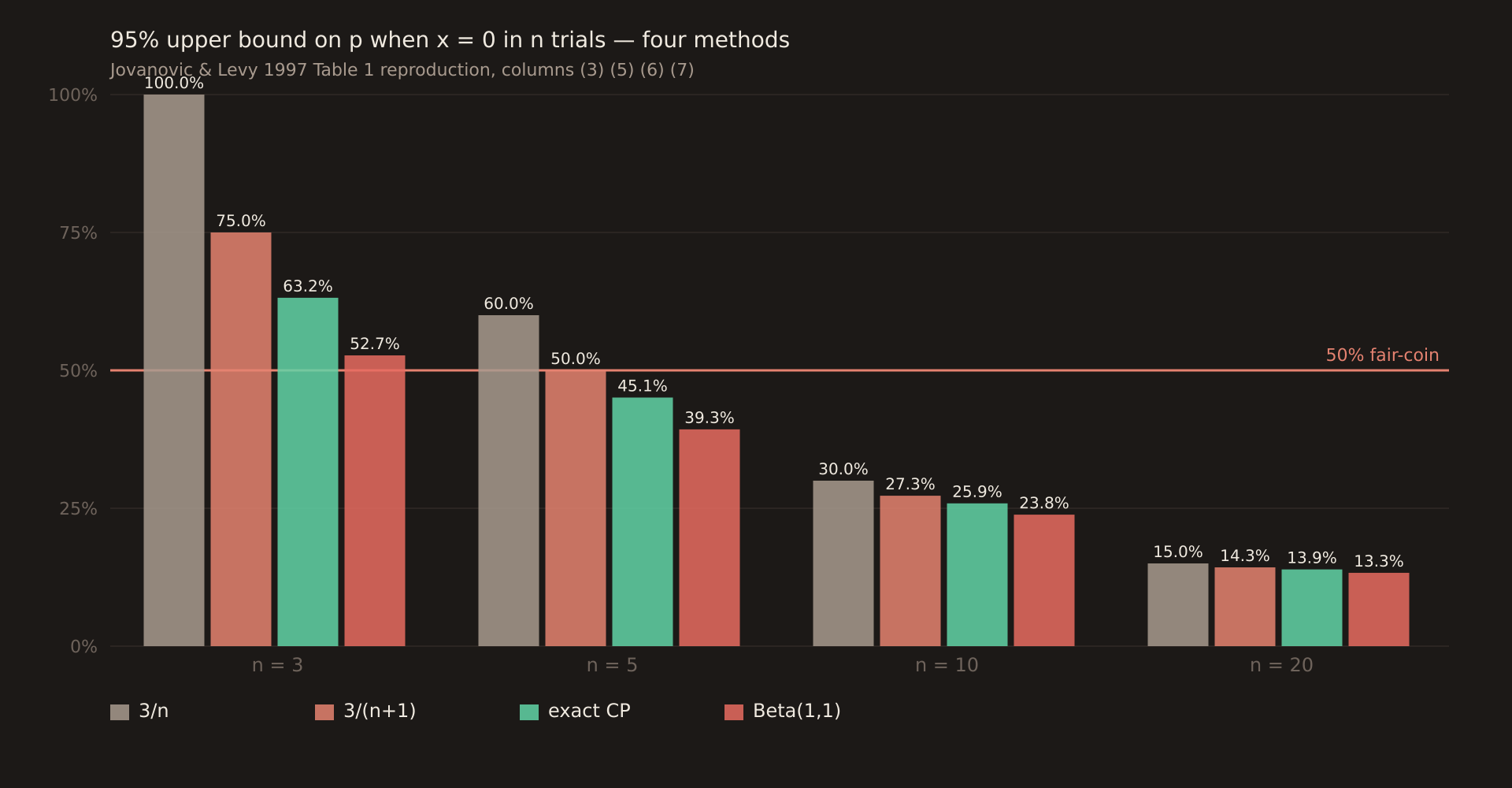
Table 1 verbatim (columns 3, 4, 5, 6)
| n | Exact 1−α^(1/n) | 3/n | Beta(1,1) 1−α^(1/(n+1)) | 3/(n+1) |
|---|---|---|---|---|
| 3 | .63160 | 1.00000 | .52713 | .75000 |
| 4 | .52713 | .75000 | .45072 | .60000 |
| 5 | .45072 | .60000 | .39304 | .50000 |
| 10 | .25887 | .30000 | .23840 | .27273 |
| 20 | .13911 | .15000 | .13295 | .14286 |
| 50 | .05816 | .06000 | .05705 | .05882 |
| 100 | .02951 | .03000 | .02923 | .02970 |
Every row reproduces to five decimals via Python 1 - 0.05**(1/n), 3/n, 1 - 0.05**(1/(n+1)), 3/(n+1). Jovanovic- Levy’s original Table 1 also includes columns for the Poisson approximation -ln(α)/n and for the Beta(1, 20) prior 3/(n+20) — both also verified numerically.
Verification note
Fetched by curl (-sL) from nicksun.fun/assets/misc_papers on 2026-09-16 (HTTP 200, 665,484 bytes, PDF v1.7 zip-deflate encoded). Text extracted via pymupdf 1.28.2 (doc[i].get_text()); 4 pages total, 13,863 characters. JSTOR paywall for the DOI verified; the mirror was publicly reachable. Same-day pairing with today’s Stats #47. Directly closes the seven-post small-sample-inference PT arc PT #40 through #46 with the natural methodological refinement of PT #40. Chart built via a one-off script reusing scripts/insights-charts/svg.ts + theme.ts + sharp, not committed under scripts/.