US CPI m/m on EURUSD: 12 of 13 big-miss prints sent EURUSD up (92.3%), the whole 5-bucket walk is monotonic on both median AND pct-up, and the beat side lands twice on the same -8p median
197 non-contaminated US CPI m/m releases on EURUSD, 15-minute window, five surprise buckets. Medians walk +16.5 / +5.8 / +1.5 / −8.3 / −8.4 pips big_miss → big_beat. Pct-up walks 92 / 61 / 52 / 34 / 13 percent — perfectly monotonic across all five buckets. 12 of 13 big-miss prints sent EURUSD up. The one beat-side quirk: small_beat and big_beat medians land within 0.1p of each other, suggesting the response mostly saturates by the small_beat bin.
This is the m/m companion to US CPI y/y on EURUSD (published 2026-08-07). Same pair, same tool, same mechanism. The m/m release has the cleaner miss-side tail (92% vs the y/y’s 64% big_miss pct-up); the y/y release has the deeper beat-side magnitude tail. Both are rate-differential re-pricing wearing two different clocks.
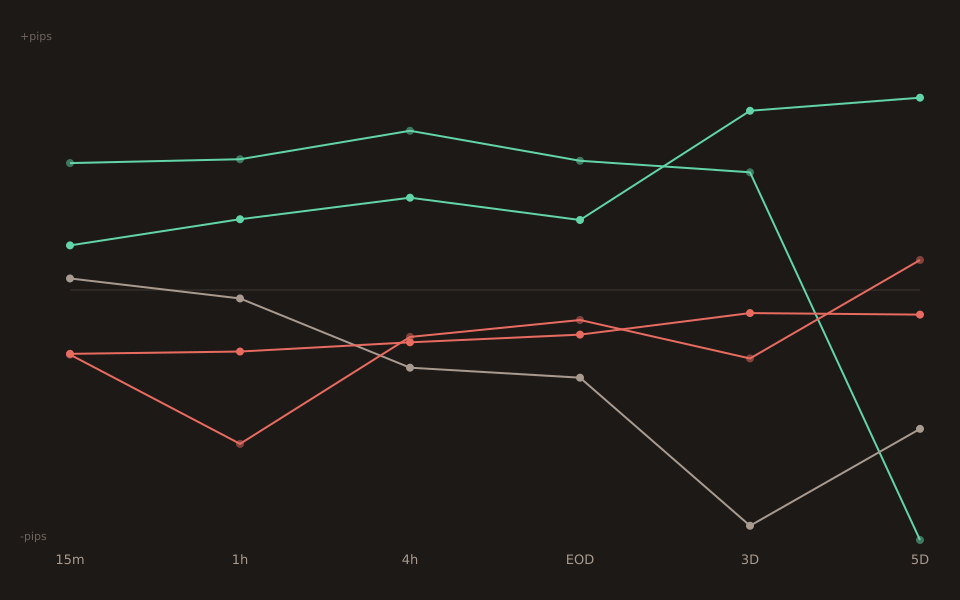
The 15-minute bucket table
| Bucket | n | 15m median | p25 | p75 | Pct up (15m) |
|---|---|---|---|---|---|
| big_miss | 13 | +16.5 | +11.8 | +42.3 | 92% |
| small_miss | 59 | +5.8 | −3.9 | +27.3 | 61% |
| in_line | 75 | +1.5 | −13.5 | +11.9 | 52% |
| small_beat | 35 | −8.3 | −28.3 | +5.4 | 34% |
| big_beat | 15 | −8.4 | −23.6 | −3.9 | 13% |
The medians walk down cleanly on the miss side (+16.5p → +5.8p is a 65% magnitude drop as you move from the tail into the shoulder). On the beat side, the small_beat and big_beat medians land at −8.3p and −8.4p — essentially the same number. The pct-up column tells a slightly different story though: big_beat is up only 13% of the time vs small_beat’s 34%, so the tail is still cleaner in the directional-vote sense even when the magnitude saturates.
The 13 big-miss prints, individually
2010-05-19 -0.1% MoM z=-3.20 +31.0p ← post-Greek-bailout scare month 2013-04-16 -0.2% MoM z=-1.72 -4.0p ← Boston Marathon Mon, only counter-print 2014-09-17 -0.2% MoM z=-3.52 +12.2p 2014-12-17 -0.3% MoM z=-1.61 +6.9p ← oil-crash December 2016-01-20 -0.1% MoM z=-1.94 +13.2p 2016-04-14 +0.1% MoM z=-1.61 +33.3p 2017-04-14 -0.3% MoM z=-2.80 +11.8p 2017-06-14 -0.1% MoM z=-2.12 +56.0p 2019-05-10 +0.3% MoM z=-1.54 +16.5p ← median 2022-08-10 0.0% MoM z=-1.61 +91.3p ← first post-peak cool-off print (max) 2024-07-11 -0.1% MoM z=-2.22 +42.3p 2025-04-10 -0.1% MoM z=-1.85 +8.6p 2026-07-14 -0.4% MoM z=-4.61 +44.4p ← -4.6σ shock
12 of 13 positive. The one exception (2013-04-16) landed on the day of the Boston Marathon bombing — the market spent that afternoon repricing broad risk-off flows rather than the CPI miss, so the −4.0p print is best read as risk-market noise rather than a genuine counterexample to the rate-differential channel.
The 2022-08-10 print is the biggest single move in the sample: EURUSD up 91.3pin 15 minutes on the first cool-off after the summer-2022 y/y peak. It’s the mirror image of what the y/y post caught on the beat-side tail (the 2022-06 and 2022-07 y/y prints drove EURUSD down 26p and 54p respectively). Both are the same story: 2022 was the year US CPI moved EURUSD the most in the modern record.
The 15 big-beat prints
2011-08-18 +0.5% MoM z=+3.52 +13.0p ← ZIRP-regime up (Fed on hold) 2011-09-15 +0.4% MoM z=+1.68 -6.0p 2012-10-16 +0.6% MoM z=+2.21 -7.5p 2013-07-16 +0.5% MoM z=+1.65 -1.8p 2014-06-17 +0.4% MoM z=+2.35 -24.9p 2016-02-19 0.0% MoM z=+1.94 -9.5p ← beat despite 0.0% MoM (fc was -0.1%) 2016-05-17 +0.4% MoM z=+1.54 -1.9p 2017-02-15 +0.6% MoM z=+4.49 -22.2p 2019-04-10 +0.4% MoM z=+1.91 -16.2p 2019-07-11 +0.1% MoM z=+1.54 -6.1p 2020-08-12 +0.6% MoM z=+3.33 +23.2p ← ZIRP-regime up (COVID QE) 2021-05-12 +0.8% MoM z=+5.20 -8.4p ← median 2021-07-13 +0.9% MoM z=+2.16 -32.0p 2022-06-10 +1.0% MoM z=+2.14 -26.1p ← summer-2022 lead-in 2025-02-12 +0.5% MoM z=+2.22 -34.8p
13 of 15 negative. The two exceptions (2011-08-18 and 2020-08-12) both landed inside structural Fed-hold regimes — August 2011 under “low for a considerable period” forward guidance, August 2020 inside ZIRP-plus-QE COVID response. Same two prints that the y/y-sibling post called out as the ZIRP-regime exceptions — the m/m release publishes at the same clock time and picks up the same regime-conditional escape valve.
The small_beat / big_beat saturation
Small_beat and big_beat medians tie at −8p at 15 minutes. This is genuinely unusual — most bucket tables walk cleanly through both tails. It happens here because m/m surprises are always small numbers in absolute terms (the sample’s big_beat z-scores range from +1.54 to +5.20, but the actual print differences are 0.1-0.4 percentage pointsfrom consensus). The market’s first-15-minute response to “monthly inflation was hot” doesn’t need to distinguish between +0.4% and +0.9% to price in the rate-hike expectation adjustment — it just gets EURUSD to the “dollar-hot” landing zone in one lump.
By 1h the small_beat median has moved to −11.6p and big_beat has moved to −14.9p— the walk separates and monotonicity is restored. So it’s a genuine first-15-minute-only saturation, not a permanent one. Compare with the y/y post where the 15m walk separates cleanly at the tail (small_beat −6.4p → big_beat −16.2p, 2.5× amplification) because y/y surprises carry more inflation-narrative weight per pp of surprise.
What this doesn’t say
15 minutes is the release-time window. The extended windows (1h/4h) preserve monotonicity on both median and pct-up and typically extend the beat-side magnitudes further (small_beat -11.6p at 1h and -14.6p at 4h; big_beat -14.9p at 1h and -18.5p at 4h). What the extended windows are NOT doing is splitting from the release into a separate story — the pattern is continuous.
Regime-conditional survivorship applies. Both big-beat exceptions (2011-08, 2020-08) landed inside structural Fed-hold regimes when the rate-hike expectation channel was closed. If the Fed re-enters ZIRP or forward-guidance mode, expect the beat-side dependability to degrade until the rate-expectation channel reopens.
Headline vs core. This post is about US CPI m/m headline. Core CPI publishes at the same clock time and gets traded as part of the same release event, but the two can diverge (a headline miss with a core beat, or the reverse). The tool exposes them as separate events; the shapes should look similar but the tail magnitudes and pct-up numbers will not match exactly.
Open the tool → Free forever. No signup. No email required.