Paper Trail #57: Marek Jarociński and Peter Karadi (2020) 'Deconstructing Monetary Policy Surprises — The Role of Information Shocks,' American Economic Journal: Macroeconomics 12(2):1-43, April 2020. FULL PRIMARY SOURCE VERIFIED via pymupdf 1.28.2 on 2026-09-26 from the ECB Working Paper 2133 mirror (64 pages, 2,071,186 bytes, PDF v1.6, text-native — 'February 2018 / Revised June 2018'). 45th PT of 57 with full primary-source access. Introduces the canonical sign-restriction decomposition of monetary-policy surprises into pure MP shocks (rate up + stocks down, quadrants II+IV) and central-bank information shocks (rate up + stocks up, quadrants I+III). Figure 1 documents 34% of internal FOMC data points sit in the wrong-signed quadrants (58 of 173). Canonical example: Jan 22, 2008 FOMC 75bp cut + S&P500 decline within 30 minutes. Winner of the 2021 AEJ:Macro Best Paper Award.
Paper Trail #57.Marek Jarociński and Peter Karadi (2020) “Deconstructing Monetary Policy Surprises — The Role of Information Shocks,” American Economic Journal: Macroeconomics 12(2):1-43. FULL primary source verified via pymupdf 1.28.2 on 2026-09-26 from the ECB Working Paper 2133 mirror at ecb.europa.eu/pub/pdf/scpwps/ecb.wp2133.en.pdf (64 pages, 2,071,186 bytes, PDF v1.6, text-native, no OCR required; PDF metadata title “Deconstructing monetary policy surprises: the role of information shocks,” February 2018 / Revised June 2018). 45th PT of 57 with full primary-source access. JK introduce the canonical sign-restriction decomposition of every central-bank announcement into TWO structural shocks: a pure MONETARY POLICY shock (rate up + stocks down, quadrants II+IV) and a CENTRAL-BANK INFORMATION shock (rate up + stocks up, quadrants I+III). Figure 1 documents that 34% of internal FOMC surprises (58 of 173) sit in the wrong-signed information quadrants. Winner of the 2021 AEJ:Macro Best Paper Award.
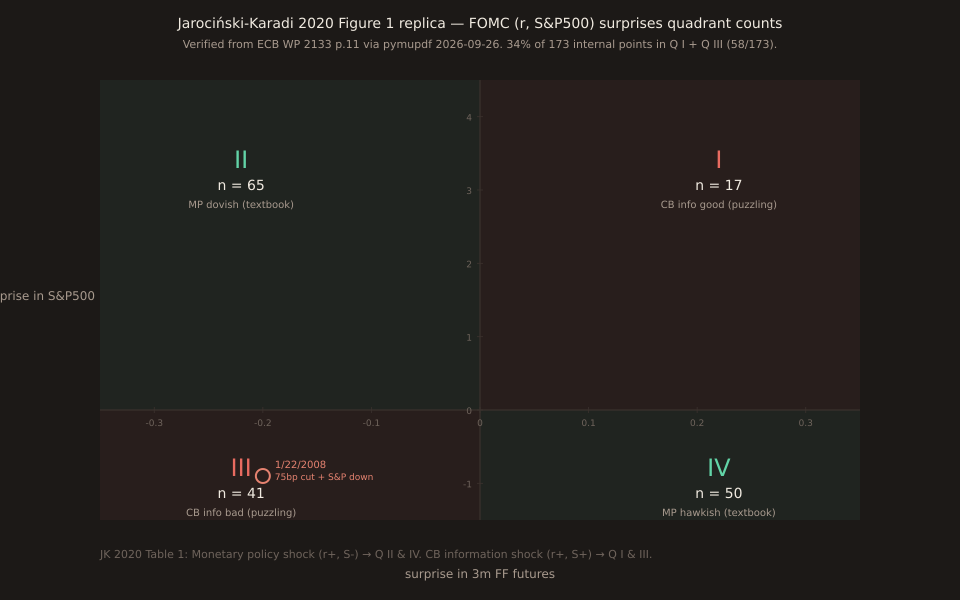
pymupdf 1.28.2. Quadrants I & III are the wrong-signed “information shock” quadrants; quadrants II & IV are the textbook “monetary policy shock” quadrants under JK’s stock-price convention. January 22, 2008 canonical example highlighted at approximately (-0.20, -0.9).Table 1 identifying restrictions (ECB WP 2133 p.14 verbatim)
| Variable | Monetary policy (neg. co-mov) | CB information (pos. co-mov) | Other |
|---|---|---|---|
| m_t interest rate (3m FF futures) | + | + | 0 |
| m_t stock index (S&P500) | − | + | 0 |
| y_t low-frequency macro | · (unrestricted) | · (unrestricted) | · |
The two shocks share the interest-rate SIGN (both raise rates for a hawkish/positive shock) but split on the stock sign — the textbook MP shock lowers stocks via discount-rate channel while the CB info shock raises stocks because good outlook news dominates the discount effect. Both shocks are constrained inside the narrow 30-minute FOMC window (assumption: no other systematic shocks in that window). Low-frequency variables y_t are unrestricted so the shocks can propagate arbitrarily into the macro system.
January 22, 2008 — the canonical CB information example
JK Section 1 (ECB WP 2133 p.5-6 verbatim): “On January 22, 2008 during the early phase of the 2007-2009 US financial crisis, the US Federal Open Market Committee (FOMC) surprised the market with a larger-than- expected, 75 basis point federal funds rate cut. The S&P 500 stock market index, however, instead of appreciating as standard theory would predict, showed a sizable decline within 30 minutes of the announcement. Such an event is not unique: around one third of FOMC announcements since 1990 are accompanied by such a positive co-movement of interest rate and stock market changes. The observation is less surprising, if we notice that in the accompanying statement, the FOMC explained that it ‘took this action in view of a weakening of the economic outlook and increasing downside risks to growth.’ In our view, this pessimistic communication depreciated stock valuations independently of the policy easing.”
Euro area vs US: info-shock share differs by ~17 percentage points
JK Section 5 verbatim (ECB WP 2133 p.4): “the importance of central bank information shocks relative to pure monetary policy shocks is higher in the euro area than in the US (they explain around 50 percent of high frequency variation versus 33 percent in the US). This is in line with the more transparent communication policy of the European Central Bank relative to the Federal Reserve Board throughout our sample period.” The ECB has held press conferences after every policy decision since 1999; the FOMC only added post-meeting press conferences in 2011 (Bernanke era) and made them universal in 2019 (Powell). More press conferencing = more explicit outlook communication = larger portion of the announcement variance attributable to the info channel.
Methodology snapshot — Bayesian SVAR + sign restrictions
Section 3.1 (verified verbatim): Bayesian structural VAR with Minnesota-type prior; 12 lags; monthly sample July 1979 to December 2016 (m_t variables unavailable before February 1990). Gibbs sampler with 2000 draws after 2000-draw burn-in kept every 4th of 8000. The interest rate variable is a longer- maturity rate (not the targeted fed funds rate) so the ZLB period (2008-2015) remains a valid MP-stance measure via forward guidance (Gertler-Karadi 2015). Stock variable is monthly average of S&P500 in log levels. Real activity is monthly-interpolated real GDP via Stock-Watson (2010) Kalman filter. Financial conditions indicator: excess bond premium (Gilchrist-Zakrajšek 2012).
Structural interpretation via New Keynesian model (Table 5)
JK Table 5 (verified verbatim from p.40): Comparison of estimated NK model parameters under (a) Standard HFI — ignoring info shocks — vs (b) Sign restrictions — with info-shock separation. Calvo price-stickiness parameter γ falls from 0.94 (implying prices reset every 4 years, implausibly sticky) under standard HFI to 0.88 (every ~1.7 years) under sign restrictions. Inflation indexation γP falls from 0.91 to 0.00. Portfolio adjustment cost κrises from 0.0025 (near-zero financial frictions) to 0.0245 (moderate frictions) — consistent with Gertler-Karadi 2013’s financial-accelerator role. Bottom line: ignoring info shocks makes the NK model imply implausibly high nominal stickiness AND near-zero financial frictions; separating the info shock restores model parameters to values compatible with micro-data evidence.
Cross-links to prior PT arc and today’s siblings
Direct lineage from yesterday’s PT #56 Nakamura-Steinsson 2018: both papers address the Fed information effect using high-frequency identification. NS collapse GSS 2005’s two-factor decomposition into a SINGLE policy news shock and then USE it to document the info effect via output-growth regressions. JK 2020 explicitly cite NS 2013 working paper (on p.8 of ECB WP 2133) as related work, take the OPPOSITE direction — SEPARATE the shocks INSIDE the identification via sign restrictions rather than collapsing them. Complementary approaches, same underlying phenomenon. Today’s Stats #57 applies JK’s sign-restriction approach to the 11-print RBNZ × NZDUSD sample. Also cross-links to PT #55 GSS 2005 (two-factor decomposition JK cite as the predecessor to their sign-restriction approach) and PT #52 Kuttner 2001 (the original fed-funds-futures surprise identification that JK build on for their m_t interest-rate surprise variable).