UK CPI on GBPUSD: the clean directional edge is gone by end of day
196 clean UK CPI releases on GBPUSD, 15 minutes after print. Miss: the pound falls -20 pips at the median, down about 85% of the time. Beat: +8 pips and up 73% of the time. In-line: -0.5 pips, near-random. Textbook. What’s interesting is what the same buckets do six hours later.
This post walks the reaction across all six windows the tool exposes, shows where the directional edge decays, and calls out an asymmetry between the miss and beat sides.
First hour: clean and asymmetric
| Surprise bucket | n | 15m median | Pct up | Whipsaw |
|---|---|---|---|---|
| big_miss | 13 | -19.9 | 15% | 31% |
| small_miss | 47 | -20.5 | 13% | 17% |
| in_line | 68 | -0.5 | 50% | 28% |
| small_beat | 52 | +8.0 | 73% | 31% |
| big_beat | 16 | +8.4 | 81% | 19% |
Miss buckets sit at -20 pips either side of the threshold. Beat buckets sit at +8 pips. That’s a magnitude asymmetry of about 2.5xin the miss direction — the pound sells off harder on a soft CPI than it rallies on a hot one. This is the standard shape you see across G10 CPI: the market already has a hot-inflation risk premium priced in, so a beat just confirms what’s expected, whereas a miss removes it.
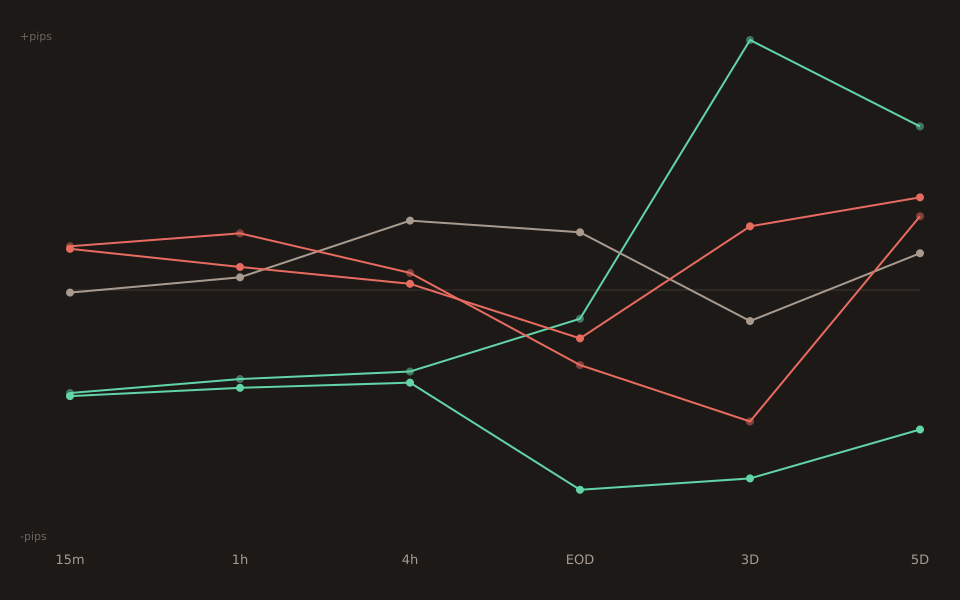
The 1h column of the tool tells basically the same story: big_miss -17p, small_miss -19p, in_line +2p, small_beat +5p, big_beat +11p. Direction preserved everywhere, magnitudes close to 15m. If you traded the first hour of a UK CPI print on GBPUSD, this is the distribution you drew from.
By end of day the signal is gone
The tool exposes six windows for a reason: it’s the same release measured at different time horizons, and the horizon matters a lot. Here’s the same five buckets across all six.
| Bucket | 15m | 1h | 4h | EOD | 3D | 5D |
|---|---|---|---|---|---|---|
| big_miss | -19.9 | -17.2 | -15.7 | -5.6 | +48.3 | +31.6 |
| small_miss | -20.5 | -18.9 | -17.9 | -38.6 | -36.4 | -26.9 |
| in_line | -0.5 | +2.5 | +13.4 | +11.2 | -6.0 | +7.1 |
| small_beat | +8.0 | +4.5 | +1.2 | -9.3 | +12.3 | +17.9 |
| big_beat | +8.4 | +11.0 | +3.3 | -14.5 | -25.4 | +14.3 |
The EOD column is where the picture breaks. big_beat has flipped from +8 pips at 15m to -14 pips by end of day. big_miss has recovered three-quarters of its move (-20p down to -6p). Only the small_missbucket actually widens over the day. The 3D and 5D columns are pure noise — the buckets don’t order themselves, and the big_miss median actually swings +48 pips positive by day three.
The mechanism isn’t mysterious. UK CPI publishes at 07:00 UK time— before New York opens. The London hedge-fund reaction is the whole 15-minute-and-first-hour move. Through the rest of the London session and once New York wakes up, dollar-side flows (US CPI, Fed pricing, general risk sentiment) overwhelm the CPI signal. By the New York close you’re looking at the residue of a lot of other things.
What this doesn’t say
It doesn’t say the reaction never persists. These are medians across 196 releases. Individual prints do drift with the initial move, or against it, or wander around all day. The 2025-12-17 big_miss print (actual 3.2% vs consensus 3.5%, z-score -2.02) moved GBPUSD -30 pips in the first 15 minutes, well past the -20pbig_miss median. Where it went from there depended on that afternoon’s other flows.
It doesn’t say small samples are precise. The tail buckets are n=13 (big_miss) and n=16 (big_beat). The direction of the story is robust because the neighboring small_miss and small_beat buckets (both n≈50) confirm it, but the ±20 pip magnitude on the tails is not a physical constant. The -39 pip small_miss EOD figure I called out is n=35 — closer to reliable than the tails but still worth treating as indicative, not decisive.
It doesn’t say beat direction is real at all horizons. The whole beat side of the table sits inside ±15 pips across every window. The clean directional story is really a story about miss-side reactions in the first hour, plus a modest beat-side reaction that decays into nothing.
How to use this
Two things follow from this shape.
First, if you take a directional CPI trade on GBPUSD, put a time stop on it. The evidence for a durable directional edge past the first hour is thin — for beats, it’s gone by the London afternoon; for misses, it survives longer but not to the New York close. A position sized for a 15-minute or 1-hour horizon should exit on that horizon.
Second, when you plan a stop, size it against the p25/p75 range in the tool for the bucket you’re targeting, not against the median. For the big_miss 15m bucket that range is roughly -38 to -7 pips. A stop tighter than 15 pips is inside the noise of a favorable outcome; a stop wide enough to contain the full middle-half band has to be at least 30 pips wide.
Open the tool → Free forever. No signup. No email required.