US ISM Manufacturing PMI on USDJPY: 0 of 12 big-miss prints had the dollar higher an hour later
196 US ISM Manufacturing PMI releases on USDJPY since 2010. The 15-minute median move goes cleanly from -23.6 pips on a big miss to +14.0 pips on a big beat, with every bucket in between sitting in the correct order. Pct-up climbs monotonically from 8% to 90% across the same buckets. And the big-miss unanimity gets sharper at one hour: 0 of 12 big-miss prints had USDJPY higher than baseline one hour later.
Textbook shape, clean sample, and — unlike some of the other “clean at 15m, gone by EOD” events on the tool — this one holds its direction all the way to end of day.
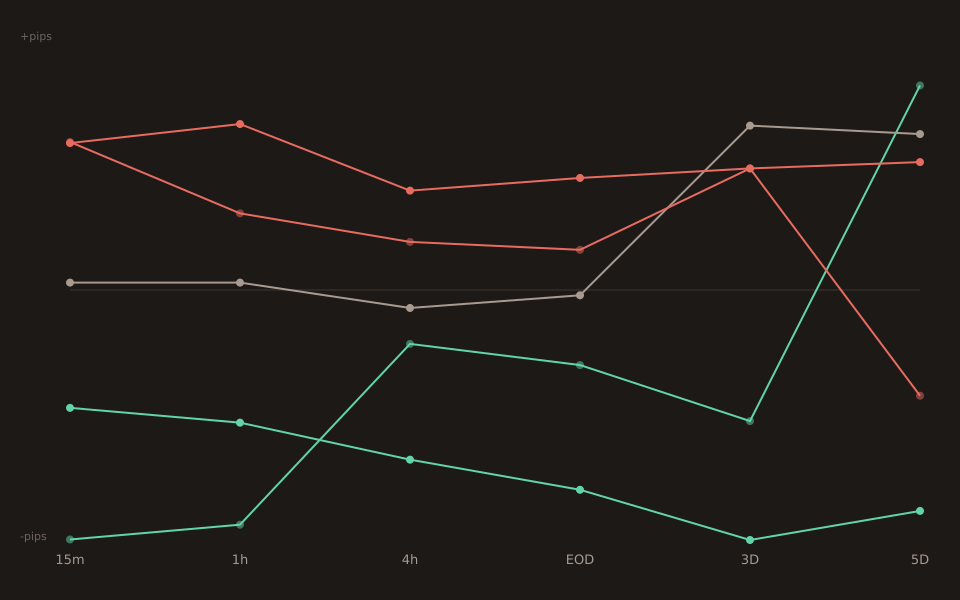
The bucket table
| Bucket | n | 15m median | 1h median | EOD median | Pct up (15m) | Pct up (1h) |
|---|---|---|---|---|---|---|
| big_miss | 12 | −23.6 | −22.2 | −7.1 | 8% | 0% |
| small_miss | 46 | −11.2 | −12.5 | −18.9 | 20% | 37% |
| in_line | 77 | +0.7 | +0.7 | −0.5 | 53% | 51% |
| small_beat | 41 | +13.9 | +15.7 | +10.6 | 76% | 73% |
| big_beat | 20 | +14.0 | +7.3 | +3.8 | 90% | 65% |
Two things worth staring at. First, the pct-up (1h) column: 0% at big_miss and 65-73% at the two beat buckets. Direction is not just leaning one way — it is, for big misses in this sample, a literal 0-of-12. Second, the 15m whipsaw column (not shown for space): small_beat and big_beat both print 15%, the two lowest whipsaw readings in the table. When the ISM prints strong, USDJPY moves up and doesn’t often bounce down first.
Why USDJPY moves cleanly on this
A US growth surprise pulls two levers that both weigh on USDJPY in the same direction. First is the direct FX channel: hot US number → stronger dollar. Second is the yield-differential channel: hot US number → higher Treasury yields → wider Treasury-JGB spread → USDJPY carry advantage widens. On EURUSD or GBPUSD only the first channel is active, and it’s often being pushed against by whatever EUR or GBP is doing on the day. On USDJPY the two channels reinforce, which is why the bucket ordering here is much cleaner than on the same event against European crosses.
The big-beat fade
The one broken pattern worth mentioning: big_beat starts at +14.0 pips at 15 minutes but drops to +7.3 at 1 hour and +3.8 at EOD. Compare to small_beat, which holds +10-15 pipsacross every window. A likely mechanical read: big beats spike the pair harder on impact, but the spike attracts profit-taking and the pair gives some of it back over the next few hours. Small beats don’t overshoot enough to trigger the fade.
This isn’t a directional signal to trade against — the median is still upat every window on the beat side — but if you’re holding a long into a big beat you should expect some bleed after the initial move, not more of the same.
What this doesn’t say
It doesn’t say ISM is the biggest USDJPY mover. NFP and CPI produce larger single-print moves. This is the cleanest directionalevent on USDJPY in the tool’s catalogue, not the loudest one.
It doesn’t hold past 3 days. At the 3D and 5D windows, the bucket ordering breaks down (big_miss even flips positive at 5D). By that point the price is driven by everything that happened between the ISM print and the measurement point, which is almost never mostly-about-the-ISM. The 15m through EOD window is where this event lives.
The tail buckets are small. Big_miss n=12 and big_beat n=20 are enough to make the direction-unanimity claim interesting but not enough to precisely peg the median. Trust the signs, be less confident about the exact magnitudes.
Open the tool → Free forever. No signup. No email required.