What actually happens to EURUSD in the 15 minutes after NFP (and the next five days)
Non-Farm Payrolls drops at 8:30 AM New York time on the first Friday of every month. If you trade EURUSD you already know it’s the biggest scheduled event on the calendar. What you probably don’t know, because nobody ever shows you, is what the pair actually does in the fifteen minutes after the number hits.
Not what it “usually” does. Not what some trader on YouTube says it did last month. What it did every time, going back sixteen years.
We ran the numbers on 195NFP releases from 2010 through mid-2026. Every EURUSD 15-minute reaction, sorted by how far the actual print came from what economists forecasted. Here’s what falls out.
The obvious result, and the one nobody talks about
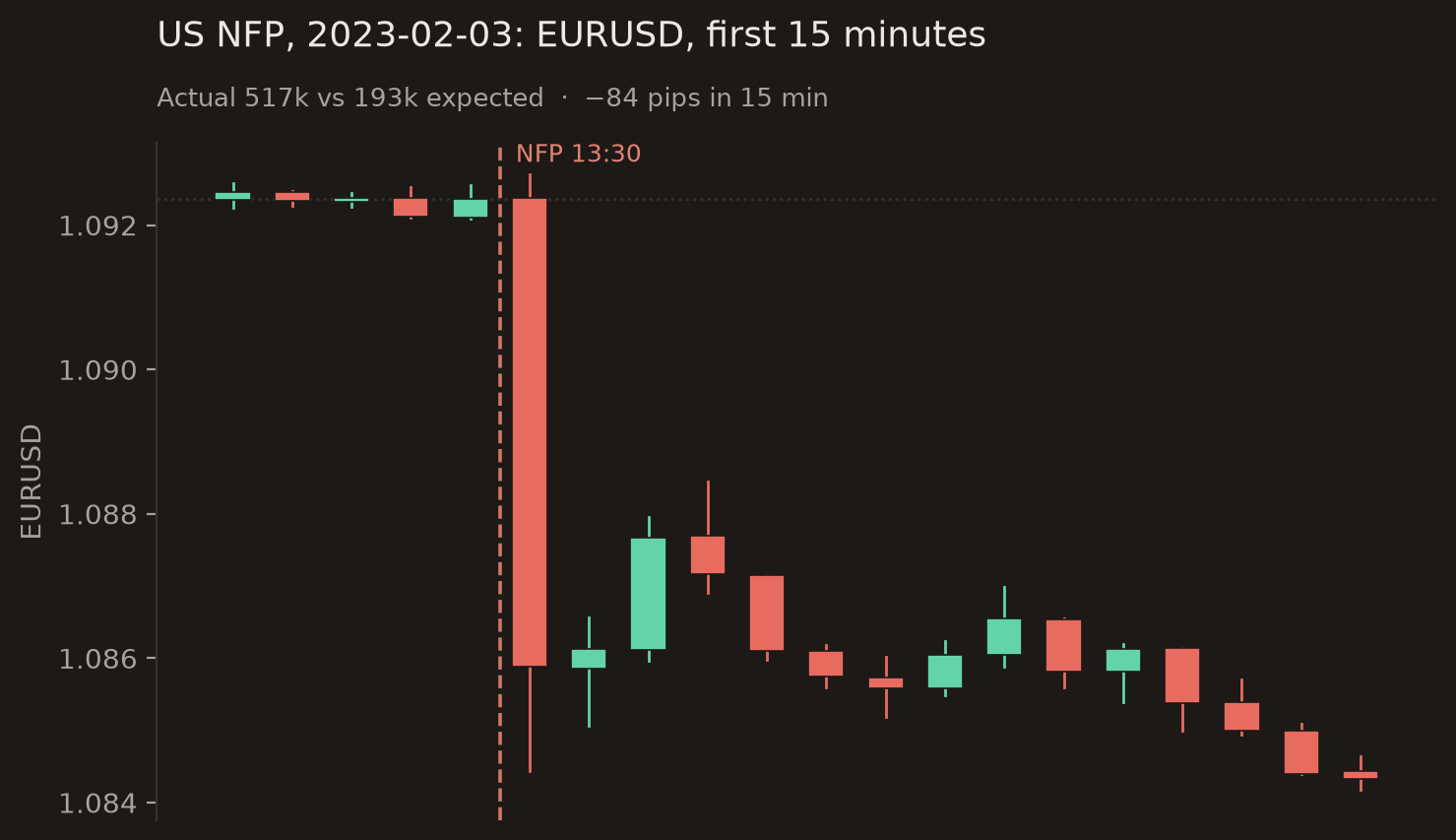
When NFP prints a big beat, economists expected 193k jobs and the actual came in at 517k, EURUSD drops. Median move at 15 minutes: −34.5 pips. Price closes below the release-minute open in 93%of cases. That’s textbook. Strong US jobs, strong dollar, EURUSD down.
Big miss goes the other way. Median +11.6 pips, up-close in 70% of cases.
So far so obvious. If you can predict the surprise you can predict the direction. The problem is you can’t predict the surprise. That’s what makes it a surprise.
Here’s the part nobody talks about. On the 171NFP releases where the print came in “close to consensus,” the median EURUSD 15-minute move was −2 pips. Coin flip. Up 51% of the time, down 49%.
But “median −2 pips” doesn’t mean nothing happens. The individual releases in that middle group still moved around 22 pipseither way. It’s just that the direction cancels out across the sample. You’re not looking at a market that sits still. You’re looking at a market that moves in random directions.
The vast majority of NFP releases are the close-to-consensus ones. Which means the vast majority of the time, “trading NFP” is trading a real move with unpredictable direction.
The whipsaw problem
There’s a second thing the numbers surface. Even in the big-beat and big-miss cases, price often runs against the eventual direction first before reversing. In our data this happens in roughly 25% of decisive NFP reactions.
If you’re stopped tight you get taken out on the fakeout and then watch price go exactly where you thought it would. If you’re stopped wide you’re risking more per trade for the same edge.
This is why “NFP is easy to trade” is one of the most confidently wrong things you’ll hear from an educator. It’s easy to identify. It’s hard to execute.
But 15 minutes isn’t where the real move is
Everything above is about the immediate reaction. Fifteen minutes after the release. That’s what most people talk about when they talk about NFP, and it’s what most educators teach.
It’s also probably not where you actually trade, if you’re honest. Most retail traders on this forum hold for hours or days, not minutes. So the real question is: what happens after the initial spike?
Here’s the same 195 releases, but measured at 1 hour, 4 hours, end of day, and then three and five trading days later.
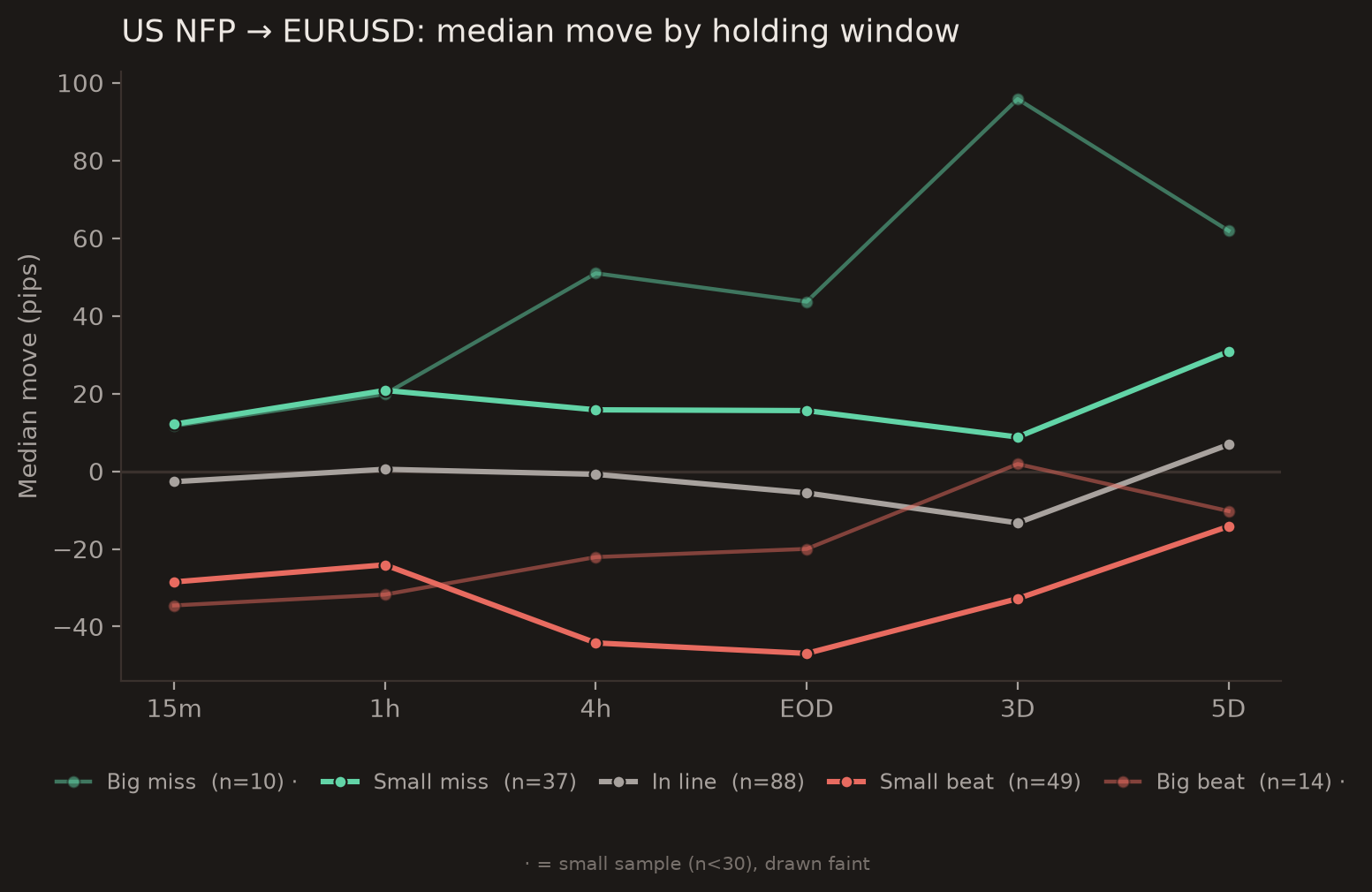
At 1 hour, small-beat NFPs show a −24 pip median on EURUSD. At 4 hours, that grows to −44 pips. By end of day, it’s −47 pips. The move nearly doubles between the one-hour mark and the close.
Then look at what happens over the next few days. At 3 days the small-beat median is back to −33 pips. At 5 days it’s −14 pips. The move is fading. The pair has walked back roughly two-thirds of the intraday reaction.
Now the misses. Small-miss at 15m is +12 pips. At 1h it’s +21. At 4h and EOD it holds around +15. At 3 days it’s back down to +9 pips, and then at 5 days it climbs to +31.
Two different behaviours on the two sides of the same event. Beats have their strongest move by end of day, then mean-revert. Misses hold or extend for days.
Notice what this says about how you’d trade it. If you catch a big-beat NFP and hold EURUSD short into the close, the average outcome is you make more money than the intraday move suggested. If you hold that same position for a week, on average you give a lot of it back. Different holding period, different trade.
For a big-miss long, the pattern flips. Multi-day holds have historically done better than intraday holds.
I want to be careful about how strong to make this claim. The extreme tiers, big-miss and big-beat, each have around 10 to 14 releases in the sixteen-year sample. That’s not a lot. The small-miss and small-beat tiers, with 37 and 49 releases each, are more reliable, and those are the tiers most releases fall into anyway.
The in-line question
There’s a widely-known effect in equities called post-earnings announcement drift. Price keeps moving in the surprise direction for weeks after an earnings beat or miss. Some traders assume the same thing happens with macro releases. It’d be reasonable to expect close-to-consensus NFP prints to show some kind of drift over the following days.
They don’t. In the close-to-consensus bucket, the 3-day median is −13 pips and the 5-day median is +7 pips. The sign flips between 3D and 5D. There’s no stable direction. On a coin-flip release, you don’t get a coin-flip reaction and then a drift. You get a coin-flip that stays a coin-flip.
That’s a useful thing to know because a lot of retail strategies try to fade the intraday move on NFP under the assumption “if the number was close to expectations then the intraday overreaction should mean-revert.” The data says the intraday move on those releases isn’t an overreaction to fade. It’s just noise. There’s nothing systematic to mean-revert to.
What we’d actually do with this
We built News Impact Explorer so you can check this for yourself before every event, not just NFP. Pick the release. Pick your instrument. Pick your window from 1 minute out to 5 days. See the historical distribution, what the median move actually is, how often price goes the direction you think, how often it fakes out first. Then decide if the trade fits your setup, instead of taking it because “NFP is coming.”
Free, no signup. Try it before Friday’s NFP: tryvantage.co/news-impact