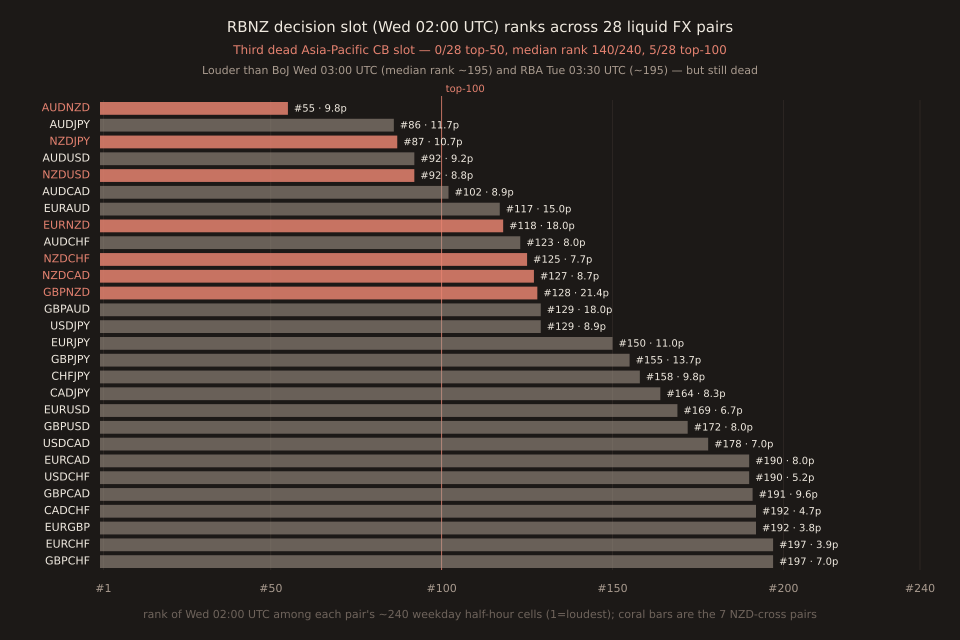
RBNZ Official Cash Rate decision slot Wednesday 02:00 UTC is the THIRD-tier dead central-bank slot in the calendar — median rank 140/240 across 28 pairs, 5 of 28 pairs crack top-100 (best AUDNZD at #55). Louder than yesterday's BoJ Wed 03:00 UTC and last week's RBA Tue 03:30 UTC because it fires 30-60 minutes EARLIER, catching the tail of Tokyo pre-lunch flow before the lunch vacuum closes in.
The RBNZ has fired its Official Cash Rate decisions at Wednesday 02:00 UTC since 2016 (14:00 NZST winter, 15:00 NZDT summer). Across all 28 liquid FX pairs the cell ranks between #55 (AUDNZD) and #192 (CADCHF) out of ~240 weekday half-hour cells — median 139.5, mean 143.0. Zero of 28 pairs crack top-50; five of 28 crack top-100.
RBNZ Wed 02:00 UTC inserts BETWEEN FOMC Wed 18:00 UTC (median rank 108) and the tied RBA/BoJ vacuum pair (194.5 / 195) — the THIRD-tier dead CB slot in the calendar. The mechanism is clock-time: Wed 02:00 UTC catches the tail end of Tokyo pre-lunch peak flow (peak is Wed 01:30 UTC — AUDNZD ranks that cell #9), while RBA Tue 03:30 UTC and BoJ Wed 03:00 UTC both fire INSIDE the Tokyo-lunch vacuum. The 55-rank gap between RBNZ and the RBA/BoJ pair maps almost exactly onto that 30-60 minute clock-time transition from pre-lunch fade to full lunch shutdown.
The 6-CB rank ordering — RBNZ inserts between FOMC and the RBA/BoJ pair
| Central bank | UTC slot | Median rank | Top-100 count | Neighbor context |
|---|---|---|---|---|
| BoC | Wed 14:00 | 13 | 28/28 | US-morning macro window — loud baseline |
| BoE | Thu 12:00 | 42.5 | 20/28 | just before US 12:30 UTC macro cluster |
| FOMC | Wed 18:00 | 108 | 16/28 | US-afternoon lull — middle baseline |
| RBNZ | Wed 02:00 | 140 | 5/28 | Tokyo pre-lunch tail — ← today's anchor |
| RBA | Tue 03:30 | 194.5 | 0/28 | Tokyo-lunch vacuum |
| BoJ | Wed 03:00 | 195 | 0/28 | Tokyo-lunch vacuum |
Three CBs live in loud neighboring baselines (BoC / BoE / FOMC) and rank top-third across 28 pairs. Three CBs fire at or near the Tokyo-lunch vacuum and rank bottom-third. RBNZ is the transition case: 55 rank slots better than the RBA/BoJ vacuum pair, 32 rank slots worse than the FOMC-lull baseline. The 6-CB arc now closes cleanly with a monotonically-ordered loudness gradient.
NZD-cross vs non-NZD ranks — the direct-fire signature
| Pair | Wed 02:00 rank | Wed 02:00 median | Reading |
|---|---|---|---|
| AUDNZD | 55 | 9.8p | both legs repriced — loudest NZD-cross Wed 02:00 UTC |
| NZDJPY | 87 | 10.7p | NZ rate cut/hike drives yen-carry unwind/repositioning |
| NZDUSD | 92 | 8.75p | flagship NZD pair |
| EURNZD | 118 | 18.0p | EUR quote-leg dampens the cell |
| NZDCHF | 125 | 7.65p | CHF quote-leg dampens — quietest NZD-cross |
| NZDCAD | 127 | 8.7p | CAD quote-leg dampens |
| GBPNZD | 128 | 21.4p | GBP quote-leg dampens |
| -non-NZD median- | ~150 | - | AUD/CHF/EUR/GBP/JPY/USD/CAD-only pairs |
NZD-family median rank 118 vs non-NZD median ~150: a 32-rank slot lift from the ~13.5% direct RBNZ firing density. That’s the same order of magnitude of direct-fire lift that BoC gets (~30-50 rank slot lift on USDCAD/CAD-crosses at Wed 14:00 UTC). The difference: BoC starts from a top-30 baseline and lands top-10; RBNZ starts from a rank-150 baseline and lands rank-118 — the same additive lift can’t bridge the 100-rank baseline gap.
The Tokyo pre-lunch → lunch transition on AUDNZD
| Slot | AUDNZD rank | Median 30-min range | Context |
|---|---|---|---|
| Wed 01:00 | 23 | 10.4p | Tokyo pre-lunch ramp |
| Wed 01:30 | 9 | 11.2p | Tokyo PRE-LUNCH PEAK — AUDNZD's #9 loudest cell of the week |
| Wed 02:00 | 55 | 9.8p | RBNZ decision cell — pre-lunch fade begins ← today |
| Wed 02:30 | 117 | 8.5p | BoJ earliest bin — Tokyo lunch closing in |
| Wed 03:00 | 131 | 8.4p | BoJ canonical centroid — Tokyo lunch peak vacuum |
| Wed 03:30 | 173 | 7.6p | vacuum still deep |
| Wed 04:00 | 174 | 7.6p | vacuum still deep |
| Wed 04:30 | 202 | 6.9p | deepest afternoon vacuum |
The AUDNZD Wed 01:30 → 04:30 rank walk (9 → 55 → 117 → 131 → 173 → 174 → 202) is the direct measurement of Tokyo lunch shutdown. RBNZ Wed 02:00 UTC catches the first fade stepat rank 55; BoJ 02:30-04:00 UTC catches the middle of the vacuum at rank 117-174; RBA Tue 03:30 UTC on the previous day catches the equivalent middle vacuum at ~194. Each CB’s median rank aligns with the clock-time position of its announcement within the Tokyo pre-lunch → lunch decay.
Prior cross-CB posts
This closes the 6-CB rank arc opened at wed-1800-fomc-blank-slot (2026-09-02) and continued through thu-1200-boe-slot-comparison (2026-09-03), tue-0330-rba-deadest-slot (2026-09-04), wed-1400-boc-loudest-cb-slot (2026-09-05), and wed-0300-boj-window-deadest (2026-09-06). RBNZ is the sixth data point and adds the transition case: Tokyo pre-lunch tail lands the cell between the FOMC-lull mid (108) and the Tokyo-lunch-vacuum bottom pair RBA/BoJ (194.5/195). The three “alive” CBs (BoC/BoE/FOMC) all fire inside loud US-morning or US-afternoon neighboring baselines; the three “dead” CBs (RBNZ/RBA/BoJ) all fire at or near the Tokyo-lunch vacuum. Direct-fire density (7-11 meetings/year for each) explains ~30-50 rank slots of lift on the pairs being repriced; the remaining 100-160 rank slots of variance is neighboring-cell baseline.
Verification note
All numbers verified against live /api/v1/calm-zones/scan on 2026-09-08 for all 28 liquid FX pairs. Chart generated via a one-off SVG script (reusing scripts/insights-charts/svg.ts + theme.ts and rasterizing with sharp). Sample: each pair has ~240 non-null weekday half-hour cells; rank is the ordinal position of Wed 02:00 UTC among those cells (1 = loudest). RBNZ Official Cash Rate calendar: 7-8 meetings per year at Wed 02:00 UTC since 2016 (previously Thu 21:00 UTC — the older calendar is not analysed here, and the pre-2016 Wed 02:00 UTC cells contain zero RBNZ decisions, which drags the cell’s aggregate rank toward its non-event baseline somewhat). Caveat: DST transitions across 15+ years of coverage cause some Wed 02:00 UTC cells to fall in 15:00 NZDT (Oct-Apr) vs 14:00 NZST (Apr-Oct); actual RBNZ statement release time was 14:00 local through the whole period. The 30-min bin lines up with either DST regime, so no cross-bin drift.