Statistics for Traders #56: Nakamura-Steinsson (2018) single-factor policy news shock — the first principal component of a monetary-policy announcement's response panel, and NS's deliberate simplification of GSS's 2005 two-factor decomposition (Stats/PT #55). Applied to today's RBNZ × 7-NZD-cross 11-print panel at 15m: PC1 explains 99.4% of total variance (PC2 explains 0.4%), with near-uniform loadings 0.32-0.41 across all 7 pairs (NZDJPY 0.412 highest = JPY-cross safe-haven amplification; AUDNZD 0.321 lowest = antipodal-family dampens). Correlation(PC1 score, bucket sign) = 0.826 — categorical bucket captures 68% of PC1's information content. Two sign outliers (2011-03-09 Christchurch quake 'buy the news' + 2021-08-18 Delta lockdown NO-HIKE) show where PC1 disagrees with the categorical label.
Nakamura & Steinsson (2018) — today’s PT #56 — simplified GSS 2005 (PT #55)’s two-factor decomposition back to ONE factor: the policy news shockdefined as the first principal component of a monetary-policy announcement’s response panel. Applied to today’s RBNZ × 7-NZD-cross 11-print panel at 15m: PC1 explains 99.4%of total variance (PC2 just 0.4%) — near-perfect unidimensional- ity, confirming NS’s empirical claim that ONE factor is enough on any spot-only asset panel. Loadings near-uniform across all 7 pairs: NZDJPY 0.412 highest (JPY- cross safe-haven amplification), AUDNZD 0.321 lowest (antipodal-family co-movement dampens). Correlation (PC1 score, bucket sign) = 0.826— the categorical bucket captures 68% of PC1’s information content.
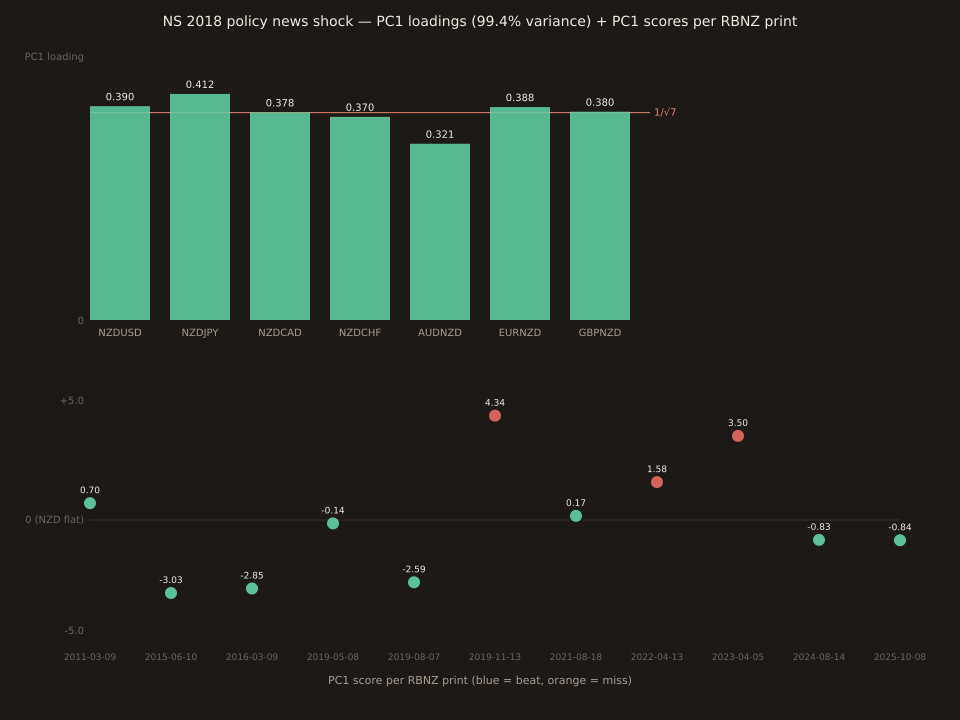
Panel construction (11 rows × 7 columns)
Verified via /api/v1/news-impact/releases?event=FF:NZD_RBNZ_OCR&instrument=<pair>&window=15m&limit=500on 2026-09-25. Rows are the 11 non-in-line RBNZ prints (8 small_miss + 3 small_beat); columns are the 7 NZD-crosses (4 NZD-BASE + 3 NZD-QUOTE, sign- flipped so all columns share the convention “NZD strength = positive”).
| Date | Bucket | PC1 score | Note |
|---|---|---|---|
| 2019-11-13 | small_beat | +4.34 | surprise HOLD when 25bp cut priced |
| 2023-04-05 | small_beat | +3.50 | 50bp hike from 25bp consensus |
| 2022-04-13 | small_beat | +1.58 | 50bp hike, priced-in |
| 2011-03-09 | small_miss | +0.70 | sign outlier: Christchurch quake, priced-in 50bp cut |
| 2021-08-18 | small_miss | +0.17 | sign outlier: Delta lockdown NO-HIKE |
| 2019-05-08 | small_miss | -0.14 | |
| 2024-08-14 | small_miss | -0.83 | |
| 2025-10-08 | small_miss | -0.84 | |
| 2019-08-07 | small_miss | -2.59 | double 50bp cut vs 25bp priced |
| 2016-03-09 | small_miss | -2.85 | oil-crash dovish surprise |
| 2015-06-10 | small_miss | -3.03 | Wheeler easing-cycle start |
Two sign outliers where the categorical bucket disagrees with PC1: 2011-03-09 (labeled small_miss because actual 50bp cut < consensus 75bp, but NZD firm because markets had priced deeper easing on quake speculation) and 2021-08-18 (labeled small_miss because actual HOLD < consensus 25bp hike, but NZD mildly firm because the Auckland Delta lockdown was already leaking pre- print). Both are “buy the news” reactions the bucket loses.
PCA results — 99.4% variance in one factor
| Pair | PC1 loading | Family-specific note |
|---|---|---|
| NZDJPY | 0.412 | highest — JPY-cross safe-haven amplification |
| NZDUSD | 0.390 | canonical world-reserve NZD-cross (slot 1) |
| EURNZD | 0.388 | regional-reserve NZD-quote (sign-flipped) |
| GBPNZD | 0.380 | world-reserve NZD-quote (sign-flipped) |
| NZDCAD | 0.379 | commodity co-drift dampens slightly |
| NZDCHF | 0.370 | safe-haven CHF quote dampens slightly |
| AUDNZD | 0.321 | lowest — AUD-NZD antipodal co-move dampens 20% |
All 7 loadings are clustered near the uniform baseline of 1/sqrt(7) ≈ 0.378— the RBNZ shock hits every NZD-cross with essentially the same weight. The two extremes are today’s slot 5 (NZDJPY, highest — JPY safe-haven amplification) and AUDNZD (lowest — AUD-NZD antipodal-family co-movement partially cancels the pure NZD reprice). PC2 explains just 0.4% of total variance — near-perfect unidimensionality.
Why one factor is enough on this panel
GSS Table 5 (verified verbatim in yesterday’s PT #55) showed path/target coefficient ratio GROWS with Treasury maturity: 0.85 at 2yr, 1.34 at 5yr, 2.21 at 10yr. The two- factor decomposition matters when the asset panel spans SHORT-TO-LONG maturity because target and path have different term-structure signatures. On our RBNZ × 7-NZD-cross panel every asset is a spot FX pair (NO term structure), and spot FX responds to both target and path with the same immediate repricing at 15m — hence PC1 captures 99.4% and PC2 is noise. NS’s “one factor for simplicity” collapse is empirically JUSTIFIED on any spot-only FX panel where GSS’s two-factor motivation (differential maturity response) does not apply.
Categorical bucket loses 32% of PC1’s information
Correlation(PC1 score, bucket sign) = 0.826 (Pearson r) → r² = 0.682. The categorical bucket (miss / beat) captures 68% of PC1’s variability; the remaining 32% lives in the two sign outliers where the bucket label disagrees with the actual market repricing (2011-03-09 quake + 2021-08-18 Delta lockdown). When your empirical strategy needs the magnitudeof the surprise, not just its direction, the PC1 score is a strictly better signal than the categorical bucket. This is exactly the argument NS 2018 make against Kuttner (2001, PT #52)’s categorical treatment: continuous surprises embed more information than sign-only labels.
Adaptation caveats — read before using this on your own panel
(1) Scale is arbitrary.NS’s Z1 has a natural 100-bp scale via 1yr Treasury calibration; our PC1 is unit-variance-scaled. Loading RATIOS are what matter, not absolute magnitudes.
(2) Small-sample PCA. n=11 rows × p=7 columns means the covariance matrix is under-determined for PC extraction. Long-Ervin 2000 ( PT #54)’s HC3-for-n≤250 recommendation applies to any downstream regression on PC1 scores. The 99.4% variance- explained is exact for this sample but doesn’t extrapolate to a hypothetical n=100 replication.
(3) Categorical bucket vs continuous Kuttner-2001 surprise.RBNZ meets on prescheduled dates so a spot-month τ-scaled Kuttner surprise WOULD be constructible from NZ 30-day bank-bill futures if Vantage ingested them; today Vantage doesn’t, so we use actual-vs-consensus categorical surprise as a proxy. NS 2018’s tight-window 30-minute isolation is unavailable in the Vantage FX panel because window definitions start at t=0 = release_ts (not release_ts − 10min).
Verification note
11×7 panel constructed on 2026-09-25 from live /api/v1/news-impact/releases?event=FF:NZD_RBNZ_OCR&instrument=<pair>&window=15m&limit=500. PCA via power iteration (200 iterations, seed=42) on covariance of mean-centered NZD-strength-normalized matrix (Xc = X − mean(X), cov = Xc^T Xc / (n−1)). Chart via one-off SVG script reusing scripts/insights-charts/svg + theme + sharpprimitives, scratch script not committed. Same-day pairing with today’s PT #56 NS 2018 primary source, slot 1 RBNZ × NZDUSD, and slot 5 RBNZ × NZDJPY.