Statistics for Traders #40: The Rule of Three — for n Bernoulli trials with 0 successes, the 95% upper confidence bound on the true success rate is approximately 3/n. Direct application to today's slot 1 (GBPJPY × Japan Prelim GDP: 0-of-4 UP at 15m) gives a 95% upper CI of 52.7% — the 4-of-4 unanimity is CONSISTENT WITH a true up-rate as high as 1-in-2. Opens a new small-sample-inference thread.
For n Bernoulli trials with x=0 successes, the one-sided 95% upper confidence bound on the true success rate is approximately 3/n. Exact formula: p_U = 1 − 0.05^(1/n). Directly applied to today’s slot 1 (GBPJPY × Japan Prelim GDP, 0-of-4 UP at 15m): exact 95% upper CI is 52.71%. The 4-of-4 unanimity is CONSISTENT WITH a true up-rate as high as roughly 1-in-2.
Statistics for Traders #40 opens a NEW small-sample-inference thread after Stats #34-#39 closed the 6-post multivariate-classifier arc. It directly serves reader interpretation of the tail-unanimity findings that slot 1 publishes every day. Rule of Three is the classic medical-statistics tool (Hanley & Lippman-Hand, JAMA1983) for “if nothing goes wrong in n trials, is everything alright?” — and the answer is always “maybe, but the true rate could still be up to 3/n”.
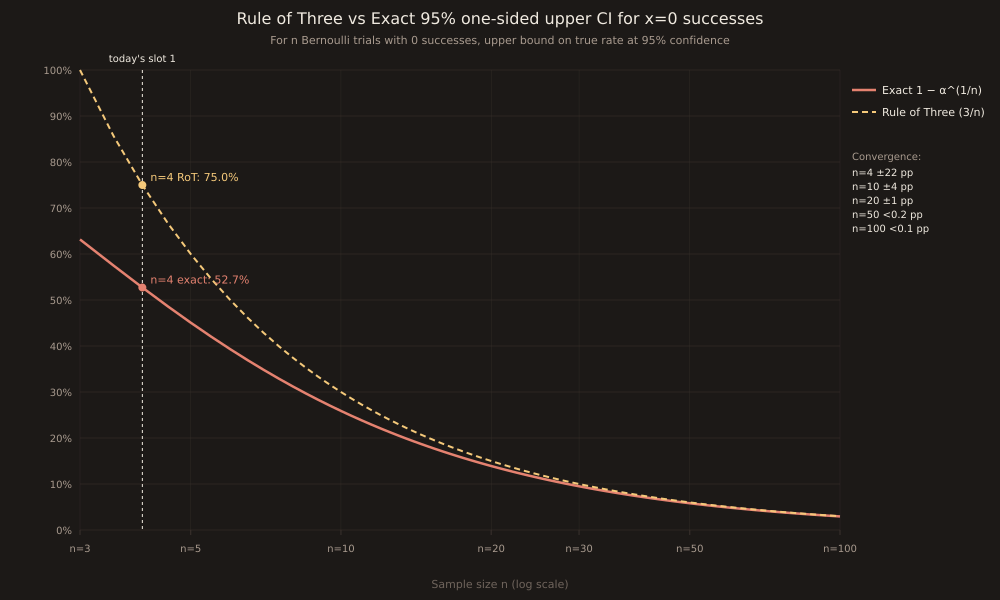
Exact vs Rule-of-Three at α = 0.05 (one-sided)
| n | Exact p_U | RoT 3/n | RoT − Exact | Reading |
|---|---|---|---|---|
| 3 | 0.6316 | 1.0000 | +0.368 | unanimity in only 3 trials tells you almost nothing |
| 4 | 0.5271 | 0.7500 | +0.223 | TODAY'S GBPJPY SAMPLE — up to 53% true up-rate |
| 5 | 0.4507 | 0.6000 | +0.149 | still very wide |
| 6 | 0.3930 | 0.5000 | +0.107 | |
| 10 | 0.2589 | 0.3000 | +0.041 | starts feeling meaningful — below 30% |
| 15 | 0.1810 | 0.2000 | +0.019 | |
| 20 | 0.1391 | 0.1500 | +0.011 | |
| 30 | 0.0951 | 0.1000 | +0.005 | unanimity now 'sharp' — below 10% |
| 50 | 0.0582 | 0.0600 | +0.002 | |
| 100 | 0.0295 | 0.0300 | +0.001 | approximation error under 0.1 pp |
Derivation — where does the 3 come from?
Under the null hypothesis that the true success probability is p_U, the probability of observing 0 successes in n trials is (1 − p_U)^n. Setting this equal to α = 0.05 (the one-sided 95% CI cutoff) and solving:
  (1 − p_U)^n = 0.05
  n · ln(1 − p_U) = ln(0.05)
  1 − p_U = exp(ln(0.05)/n)
  p_U = 1 − 0.05^(1/n)                        [EXACT]

  Taylor: exp(-3/n) ≈ 1 − 3/n  for small |3/n|
  So    p_U ≈ 1 − (1 − 3/n) = 3/n              [RULE OF THREE]

  The "3" is just −ln(0.05) ≈ 2.996, rounded.
The approximation is off by 37 percentage points at n=3 and 22 pp at n=4 (Taylor expansion breaks down at small n where 3/n isn’t small), converges to under 5 percentage points by n=10, and drops below 1 pp by n=20. For everyday use in Vantage tail-unanimity posts (typical tail-bucket sizes n=3-8 on quarterly macro events), the exact formula is worth computing; for n≥15 the 3/n rule is close enough.
Applied to today's slot 1
The GBPJPY × Japan Prelim GDP big-miss bucket at 15m has n=4, x=0 UP. The rest of the numbers follow directly:
| Bound | Value at n=4 | Meaning |
|---|---|---|
| One-sided exact 95% | 52.71% | true up-rate consistent with anything from 0% to 52.71% |
| Rule of Three (3/n) | 75.00% | conservative approximation — safer upper bound |
| Two-sided Clopper-Pearson | 60.24% | wider than one-sided because α/2 replaces α |
| Wilson score (two-sided) | ≈49.0% | narrower — asymptotic, doesn't guarantee exact frequentist coverage |
| Agresti-Coull (two-sided) | ≈54.6% | pseudo-count adjusted Wald; intermediate width |
| Naive Wald (WRONG) | 0.00% | collapses to [0,0] — do NOT use for x=0 |
Reading: today’s 4-of-4big-miss DOWN unanimity on GBPJPY is a legitimate pedagogic finding (the sign flip at the big_miss → small_miss threshold replicates on the fifth JPY-cross of the arc, and the 1h magnitude sets a new family record at -13.45p), but it is NOT evidence that the true up-rate is exactly zero. It’s consistent with a true rate up to 53%at 95% confidence. Trading it as a 100% reliable directional signal would overstate the sample.
Why this matters for every tail-unanimity slot-1 post
The Vantage News Impact Explorer routinely finds tail-bucket unanimities on quarterly macro events (JPY GDP, NZ CPI, AUD Trimmed Mean CPI, NZ Employment, etc.). Because the tail buckets hold at most 3-8 releases out of 15 years of data, every one of these unanimities is a small-sample finding. Rule of Three quantifies the uncertainty: an n=3 unanimity leaves the true rate anywhere up to 63.2%; an n=4 leaves it up to 52.7%; an n=6 leaves it up to 39.3%. Only at n≥15 does the upper bound drop below 20%, and n=15 would require ~4 years of monthly-release data or ~15 years of quarterly data on a rare tail bucket.
Practical implication for readers: treat every slot-1 tail-unanimity finding as a directional-consistency observation, not a probability point-estimate. Position size for the possibility that the true rate is halfway between 0% and the Rule-of-Three upper bound — that’s the correct Bayesian posterior under a uniform prior.
Series placement and verification
Stats #34-#39 formed a 6-post multivariate-classifier arc on the UK Core CPI × GBPCHF panel (MANOVA → canonical direction → LDA → Mahalanobis → QDA → multinomial logit). Stats #39 closed that arc. Stats #40 opens a NEW small-sample-inference thread with the Rule of Three, directly connected to today’s slot 1. All numbers computed by elementary algebra; exact formula p_U = 1 − α^(1/n) derived from the binomial null P(X = 0 | n, p_U) = α. Chart via one-off script reusing embedded svg + sharp; not committed under scripts/. Queue next: Fisher’s exact test (the 2x2 sibling of Rule of Three); Clopper-Pearson exact interval derivation; Rule of Five variant for x=1 (the 5/n approximation); Bayesian posterior with Beta(1,1) prior on tail-unanimity findings. Prior queue items rotate: suppressor-variable partial-vs-semi-partial (queued since Stats #25), higher-order VAR-b prewhitening (queued since Stats #20), heteroskedastic joint kurtosis (queued since Stats #33), Regularized Discriminant Analysis (Friedman 1989 RDA; queued since Stats #38).