AUDNZD's top-2 loudest half-hour cells of the week are BOTH outside the London/NY overlap — Wed 21:00 UTC (12.60p) and Fri 21:30 UTC (12.50p), both Sydney/Wellington-morning cluster
240weekday half-hour cells across AUDNZD’s week (5 days × 48 half-hours). Rank them by median 30-minute range and the top of the list looks like this: Wed 21:00 UTC at 12.60 pips, Fri 21:30 UTC at 12.50 pips, Fri 14:30 UTC at 12.00, Thu 14:30 at 11.90. The top-2 are both in the Sydney/Wellington morning cluster. Overlap only shows up starting at rank 3.
Twelve days ago I published “AUDNZD is the only major pair whose loudest hour isn’t in the London/NY overlap” with the single-cell claim (Wed 21:00 UTC is the pair’s single loudest cell). Today’s post is the deepening: the #2 cell is also outside overlap. It’s not a single-cell fluke — the Sydney/Wellington cluster has taken over the top of AUDNZD’s loudness distribution.
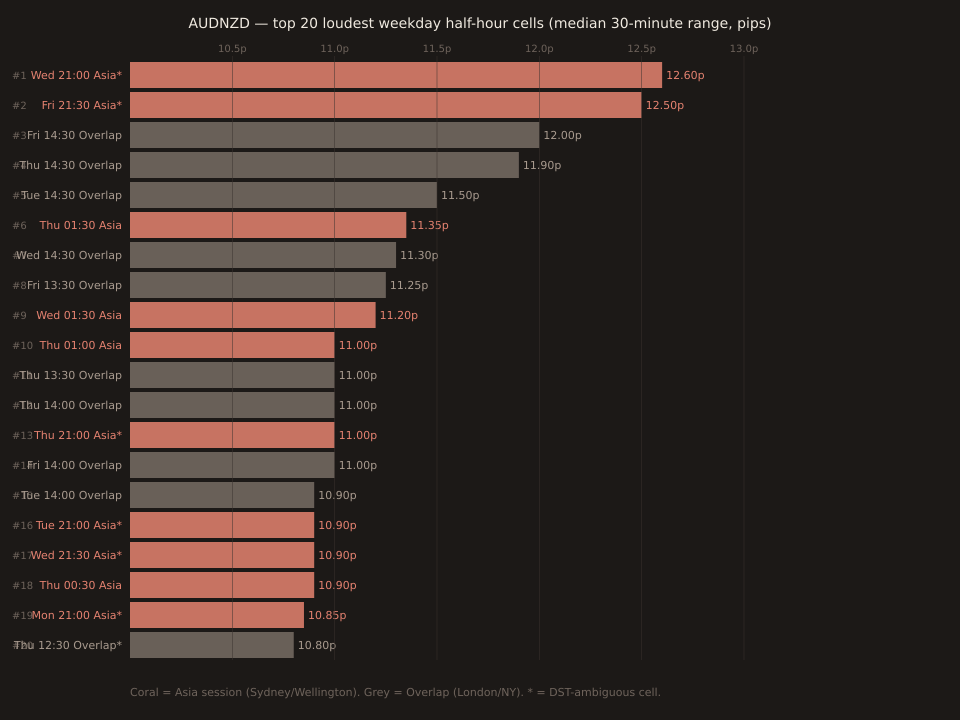
The top-20, ranked
| Rank | Day | UTC | Session | Median (pips) | n_days |
|---|---|---|---|---|---|
| 1 | Wed | 21:00 | Asia* | 12.60 | 847 |
| 2 | Fri | 21:30 | Asia* | 12.50 | 826 |
| 3 | Fri | 14:30 | Overlap | 12.00 | 826 |
| 4 | Thu | 14:30 | Overlap | 11.90 | 842 |
| 5 | Tue | 14:30 | Overlap | 11.50 | 839 |
| 6 | Thu | 01:30 | Asia | 11.35 | 842 |
| 7 | Wed | 14:30 | Overlap | 11.30 | 847 |
| 8 | Fri | 13:30 | Overlap | 11.25 | 826 |
| 9 | Wed | 01:30 | Asia | 11.20 | 847 |
| 10 | Thu | 01:00 | Asia | 11.00 | 842 |
| 10 | Thu | 13:30 | Overlap | 11.00 | 842 |
| 10 | Thu | 14:00 | Overlap | 11.00 | 842 |
| 10 | Thu | 21:00 | Asia* | 11.00 | 842 |
| 10 | Fri | 14:00 | Overlap | 11.00 | 826 |
| 15 | Tue | 14:00 | Overlap | 10.90 | 839 |
| 15 | Tue | 21:00 | Asia* | 10.90 | 839 |
| 15 | Wed | 21:30 | Asia* | 10.90 | 847 |
| 15 | Thu | 00:30 | Asia | 10.90 | 842 |
| 19 | Mon | 21:00 | Asia* | 10.85 | 758 |
| 20 | Thu | 12:30 | Overlap* | 10.80 | 842 |
Star (*) marks cells where the tool’s session_ambiguousflag is true — usually a DST-boundary cell. That’s a labelling nuance, not a data-quality problem; the median-range value is computed from the actual observed range on each day of the sample, not from a session assumption.
Session split in the top-20
| Session | Cells in top-20 | Time cluster |
|---|---|---|
| Asia | 10 | 21:00-01:30 UTC (Sydney/Wellington morning) |
| Overlap | 10 | Tue-Fri 13:30-14:30 UTC (London/NY US-data) |
A perfectly even split — 10 Asia, 10 Overlap. On every other pair, Overlap sweeps 18-20 of the top-20 cells and Asia contributes 0-2. AUDNZD is the pair where the two clusters compete for the top of the loudness distribution, and the top-2 slots belong to Asia.
What Fri 21:30 UTC actually is
Friday 21:30 UTC. During Australian summer (AEDT), that’s Saturday 08:30 Sydney; during winter (AEST) it’s Saturday 07:30. In Wellington (NZDT summer) it’s Saturday 10:30; (NZST winter) Saturday 09:30. Either way, it lands in the Sydney/Wellington Saturday morning — technically the FX week is closed (most brokers cut 22:00 UTC Friday) but liquid market-makers are still standing at desks doing week-end rebalancing.
Mechanically, this half-hour lands roughly afterthe US session close but before the formal FX week close. It captures the late-Friday risk-adjustment where Sydney/Wellington desks square positions accumulated during the US session against their own book. For AUDNZD specifically — a pair whose flow is dominated by Pacific-Asia relative-value rather than USD-sentiment — this is one of the day’s biggest ordering windows.
Wed 21:00 UTC (the #1 cell) is the mirror image at the other end of the week: Thursday 07:00 Sydney / 09:00 Wellington — the mid-week arrival at desks in Australia and New Zealand, with the overnight US session to react to and the day’s Australian and New Zealand macro releases about to hit. Both peaks are Sydney/Wellington-morning phenomena, just at opposite ends of the AU/NZ trading week.
What this doesn’t say
The magnitudes are small in absolute terms.A 12.60p median half-hour range is quiet compared to GBPNZD’s 29.80p #20 cell (per the GBPNZD top-20 post, 2026-08-12). AUDNZD is the quietest of the Australasian pairs. The point of the post is about the timing SHAPE, not the amplitude.
Sample size varies across days.Wed 21:00 UTC has n=847 days of observation, Fri 21:30 has n=826, Mon 21:00 has n=758 (Monday count lower because of weekend-boundary effects — Sunday 22:00 UTC is technically the Sunday-evening market open in the tool, but Monday counts start from that first-full-Monday session). The pattern doesn’t depend on any single day’s sample being exhaustive.
DST rotation matters for the “Asia” label but not for the loudness measurement. The tool bins by UTC clock, not by local time. Wed 21:00 UTC is the same UTC bin all year; what shifts by DST is which local Sydney/Wellington hour that maps to. The session label uses a majority-of-year assignment; the loudness number is invariant to it.
Open the tool → Free forever. No signup. No email required.