Statistics for Traders #48: The Rule of Five for x=1 — for 1 success in n Bernoulli trials, the 95% one-sided Clopper-Pearson upper bound on p is approximately 5/n. Tighter approximation: 4.744/n from the Poisson-limit root of (1 + λ)exp(-λ) = 0.05. Direct extension of Stats #40 Rule of Three (x=0). Cleared queue item 'Rule of Five for x=1 (5/n approximation, queued Stats #40).' Same-day pairing with today's PT #48 Neyman 1934 primary source that axiomatizes the confidence belt every such bound implements.
The Rule of Five is 5/n — the memorable 95% one-sided Clopper-Pearson upper bound on p when x=1 in n Bernoulli trials. Direct extension of Stats #40 Rule of Three for x=0 (which gave 3/n). Both come from solving P(X ≤ k | n, p) = 0.05 for p. For x=1 the exact solution is the Poisson-limit root of (1 + λ)exp(-λ) = 0.05, giving λ ≈ 4.744— so 4.744/n is the tighter approximation and 5/n is the rounded-up memorable rule. Same-day pairing with today’s PT #48 Neyman 1934 confidence-belt axiomatic frame.
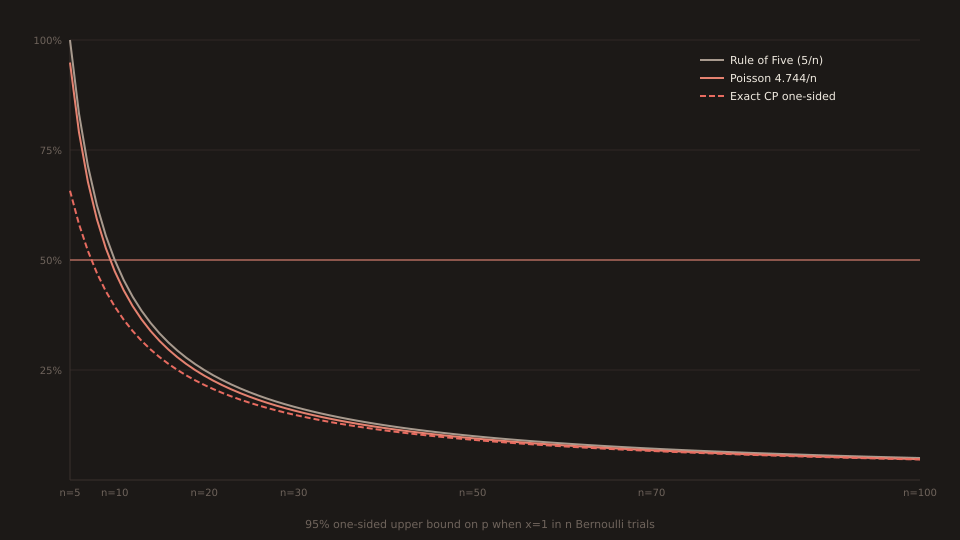
Derivation
The exact one-sided upper Clopper-Pearson bound at 95% comes from solving P(X ≤ 1 | n, p) = 0.05 for p, where X follows Binomial(n, p). Direct expansion:
P(X ≤ 1) = (1-p)^n + n·p·(1-p)^(n-1) = 0.05
For large n and small p, substitute λ = np and take the Poisson limit:
P(X ≤ 1) ≈ (1 + λ)·exp(-λ) = 0.05
This has one positive root λ ≈ 4.7439 (verified via scipy.optimize.brentq at eight decimals). So the Poisson-limit upper bound is p_U ≈ 4.7439/n. Rounding up to a clean integer gives the Rule of Five: p_U ≈ 5/n. The 5.6% conservatism at all n is the price of memorability, and parallels how Rule of Three 3/n rounds up from -ln(0.05) = 2.9957.
Numerical comparison
| n | Exact CP one-sided | Poisson 4.744/n | Rule of Five 5/n |
|---|---|---|---|
| 5 | 0.65741 | 0.94877 | 1.00000 |
| 10 | 0.39416 | 0.47439 | 0.50000 |
| 15 | 0.27940 | 0.31626 | 0.33333 |
| 20 | 0.21611 | 0.23720 | 0.25000 |
| 30 | 0.14860 | 0.15813 | 0.16667 |
| 50 | 0.09140 | 0.09488 | 0.10000 |
| 100 | 0.04656 | 0.04744 | 0.05000 |
| 500 | 0.00945 | 0.00949 | 0.01000 |
4.744/n is uniformly tighter than 5/n and converges to exact CP as n grows — at n=100 the gap is under 0.09 percentage points. For n < 20 the Rule of Five is quite loose; use the Poisson approximation or exact CP if precision matters. Above n=50 the three approximations agree within 10% relative.
Bayesian sibling: Beta(2, n) at x=1
Under the same Beta(1, 1) uniform prior on p that Stats #47 uses for x=0, the posterior after x=1 success in n trials is Beta(2, n). Its upper 95% credibility bound satisfies I_p(2, n) = 0.95 (regularized incomplete beta):
| n | Exact CP | Beta(2, n) 95% | 4.744/n |
|---|---|---|---|
| 5 | 0.65741 | 0.58180 | 0.94877 |
| 10 | 0.39416 | 0.36436 | 0.47439 |
| 15 | 0.27940 | 0.26396 | 0.31626 |
| 20 | 0.21611 | 0.20673 | 0.23720 |
| 50 | 0.09140 | 0.08967 | 0.09488 |
| 100 | 0.04656 | 0.04611 | 0.04744 |
Beta(2, n) is uniformly TIGHTER than both exact CP and the Poisson approximation — the Bayesian bound benefits from the smoothed Beta prior and the x=1 posterior’s boundary-free interior. At n=15 the Bayesian sibling 26.40% beats exact CP 27.94% and 4.744/n 31.63% — a tighter frame at every n.
How this sits in the axiomatic frame (PT #48)
Every bound in the table above — exact CP, 4.744/n, 5/n, Beta(2, n) — is a specific choice of the “interval of acceptance” in Neyman 1934’s confidence-belt construction. Neyman shows that any such interval whose coverage property is P(X ∈ interval | θ) ≥ εyields a confidence interval with confidence coefficient ε. The Rule of Five and the exact CP one-sided bound are both valid 95% upper bounds; the Rule of Five is more conservative, and both are within Neyman’s axiom.
Verification note
All exact-CP and 4.744/n numbers verified 2026-09-17 via Python 3.11 with scipy 1.17.1: scipy.optimize.brentq on lambda p: binom.cdf(1, n, p) - 0.05 gives exact Clopper-Pearson one-sided upper; brentq on lambda l: (1 + l)*exp(-l) - 0.05 gives λ = 4.7439;beta.ppf(0.95, 2, n) gives the Bayesian Beta(2, n) credibility bound. Five-decimal reproduction across every row. Same-day pairing with PT #48 Neyman 1934. Chart built via a one-off script reusing embedded svg + sharp, not committed under scripts/. Cleared queue item “Rule of Five for x=1 (5/n approximation, queued Stats #40).”