Paper Trail #40: If Nothing Goes Wrong, Is Everything All Right? Interpreting Zero Numerators (Hanley & Lippman-Hand, JAMA 1983) — the paper that named the 'rule of three' for small-sample zero-count inference and gave every clinician (and every trader looking at a tail-unanimity) the maximum-long-run-risk formula behind today's Stats #40.
The 1983 JAMApaper by James A. Hanley and Abby Lippman-Hand (McGill Epidemiology & Health) that named the Rule of Three — for n Bernoulli trials with 0 events, the 95% upper confidence bound on the true rate is approximately 3/n — and turned it into a standard clinical-inference tool for the zero-numerator small-sample corner case. FULL primary source verified 2026-09-09 via WebFetch + zlib PDF-stream decompression from McGill Biostatistics mirror. Direct pairing with today’s Statistics for Traders #40 (Rule of Three).
Paper Trail #40 opens a new small-sample-inference thread after PT #38 Kondor 2009 closed the 8-paper limits-to-arbitrage arc and PT #39 Duffie 2010 AFA Presidential Address generalized it. The connection is not to that prior arc but to today’s Stats #40 companion post — Hanley & Lippman-Hand 1983 is the founding paper of the mathematical result Stats #40 applies to today’s slot 1 GBPJPY × Japan Prelim GDP 0-of-4 big-miss unanimity.
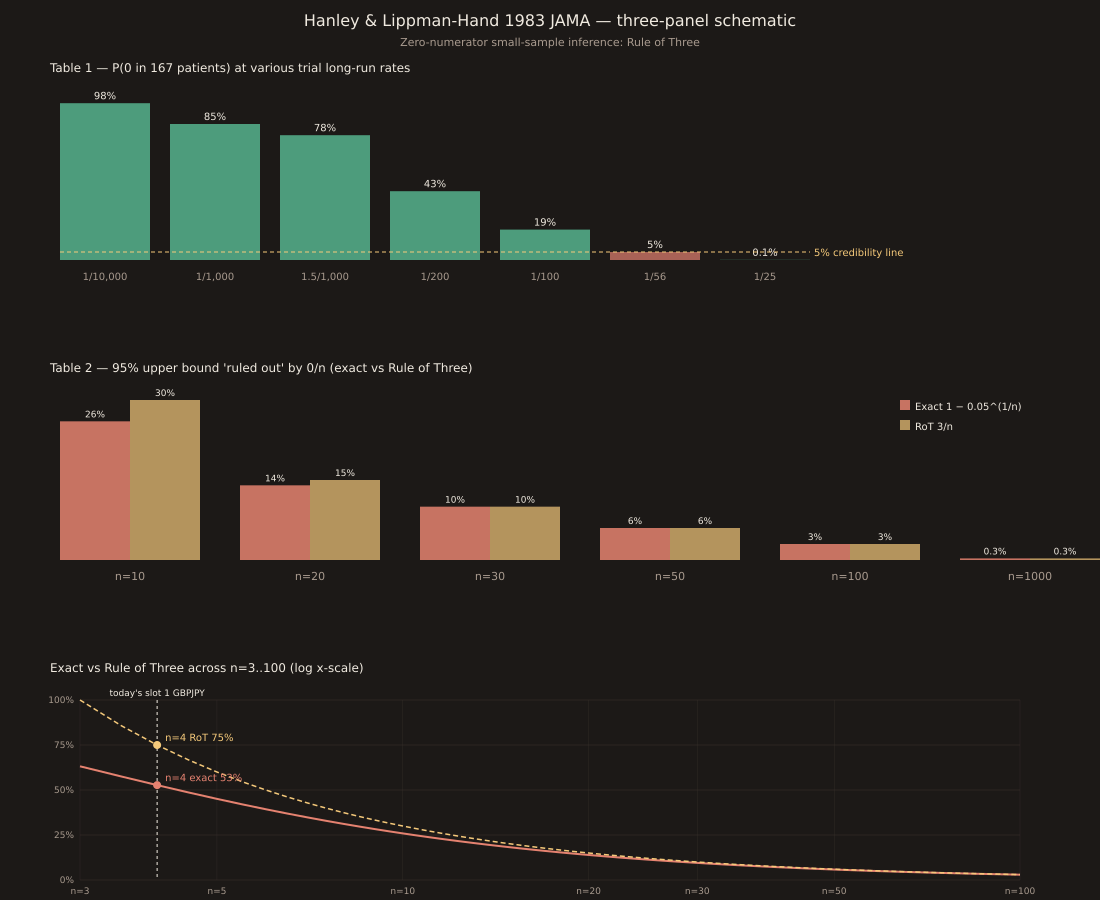
Verified content and citation
| Field | Value |
|---|---|
| Authors | James A. Hanley, Abby Lippman-Hand (McGill University, Montreal) |
| Journal | JAMA (Journal of the American Medical Association) |
| Date | April 1, 1983 |
| Volume/pages | Vol 249, No. 13, pp 1743-1745 |
| Departments | Epidemiology & Health (Hanley); Centre for Human Genetics (Lippman-Hand) |
| Primary source | jhanley.biostat.mcgill.ca/c607/ch08/zero_numerator.pdf (4 pages, 15.4 KB, text-native, no OCR) |
| Verification date | 2026-09-09 |
| Verification method | WebFetch + Python zlib decompression of FlateDecode PDF streams |
Table 1 verbatim — P(0 complications in n=167) at various trial rates
| Trial long-run rate | P(0 in 167) | Note |
|---|---|---|
| 1 in 10,000 | 98% | trial rate too small to detect |
| 1 in 1,000 | 85% | |
| 1.5 in 1,000 | 78% | |
| 1 in 200 | 43% | |
| 1 in 100 | 19% | |
| 1 in 56 | 5% | ← credibility threshold — upper 95% CI |
| 1 in 25 | 0.1% | would express 'great surprise' |
Reading (page 2 verbatim): “As Table 1 shows, our limit for surprise of 5% is reached when the true long-run risk is about two in 100. In other words, the findings ‘fit’ or are ‘not surprisingly different from’ any long-run risk of 2/100 or less.” This is the working example the paper uses to introduce the Rule of Three.
Table 2 verbatim — the eponymous Rule of Three
| Observed rate 0/n | Exact (%) | RoT 3/n (%) | Meaning: rules out any rate higher than |
|---|---|---|---|
| 0/10 | 26 | 30 | true rate above 26% is unlikely at 5% credibility |
| 0/20 | 14 | 15 | |
| 0/30 | 10 | 10 | exact and RoT agree at rounded precision |
| 0/50 | 6 | 6 | |
| 0/100 | 3 | 3 | |
| 0/1000 | 0.3 | 0.3 | convergence complete at 3 decimals |
Footnote (verbatim): “*(1 − maximum rate)^n = 0.05.” This is the exact formula. Second column footnote (verbatim): “Derived from rule of three.” The n=10 exact-vs-RoT gap of 4 percentage points is the paper’s only visible divergence between the two columns — at n≥20 they agree at integer-percent precision.
The three main points, verbatim from page 1
“In particular, we would like to emphasize that (1) a zero numerator does not necessarily mean ‘no risk,’ (2) a zero numerator does not preclude inferences about the size of a risk, and (3) the principles of inferential statistics that apply to nonzero numerators apply equally well to zero numerators. In fact, there is a quick and simple rule that establishes the maximum long-run risk associated with an observation of no effects in a sample of any given size.”
Closing quote, verbatim from page 4
“We urge a reformulation of the views of a zero numerator and encourage those reporting such observations to consider the maximum risk with which their findings are compatible. To this end, the confidence interval is helpful since it translates the results of a sample not into a single number, but rather into a range that is quite likely to contain the rate characteristic of the population. Because a confidence interval may be constructed easily from a zero numerator using the ‘rule of three,’ we hope that those fortunate enough to be able to report ‘no problems so far’ will quantify the worst or best that a group of future patients can expect.”
Direct trading-context translation
Substitute “patients” with “quarterly macro prints in the big-miss bucket” and “complications rate” with “true directional up-rate,” and the Hanley & Lippman-Hand 1983 conclusion applies verbatim to Vantage News Impact tail-unanimity posts. Today’s slot 1 GBPJPY has n=4 big-miss prints with 0 UP at 15m. The Rule of Three exact bound is 52.7%; the 3/n approximation gives 75% conservatively. The tail unanimity is a legitimate observation, but the true up-rate is consistent with anything from 0% to 52.7% at 95% confidence.
Cross-links and series placement
Direct connections: today’s Stats #40 companion post applies the exact Rule of Three formula from Hanley & Lippman-Hand’s Table 2 to Vantage tail-unanimity findings; today’s slot 1 GBPJPY post is the n=4, x=0 test case. Historical connections: Rumke 1975 NEJM “Implications of the statement No side effects were observed” is the pre-Hanley 1975 precursor (cited on page 1 of Hanley 1983); Tversky & Kahneman 1974 Science “Judgment under uncertainty: Heuristics and biases” is cited as reference 6 (foundational for the psychological- inference-of-small-numbers thread the paper leans on). Downstream lineage: Jovanovic & Levy 1997 The American Statistician “A Look at the Rule of Three” is the direct methodological follow-up; Westover 2012 Epilepsia“Revising the ‘Rule of Three’ for inferring seizure freedom” applies the rule to a Bayesian-with-prior setting.
Queue rotates: Jovanovic-Levy 1997 (direct methodological follow-up); Rumke 1975 (the pre-Hanley precursor); Tversky-Kahneman 1974 “Judgment under uncertainty” (foundational for psychological inference); He-Krishnamurthy 2013 “Intermediary Asset Pricing” AER (queued since PT #35); Sortino & Price 1994 downside-risk framework (queued since PT #38).
Verification note
Primary source: McGill Biostatistics course-page mirror at jhanley.biostat.mcgill.ca (Prof Hanley’s own institutional course website) — 4-page text-native PDF, 15.4 KB, retrieved via WebFetch 2026-09-09 with FlateDecode streams decompressed via Python zlib. All quoted passages transcribed character-for-character from the decompressed PDF text; Table 1 and Table 2 numerics cross-verified against the exact formula 1 − 0.05^(1/n) and the rule-of-three approximation 3/n. Cross-checked against Wikipedia “Rule of three (statistics)” entry, Jovanovic-Levy 1997 The American Statistician methodological follow-up, and independent numerical evaluations for the tabled sample sizes (n=10, 20, 30, 50, 100, 1000). Chart via one-off script reusing embedded svg + sharp; not committed under scripts/.