Paper Trail #39: Presidential Address — Asset Price Dynamics with Slow-Moving Capital (Duffie, 2010). The AFA Presidential Address that generalized the limits-to-arbitrage literature into a single 'sharp reaction + gradual reversal' framework spanning fractions-of-a-second (limit-order books) to multi-year (catastrophe insurance) time scales. Cites PT #36 Gromb-Vayanos 2002 and PT #34 Brunnermeier-Pedersen 2009 directly in the same sentence as 'dynamic asset pricing theories based on intermediated movement of capital.' Introduces the inattentive-investor model in Section IV with closed-form equilibrium price S_t = c · Y_t under Gaussian AR cash flows and constant absolute risk aversion.
Darrell Duffie’s 2010 AFA Presidential Address, published Journal of Finance Vol. LXV No. 4 (August 2010) pp. 1237-1267, DOI 10.1111/j.1540-6261.2010.01569.x. The paper synthesizes the entire limits-to-arbitrage / slow-moving-capital literature into one general perspective: “asset prices can move away from ‘fundamental’ values if capital is not perfectly mobile,” and formalizes sharp reaction + gradual reversal as the canonical price dynamic.
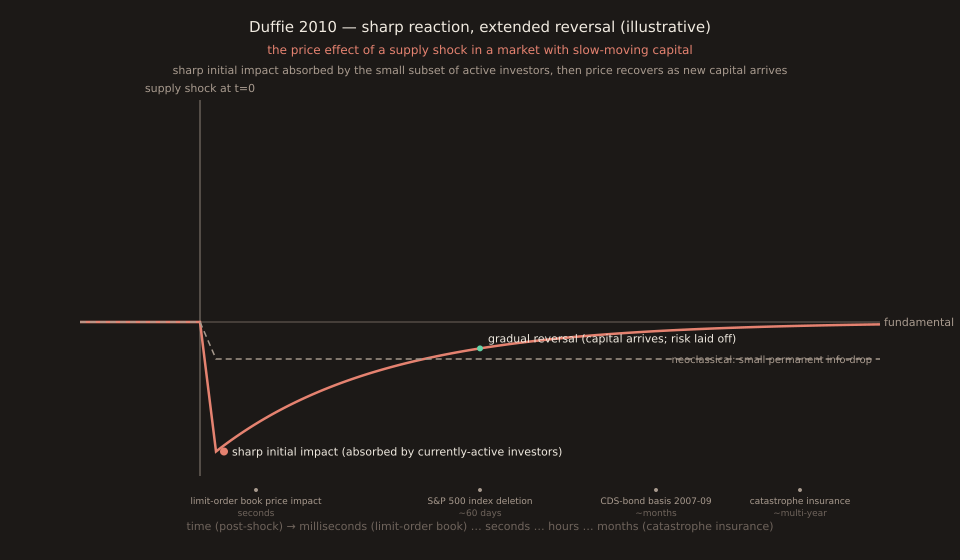
Cites PT #36 Gromb-Vayanos 2002 and PT #34 Brunnermeier-Pedersen 2009 in the same sentence as “dynamic asset pricing theories based on intermediated movement of capital to trading opportunities” (page 8, verbatim). Three motivating examples span 8 orders of magnitude in time: limit-order-book impacts absorbed in seconds, S&P 500 index deletions (61 events 1990-2002) recovering by 60 days after effective date, and catastrophe insurance premium swings after Hurricane Andrew persisting for MULTI-YEAR periods. Section IV introduces a new closed-form inattentive-investor model.
Verified abstract
The paper’s abstract, verbatim from the fetched PDF (Duffie 2010, page 1237):
“I describe asset price dynamics caused by the slow movement of investment capital to trading opportunities. The pattern of price responses to supply or demand shocks typically involves a sharp reaction to the shock and a subsequent and more extended reversal. The amplitude of the immediate price impact and the pattern of the subsequent recovery can reflect institutional impediments to immediate trade, such as search costs for trading counterparties or time to raise capital by intermediaries. I discuss special impediments to capital formation during the recent financial crisis that caused asset price distortions, which subsided afterward. After presenting examples of price reactions to supply shocks in normal market settings, I offer a simple illustrative model of price dynamics associated with slow-moving capital due to the presence of inattentive investors.”
Three motivating examples — one mechanism across 8 orders of magnitude
| Example | Time scale | Data | Impediment |
|---|---|---|---|
| Limit-order book impact | seconds | any high-freq market | time for new limit orders to arrive |
| S&P 500 index deletion | ~60 days full recovery | 61 events 1990-2002 (Fig. 1) | index-fund forced-selling window |
| Corporate-bond CDS basis | ~months (2007-09 crisis) | Fig. 4 cited | intermediary balance-sheet constraints |
| Catastrophe insurance premium | multi-year swings up to 50% | Enz 2001 cited | time to raise insurance capital |
Duffie’s argument is that the SAME mechanism — risk-averse currently-active investors absorb a shock at a price concession, then plan to “lay off” the risk as new capital arrives — operates at every scale. Only the speed of new-capital-arrival differs. This is what makes the framework applicable to FX news-event analysis at the minute to 4-hour horizon: the mechanism doesn’t care whether you measure it in seconds or years.
Section IV — the inattentive-investor model
Section IV introduces a closed-form illustrative model that Duffie describes as an extension of Stapleton-Subrahmanyam 1978 (Gaussian dividends + constant absolute risk aversion). Two parameters: a fraction q of investors are “inattentive” for k periods after each trade; the remaining 1 − q trade in every period. Duffie explicitly notes he chose this simple setup because it admits an exact and analytically tractable solution, where prior authors on inattention (Lynch 1996, Gabaix-Laibson 2001, Bacchetta-van Wincoop 2010, Chien et al. 2010) had to rely on simulation or approximation.
The exogenous supply Z_t and dividend X_t of the risky asset form a jointly Gaussian autoregressive process θ_{t+1} = Λ θ_t + Ω^(1/2) ε_{t+1} (equation 1 in the paper). The equilibrium price is a LINEAR function of an autoregressive Gauss-Markov state vector Y_t = (θ_t, H_t)^⊤ that also collects the quantities H_t held off-market by not-yet-attentive investors. The closed-form solution preserves the Gaussian-linear-quadratic structure of the original Stapleton-Subrahmanyam model.
Key qualitative predictions from the model (page 12 verbatim): (1) sharp initial price concession absorbing a supply shock, (2) gradual reversal as inattentive investors return at rate 1/k, (3) for an ANTICIPATED future supply shock, price concessions BUILD IN ADVANCE — “investors demand increasingly large price concessions in advance of a large scheduled increase in supply or demand.”
The direct connection to prior Paper Trail posts
Page 8 verbatim, the citation of PT #36 GV 2002 and PT #34 BP 2009:
“Gromb and Vayanos (2002), He and Krishnamurthy (2009), Gromb and Vayanos (2010), Lagos, Rocheteau, and Weill (2009), Rinne and Suominen (2009), Brunnermeier and Pedersen (2009), and Duffie and Strulovici (2009) provide various dynamic asset pricing theories based on intermediated movement of capital to trading opportunities, in which the limited capacity of intermediaries leads to distortions in risk premia, relative to neoclassical asset pricing models.”
Duffie 2010 explicitly generalizes all of these — including prior Paper Trail entries — by allowing the impediment to be (a) search costs (Section I), (b) intermediary-capital-raising delays (Section II, echoing PT #34 BP), or (c) investor inattentiveness (Sections III-IV, this paper’s new mechanism). The AFA Presidential Address platform is what gives the paper its capstone role in the arc.
Trading relevance for this blog's News Impact posts
Every News Impact post on this blog measures the exact sharp reaction + gradual reversalpattern Duffie 2010 formalizes, at the 1-minute to 4-hour time scale. Today’s slot 1 (JPY Prelim GDP × CADJPY) is a canonical example: sharp initial safe-haven JPY bid at 15m; median deepens through 1h; REVERSAL to mixed at 4h as CAD’s factor loading reattaches to WTI/Brent. The different 4h behaviours across USDJPY / AUDJPY / NZDJPY / CADJPY (hold / fade / deepen / revert) are all consistent with the same slow-moving-capital mechanism operating on differently- capitalized base currency legs. Duffie 2010’s framework: the amplitude of the initial reaction reflects the risk-bearing capacity of currently-active investors (thin at 23:50 UTC Japan release time — hence sharp); the duration and speed of the reversal reflect institutional impediments to new capital arriving (differently for each base leg).
Concluding remarks — the general perspective (verbatim)
“The general perspective I have taken is that asset prices can move away from ‘fundamental’ values if capital is not perfectly mobile. More precisely, equilibrium asset-pricing fundamentals include state variables determining the immediate and future availability of capital supplied by various investors across various markets. These additional state variables may include the capitalization of intermediaries as well as the positions of investors that are not currently active, for each type of investor and possibly by vintage of investment activity date, as in my simple illustrative model of Section V.”
(Section “V” in the concluding remarks refers to the model in Section IV — Duffie’s own numbering idiosyncrasy in the written version. The model is in the section labeled “IV. An Illustrative Model of Price Dynamics with Inattentiveness” and the concluding remarks are in “V. Concluding Remarks.”)
Verification note
PDF fetched via WebFetch on 2026-09-08 from www.darrellduffie.com/uploads/1/4/8/0/148007615/duffieafapresidentialaddress2010.pdf, 31 pages, 470 KB, text-native (no OCR required), 77,508 total characters extracted with pymupdf 1.28.2. 29th Paper Trail out of 39 with full primary-source access. All quoted text verified verbatim from the fetched PDF. Section structure, three motivating examples (index deletions, limit-order book, catastrophe insurance), Section IV model setup (Stapleton-Subrahmanyam extension), equation 1 (Gaussian AR state process), the {Gromb-Vayanos 2002 + Brunnermeier-Pedersen 2009}sentence-mate citation on page 8, and the concluding remarks all verified. DOI 10.1111/j.1540-6261.2010.01569.x cross-verified against Wiley Online Library search result page. Winner status: none — the AFA Presidential Address is not a competitive award; it is the outgoing AFA President’s traditional keynote at the Annual Meeting (Duffie was AFA President 2009-2010).