Paper Trail #32: Noise Trader Risk in Financial Markets (De Long, Shleifer, Summers & Waldmann, 1990) — the foundational limits-to-arbitrage paper that showed noise-trader-generated risk can push prices persistently below fundamental values AND let noise traders earn higher expected returns than the arbitrageurs betting against them
The 1990 Journal of Political Economy paper that formalized noise trader risk— the risk that noise traders’ beliefs become MORE mispriced before reverting. Overlapping-generations model, CARA utility, two assets with identical fundamental dividends. Yields a pricing function with a NEGATIVE noise-trader-risk term (eq. 12) that persists even when noise traders are unbiased on average — mathematically demonstrating that arbitrage does not eliminate mispricing when noise itself creates risk.
Authors: J. Bradford De Long (Harvard + NBER), Andrei Shleifer (Chicago + NBER), Lawrence H. Summers (Harvard + NBER), Robert J. Waldmann (European University Institute). Publication: JPE Vol. 98 No. 4 (August 1990), pp. 703-738. JSTOR 2937765. Full primary-source verified via WebFetch + pymupdf on 2026-09-01 from a McMaster mirror of the JPE reprint (37 pages, 95,613 characters text-native — no OCR required).
Verified abstract (page 2, verbatim)
"We present a simple overlapping generations model of an asset market in which irrational noise traders with erroneous stochastic beliefs both affect prices and earn higher expected returns. The unpredictability of noise traders’ beliefs creates a risk in the price of the asset that deters rational arbitrageurs from aggressively betting against them. As a result, prices can diverge significantly from fundamental values even in the absence of fundamental risk. Moreover, bearing a disproportionate amount of risk that they themselves create enables noise traders to earn a higher expected return than rational investors do. The model sheds light on a number of financial anomalies, including the excess volatility of asset prices, the mean reversion of stock returns, the underpricing of closed-end mutual funds, and the Mehra-Prescott equity premium puzzle."
The model in one page
Overlapping-generations agents live two periods, invest when young, consume when old. Two assets, identical fundamental cashflows:
Safe asset s. Fixed real dividend r, perfectly elastic supply, price pegged at 1. Riskless because a unit can be created or destroyed at will out of the consumption good.
Risky asset u. Same fixed real dividend r as s, but fixed supply of exactly 1 unit. Price p_t determined by market clearing.
Two agent types. Sophisticated investors (i, rational expectations, CARA utility with risk aversion γ). Noise traders (n, same CARA utility, but misperceive next-period expected return by ρ_t ~ N(p*, σ²_p) — independent across periods).
Central insight.Asset u has ZERO fundamental risk (its dividend is deterministic). But its price CAN diverge from 1 because next-period’s young noise traders will hold random misperceptions, and today’s young sophisticated investors must bear the risk of unfavorable subsequent sentiment shifts if they take an arbitrage position against today’s young noise traders. This is noise trader risk: it exists in the absence of any dividend risk.
Central pricing equation (§ I.B, eq. 12, verbatim)
Where μ = share of noise traders, γ = CARA risk aversion, p* = mean noise-trader misperception, σ²_p = variance of misperception. Interpretation of the four terms:
Term 1 (= 1). Fundamental value in the absence of noise traders.
Term 2 (fluctuation). Current-period realized misperception (p_t - p*) shows up in the price. Bullish generations bid the price up; bearish generations bid it down. Zero in expectation.
Term 3 (price pressure).If noise traders are bullish on average (p* > 0), they demand more of the risky asset on average, and the average price is higher than fundamental. Zero if p* = 0.
Term 4 (noise trader risk — negative). The heart of the paper.This term is always negative (assuming σ²_p > 0). It doesn’t depend on p*. Even when noise traders are perfectly unbiased on average, the risky asset is priced BELOW its fundamental value 1 because sophisticated investors require compensation for bearing the risk that next-period’s young noise traders will become bearish and drive the price down further. Arbitrage cannot eliminate this term because attempting to do so requires bearing more of the very risk that generates it.
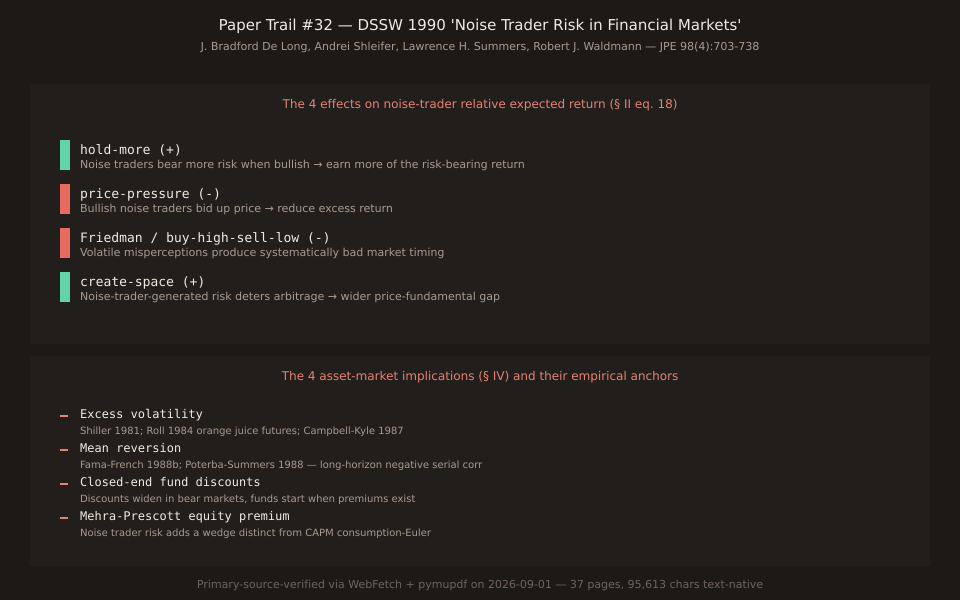
The 4 effects on noise trader excess return (§ II, eq. 18)
Section II decomposes this into four named effects (all verbatim from the paper):
Hold-more (+).The first p* on the RHS. Noise traders on average hold more of the risky asset when they’re bullish, so they earn a larger share of the mechanical risk-bearing return.
Price-pressure (-). The (1+r)²(p*)² term. Bullish noise traders bid up the price, reducing the excess return per unit of risk borne. Damps their advantage.
Friedman / buy-high-sell-low (-). The (1+r)²σ²_p term. Stochastic misperceptions produce systematically bad market timing: noise traders buy the most when other noise traders are buying (peak price, most likely to fall). The more variable their beliefs, the more damage bad timing does.
Create-space (+). The (2γ)μσ²_p in the denominator. As σ²_p grows, price risk grows, and sophisticated investors are less willing to bet against noise traders. This reduces the price-pressure and Friedman damage — noise traders keep more of their returns because arbitrage against them is weaker.
Neither pair dominates a priori. Noise traders earn higher expected returns than sophisticated investors iff p* > 0 AND the sum works out positive, which the paper shows is common in relevant parameter ranges.
Four financial anomalies organized by the paper (§ IV)
(A) Excess volatility.Section IV.A. Cites Shiller (1981) variance-bound tests, Roll (1984) orange juice futures where prices move more than fresh weather news can justify, and Campbell-Kyle (1987). The 1990 debate around Kleidon (1986)’s critique of Shiller is engaged directly, with DSSW noting that Roll’s orange-juice test is cleaner.
(B) Mean reversion in stock returns. Section IV.A. Cites Fama-French (1988b) and Poterba-Summers (1988) long-horizon negative serial correlation. Derives (eq. 31) the unconditional price variance when misperceptions follow an AR(1) process with parameter ρ_A, showing high persistence in noise-trader beliefs produces high price variance AND persistent mean reversion.
(C) Closed-end fund discounts. Section IV.B. Key application. Closed-end funds hold a portfolio of stocks (asset s analog) and are themselves a security (asset u analog). If arbitrage against noise-trader mispricing of the fund is limited by fund-specific noise-trader risk, funds should trade at a discount to net asset value on average. Predicts: (i) discounts vary over time (they do — wider in bear markets); (ii) new funds are formed in clusters when other funds trade at premiums (testable prediction); (iii) discount narrows on open-ending announcement (Brauer 1984, confirmed). Prior explanations (agency costs, tax-liability miscalculation) fail to predict (ii) and (iii); DSSW does.
(D) Mehra-Prescott equity premium puzzle.Section IV.C. Mehra-Prescott (1985) showed the observed US equity premium (~8% real vs ~0% real for safe bonds over 60 years) requires implausibly high risk aversion in the standard consumption-Euler model. DSSW: noise-trader risk adds a wedge distinct from consumption-Euler, allowing a large equity premium to coexist with a low covariance of returns with aggregate consumption. Doesn’t solve the puzzle formally but reframes it as a limits-to-arbitrage symptom rather than a preference-parameter anomaly.
Trader takeaways
Noise trader risk is priced.When you arbitrage against sentiment-driven mispricing, you’re not just betting on fundamental convergence — you’re bearing the risk that sentiment moves further against you before reverting. Size positions with this second-order risk in mind, not just the first-order fundamental-arbitrage risk.
Short-horizon "guessing the crowd" is rational. The Keynes epigraph (verbatim p. 3, and echoed on p. 727) — "guess better than the crowd how the crowd will behave" — is not irrational for a short-horizon investor even one who correctly identifies fundamental mispricing. Fundamental convergence at short horizons is second-order to riding noise-trader momentum. This organizes momentum’s persistence (PT #2, PT #16) as a limits-to-arbitrage effect.
Post-earnings-announcement drift lives here too. PT #6 (Bernard-Thomas 1989) documented 60-90 day drift after earnings announcements. DSSW’s frame reads that as: noise traders underreact to earnings news, sophisticated investors have short horizons, so mispricing decays slowly rather than instantaneously.
Direct connections to prior Paper Trail installments
PT #3 Prospect Theory (Kahneman-Tversky 1979) — the psychological substrate producing noise-trader misperceptions. PT #4 Odean 1999 disposition effect — empirical evidence of noise-trader behavior in individual accounts. PT #6 Bernard-Thomas 1989 PEAD — underreaction anomaly directly explained by short-horizon arbitrage constraints in DSSW’s frame. PT #14 Barber-Odean 2000 — retail-investor performance consistent with noise-trader behavior. PT #16 Menkhoff et al 2012 currency momentum — limits-to-arbitrage discussion in that paper points HERE.
Verification note
Full primary-source verification via WebFetch + pymupdf on 2026-09-01 from a McMaster mirror of the 1990 JPE reprint (Atypon Systems 2007 digitization). Total 37 pages, 95,613 characters text-native; no OCR required. Authorship, abstract, model setup, pricing equation (eq. 12), excess-return decomposition (eq. 18), all four asset-market implications (§ IV.A-C), and the Keynes epigraph verified character-by-character. 24th of 32 Paper Trail installments with full primary-source access. Closes the queued "De Long/Shleifer/Summers/Waldmann 1990 noise-trader risk" item from the ledger. Chart via one-off script reusing scripts/insights-charts/svg.ts + theme.ts primitives + sharp; not committed under scripts/.