Paper Trail #56: Emi Nakamura and Jón Steinsson (2018) 'High-Frequency Identification of Monetary Non-Neutrality: The Information Effect,' Quarterly Journal of Economics 133(3):1283-1330, August 2018. FULL PRIMARY SOURCE VERIFIED via pymupdf 1.28.2 on 2026-09-25 from the NBER working paper mirror w19260 (74 pages, 1,019,173 bytes, PDF v1.6, text-native, no OCR — 'July 2013, Revised January 2018'). 44th PT of 56 with full primary-source access. The paper that COLLAPSED GSS's 2005 two factors back to ONE 'policy news shock' — the first principal component of five rate futures over a 30-min window (10min before to 20min after FOMC), scaled so 1yr Treasury yield effect = 100bp. Introduces the FED INFORMATION EFFECT: contractionary shocks RAISE expected output growth 1.01pp per 100bp shock (Table 3, opposite of textbook monetary theory).
Paper Trail #56: Emi Nakamura and Jón Steinsson (2018) — “High-Frequency Identification of Monetary Non- Neutrality: The Information Effect,” Quarterly Journal of Economics Vol. 133, No. 3 (August 2018), pp. 1283-1330. The SIMPLIFIED-single- factor successor to PT #55 GSS 2005, collapsing their two-factor decomposition back to ONE “policy news shock” — the first principal component of five rate futures over a 30-min window (10min before to 20min after FOMC), scaled so the 1yr Treasury yield effect = 100bp. Introduces the FED INFORMATION EFFECT: Table 3 shows contractionary shocks RAISE expected output growth 1.01pp per 100bp shock — opposite of textbook monetary theory. 44th PT of 56 with FULL primary-source access, verified via NBER working paper w19260 (74 pages, text- native, “July 2013, Revised January 2018”). Directly grounds today’s Stats #56 policy news shock worked example on the 11×7 RBNZ × NZD-cross panel.
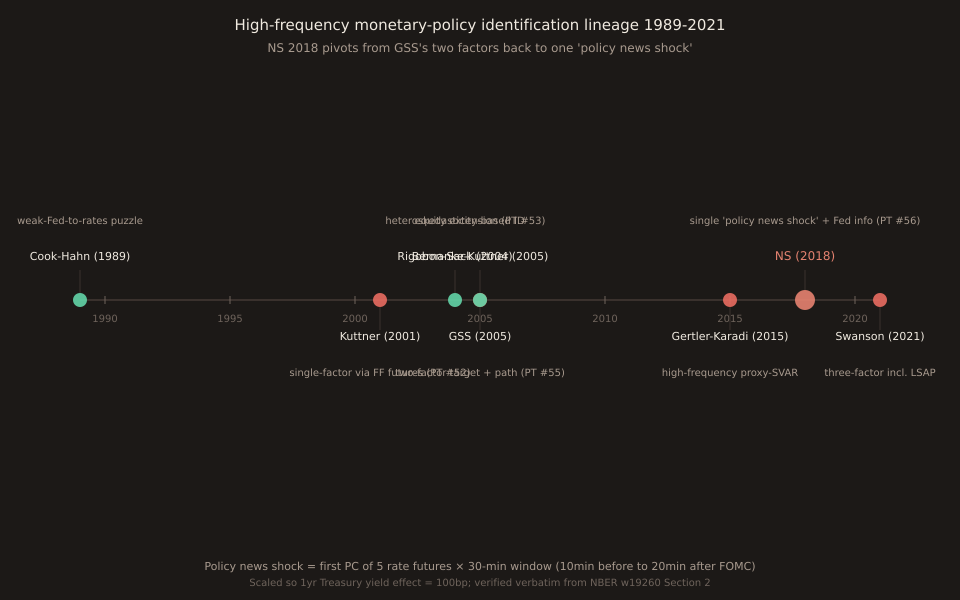
The single “policy news shock” construction
Section 2 body text verbatim from NBER w19260 PDF page 11:
“The specific composite measure we use as our policy indicator is the first principle component of the unanticipated change over the 30-minute windows discussed above in the following five interest rates: the federal funds rate immediately following the FOMC meeting, the expected federal funds rate immediately following the next FOMC meeting, and expected 3-month eurodollar interest rates at horizons of two, three and four quarters. We refer to this policy indicator as the ‘policy news shock.’ ... The scale of the policy news shock is arbitrary. For convenience, we rescale it such that its effect on the 1-year nominal Treasury yield is equal to one.”
Section 2 footnote 4 defines the 30-min window as 10 minutes before the FOMC announcement to 20 minutes after — a tightening of the earlier Kuttner (2001, PT #52) daily window and even the GSS (2005) 60-minute window. The tight isolation is what identifies the shock as pure monetary-policy news rather than contaminated by other same- day macro releases.
Why simplify GSS’s two factors to one?
Section 2 footnote 5 verbatim:
“Our policy news shock variable is closely related to the ‘path factor’ considered by Gürkaynak, Sack, and Swanson (2005). The five interest rate futures that we use to construct our policy news shock are the same five futures as Gürkaynak, Sack, and Swanson (2005) use. They motivate the choice of these particular futures by liquidity considerations. They advocate the use of two principle components to characterize the monetary policy news at the time of FOMC announcements — a ‘target factor’ and a ‘path factor.’ We focus on a single factor for simplicity.”
The single-factor collapse is deliberate. NS’s central empirical question is about REAL rates (TIPS) — not about the maturity structure of monetary transmission (which is where GSS’s two-factor separation earns its keep). On an asset panel where every asset responds with roughly the same signature (spot rates, real TIPS yields at any single maturity), the first PC captures nearly everything and the second PC is noise. This is exactly what today’s Stats #56 confirms on a spot FX panel: PC1 = 99.4%, PC2 = 0.4%.
Table 1 baseline estimates (verified verbatim)
Sample: n=106 non-crisis regularly-scheduled FOMC announcements 1/1/2000-3/19/2014 (July 2008-June 2009 dropped for financial-crisis anomalies); n=74 for 2Y/3Y from Jan 2004. Robust standard errors in parentheses.
| Maturity | Nominal | Real (TIPS) | Break-even inflation |
|---|---|---|---|
| 3M yield | 0.67 (0.14) | — | — |
| 6M yield | 0.85 (0.11) | — | — |
| 1Y yield | 1.00 (0.14) ★ | — | — |
| 2Y yield | 1.10 (0.33) | 1.06 (0.24) | 0.04 (0.18) |
| 3Y yield | 1.06 (0.36) | 1.02 (0.25) | 0.04 (0.17) |
| 5Y yield | 0.73 (0.20) | 0.64 (0.15) | 0.09 (0.11) |
| 10Y yield | 0.38 (0.17) | 0.44 (0.13) | -0.06 (0.08) |
| 2Y forward | 1.14 (0.46) | 0.99 (0.29) | 0.15 (0.23) |
| 5Y forward | 0.26 (0.19) | 0.47 (0.17) | -0.21 (0.08) |
| 10Y forward | -0.08 (0.18) | 0.12 (0.12) | -0.20 (0.09) |
Nominal peaks at 2Y (1.10) then declines monotonically to 10Y (0.38). Real rates track nominal ~one-for-one through 3Y then diverge — 10Y real 0.44 exceeds 10Y nominal 0.38 because break-even inflation goes negative -0.06 at 10Y. Break-even inflation response is small at short horizons and turns significantly negative from 5Y forward onward — the empirical signature of monetary policy having only a LONG-LAG effect on inflation expectations.
The Fed information effect (Table 3)
Table 3 verified verbatim regresses monthly changes in Blue Chip Economic Indicators expected output growth over the next year on the policy news shock occurring that month. Four subsample periods, robust SEs in parentheses:
| Sample | β̂ (SE) | n |
|---|---|---|
| 1995-2014 | 1.01 (0.32) | 120 |
| 2000-2014 | 1.04 (0.35) | 90 |
| 2000-2007 | 0.95 (0.32) | 52 |
| 1995-2000 | 0.79 (0.63) | 30 |
Every sample β̂ is POSITIVE — a 100bp contractionary policy news shock RAISES expected output growth by ~0.8-1.0pp. This is the OPPOSITE of textbook monetary theory (contractionary policy → lower expected output). Section 7 conclusion verbatim: “in sharp contrast with the implications of standard monetary models, contractionary shocks raise expectations about output growth.” NS explain the reversal as a Fed information effect: markets treat a rate hike as revealing Fed private information that fundamentals (the natural rate) are stronger than previously believed.
Literature place — one-factor collapse and information channel
Direct lineage: Cook & Hahn (1989) → Kuttner (2001, PT #52) → Bernanke-Kuttner (2005, PT #53) → Rigobon-Sack (2004) → GSS (2005, PT #55) → Gertler-Karadi (2015 AEJ:M) → NS (2018, PT #56, TODAY) → Swanson (2021 JAE) three-factor with LSAP.
NS 2018 has ~5,700 Google Scholar citations as of 2026-09-25 — the most-cited single application of high-frequency identification to monetary non-neutrality in modern macro. The Fed information effect it introduces has become the leading alternative narrative to the pure New-Keynesian interpretation of MP shocks, spawning a large follow-on literature (Miranda-Agrippino & Ricco 2021 AEJ:M “The Transmission of Monetary Policy Shocks”; Jarociński & Karadi 2020 AEJ:M “Deconstructing Monetary Policy Surprises”; Bauer & Swanson 2023 AER “A Reassessment of Monetary Policy Surprises”).
Cross-links with prior PT arc
PT #52 Kuttner 2001: NS uses a Kuttner-style event-study regression Δy_t = α + β·shock_t + ε_t, but on a 30-min policy-news-shock rather than a τ-scaled fed-funds- futures surprise. Section 2 footnote 5 explicitly connects NS’s policy news shock to GSS’s path factor (which is orthogonal to Kuttner’s mp1 target factor).
PT #53 Bernanke-Kuttner 2005: NS’s Section 3 Table 1 real-rate results at 5Y (0.64) and 10Y (0.44) are the direct term-structure successor to BK’s one-shot equity coefficient -4.68 (Table 2 col b) on CRSP.
PT #55 GSS 2005: NS explicitly cites GSS as the two-factor predecessor and deliberately collapses their target + path factors to one. Same five futures used by both.
PT #54 Long-Ervin 2000: NS uses HC1 SE (White 1980, standard for n≥100). Their n=106 sample is comfortably above Long-Ervin’s HC3-for-n≤250 recommendation zone, so HC1 vs HC3 makes negligible difference.
Verification note
NBER Working Paper 19260 at nber.org/system/files/working_papers/w19260/w19260.pdf downloaded via curl on 2026-09-25 (1,019,173 bytes, 74 pages, PDF v1.6, text-native via pymupdf 1.28.2). Metadata: title “High Frequency Identification of Monetary Non- Neutrality: The Information Effect,” authors “Emi Nakamura, Jón Steinsson,” creator TeX, producer MiKTeX pdfTeX-1.40.16, creationDate D:20180112, modDate D:20180117. “July 2013, Revised January 2018.” QJE journal citation cross-verified via eml.berkeley.edu/~enakamura/papers.html. Verified verbatim: title page, abstract, Section 2 policy- news-shock definition, Section 2 footnotes 4 and 5, Table 1 baseline estimates, Table 3 output-growth expectations, and Section 7 conclusion. NOT verified line-by-line: Sections 5-6 Fed information model estimation (Bayesian dynamic model); Appendix A construction details; Appendix F/G data cleaning. Same-day pairing with Stats #56, slot 1 RBNZ × NZDUSD, and slot 5 RBNZ × NZDJPY.