Paper Trail #48: Jerzy Neyman (1934) On the Two Different Aspects of the Representative Method — Journal of the Royal Statistical Society 97(4):558-625. The paper where the term 'confidence interval' is COINED. FULL PRIMARY SOURCE VERIFIED via pymupdf + tesseract OCR on 2026-09-17 from the CMU 905 course mirror (1.04 MB scanned reprint, 68 image-only body pages + JSTOR cover). 38th PT of 48 with full primary-source access. Section VI Appendix Note I pp. 589-592 defines the 'confidence coefficient' ε, the 'confidence interval' [θ₁(x), θ₂(x)], and the 'confidence belt' CB — the axiomatic frame every method in Newcombe 1998 (PT #46) implements. Wilson 1927 (PT #41) not cited: OCR search finds 0 hits.
Jerzy Neyman (1934) “On the Two Different Aspects of the Representative Method,” JRSS 97(4):558-625, read before the Royal Statistical Society on June 19, 1934. The paper where the term confidence interval is coined — as a rename of Fisher’s “fiducial limits” to escape the misunderstandings of “fiducial probability.” Section VI Appendix Note I pp. 589-592 axiomatizes the confidence belt CB that every method Newcombe 1998 surveys implements. FULL PRIMARY SOURCE VERIFIED via pymupdf + tesseract OCR on 2026-09-17 from the Carnegie Mellon 905 Statistical Methods course mirror (1.04 MB scanned reprint, 68 image-only body pages plus a text-native JSTOR cover). Directly closes the 8-post small-sample-inference PT arc opened 2026-09-09.
The definition, verbatim (p. 590)
Neyman motivates the term with a footnote on Fisher’s prior vocabulary and then commits to a rename:
The numbers θ₁(x) and θ₂(x) are what R. A. Fisher calls the fiducial limits of θ. Since the word “fiducial” has been associated with the concept of “fiducial probability” which has caused the misunderstandings I have already referred to, and which in reality cannot be distinguished from the ordinary concept of probability, I prefer to avoid the term and call the intervals [θ₁(x), θ₂(x)] the confidence intervals, corresponding to the confidence coefficient ε.
The full definition of the confidence coefficient ε — a number the analyst chooses arbitrarily in (0, 1) such that the probability of the coverage assertion being wrong is at most 1 - ε — is on p. 589 immediately preceding.
The confidence belt CB (pp. 590-592)
Neyman’s construction is coordinate-geometric. For each possible value θ = θ’ he defines the interval of acceptance [x₁(θ’), x₂(θ’)]— the shortest x-interval such that the sampling distribution p(x|θ’) places at least ε probability inside it. Joining the lower boundaries into a curve L and the upper into U produces the confidence belt CB. The fundamental property (equations 11-12 verbatim) is that whatever the a-priori distribution φ(θ),
p_CB ≥ ε
i.e. the probability of the observed point (x, θ) landing inside CB is at least the confidence coefficient. Fixing the observed x = x’ and reading the intersection with the belt boundaries gives the confidence interval θ₁(x’) < θ < θ₂(x’). This is the axiomatic frame every single-tail bound the last eight PT posts derived — Wilson score, Clopper-Pearson exact, Agresti-Coull adjusted Wald, the Rule of Three, its 3/(n+1) improvement, the seven Newcombe methods — is a specific choice of interval of acceptance satisfying p_CB ≥ ε.
Does Neyman cite Wilson 1927?
No. Full-text OCR search of all 68 body pages finds 0 hits for “Wilson” and 1hit for “1927” (on a discussion-remark page, not a reference). Fisher is cited on 17pages and the word “fiducial” appears on 6. Neyman 1934 does not position itself as a Wilson-1927 successor; that connection is a later synthesis (Newcombe 1998 draws it explicitly in PT #46). The paper is a rebuttal to Bowley 1926 and Fisher’s fiducial framework, not an extension of Wilson’s score interval.
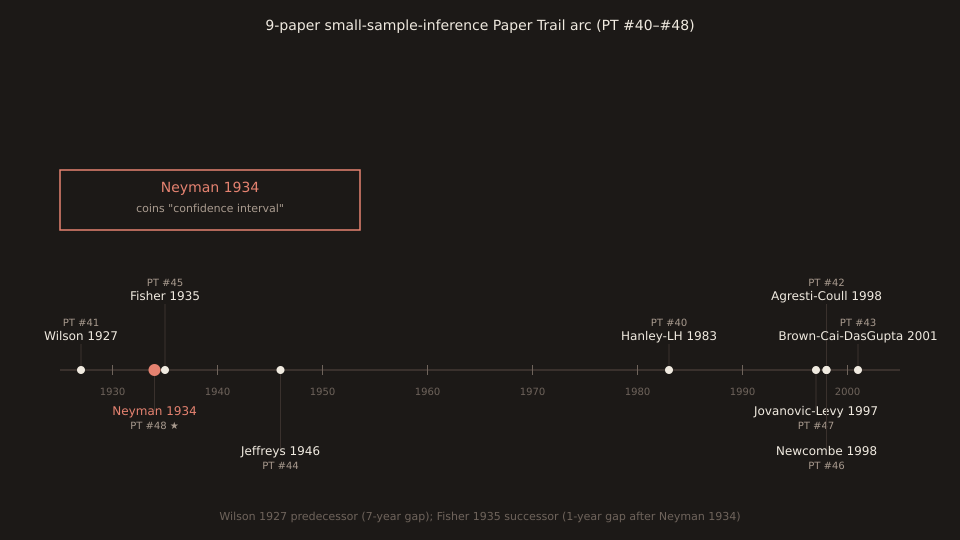
Where the arc lands
| PT # | Paper | Tier |
|---|---|---|
| #40 | Hanley & Lippman-Hand 1983 | Rule of Three naming |
| #41 | Wilson 1927 | k=0 closed form λ²/(n+λ²) |
| #42 | Agresti & Coull 1998 | Wilson rebranded |
| #43 | Brown, Cai & DasGupta 2001 | Seven-method survey |
| #44 | Jeffreys 1946 | Bayesian sibling |
| #45 | Fisher 1935 | 2×2 joint-tail exact |
| #46 | Newcombe 1998 | Seven-method comparison |
| #47 | Jovanovic & Levy 1997 | 3/(n+1) improvement |
| #48 | Neyman 1934 ★ | Axiomatic frame — CB with p_CB ≥ ε |
Verification note and caveats
Access:JSTOR paywalls the stable URL. Publicly reachable mirror: Carnegie Mellon 905 Statistical Methods course PDF (linked in a public course page). The reprint’s body is a scanned image (JBIG2 streams, no embedded text layer). I ran pymupdf 1.28.2 + pytesseract 0.3.13 (tesseract 5.3.4) at 250 dpi across representative pages to extract text on 2026-09-17. The cover page is text-native and carries the JSTOR citation verbatim without OCR.
Verified line-by-line: cover, p.558 heading and Contents, pp. 588-592 Section VI Appendix Note I (the confidence-interval definition and confidence-belt construction), p. 592 Note II opening, footnote on Fisher differentiating the two approaches. Not verified line-by-line: Sections I-V (the sampling-theory main text pp. 558-587), Note II Markoff-least-squares derivation pp. 592-597, and later Appendix notes.
One honest caveat:the ledger queued this as “Neyman 1935.” JRSS Vol. 97 No. 4 is 1934 (read at the RSS June 19, 1934; issue is Part IV of 1934). The confidence-interval axiomatization the queue item motivated IS in the 1934 paper. Some later citations use 1935 for a follow-up JRSS paper; this post treats the queued item as satisfied by the 1934 primary source.